Fire Extinguisher 6-Year Maintenance: What the Teardown Actually Involves and Why It's Not Optional
Most facility managers have seen "6-year maintenance" appear on a fire extinguisher service invoice and quietly wondered whether it is a legitimate requirement or a convenient upsell. The answer matters more than many realize. Fire extinguisher 6-year maintenance is a mandatory compliance milestone under NFPA 10, and a unit that has not received its required 6-year internal examination is not in full compliance, even if it sailed through its most recent annual inspection.
This distinction is critical. Annual inspections assess visible condition; the 6-year teardown assesses internal integrity. Valve seats, O-rings, dip tubes, and agent condition all degrade in ways that no external check can detect. NFPA 10 requires a full internal examination and recharge at the 6-year mark for every stored-pressure dry-chemical extinguisher, regardless of how the unit looks from the outside.
This post breaks down exactly what that process involves, why annual inspection cannot substitute for it, what documentation must appear on the unit's durable label, and what liability exposure builds when the service gets skipped. It also covers how to evaluate service providers and budget accurately across a multi-unit facility.
What NFPA 10 Actually Requires at the 6-Year Mark
Both NFPA 10 and NFPA 1 require a full internal and external examination of stored-pressure fire extinguishers every six years. This is codified regulatory language, not a manufacturer recommendation or an optional service tier.
The six-year interval applies to extinguisher types subject to 12-year hydrostatic testing, including dry-chemical stored-pressure units, which represent the majority of extinguishers in commercial buildings, schools, and government facilities. For a broader look at how the 5- and 12-year hydrostatic testing intervals intersect with the six-year requirement, note that the testing cycles are distinct milestones tracked independently.
Annual inspections and the six-year internal examination operate on separate compliance clocks. The annual inspection confirms external condition: pressure gauge reading, visible damage, label legibility, and tamper seal integrity. It does not assess internal components. A unit that has not received its required 6-year internal examination is not in full compliance with NFPA 10, regardless of its annual inspection history.
One important distinction for mixed-equipment facilities: nonrechargeable extinguishers are exempt from the six-year examination but must be removed from service after 12 years. Facilities managing both rechargeable and nonrechargeable units need separate tracking systems, since the compliance obligations differ fundamentally. Reviewing government facility fire extinguisher compliance requirements can help clarify how these timelines apply under OSHA and Cal/OSHA frameworks alongside NFPA 10.
Why Annual Inspection Does Not Replace the 6-Year Teardown
Understanding why these are separate requirements clarifies why one cannot substitute for the other.
Annual inspection is a surface-level verification. A technician confirms that the pressure gauge reads in the operable range, the unit is accessible and properly mounted, the label is legible, the safety pin is intact, and no obvious physical damage is visible. That entire process happens without opening the extinguisher. Nothing about it reveals what is happening inside. These two requirements operate on separate compliance clocks and assess entirely different conditions.
The failure modes that accumulate over six years of service are all internal. O-rings and valve seat seals degrade with age and pressure cycling. Dry chemical agent absorbs moisture and cakes, compromising discharge performance. Dip tubes corrode or crack. Cylinder walls can pit in ways that foreshadow structural issues before the 12-year hydrostatic test. A unit with six consecutive clean annual inspections can simultaneously harbor a corroded dip tube or compacted agent, conditions that only an internal examination reveals.
NFPA 10 treats the 6-year internal examination as a separate record requirement, distinct from annual inspection documentation. For a deeper look at what fire extinguisher inspection requirements actually mandate, the documentation standards and timing are covered in detail here.
Facility managers who track only annual inspections have an accurate picture of their paperwork and an incomplete picture of their equipment.
Inside the Teardown: What Technicians Actually Inspect
Once you understand what annual inspection cannot see, the logical next question is: what does a proper teardown actually involve?
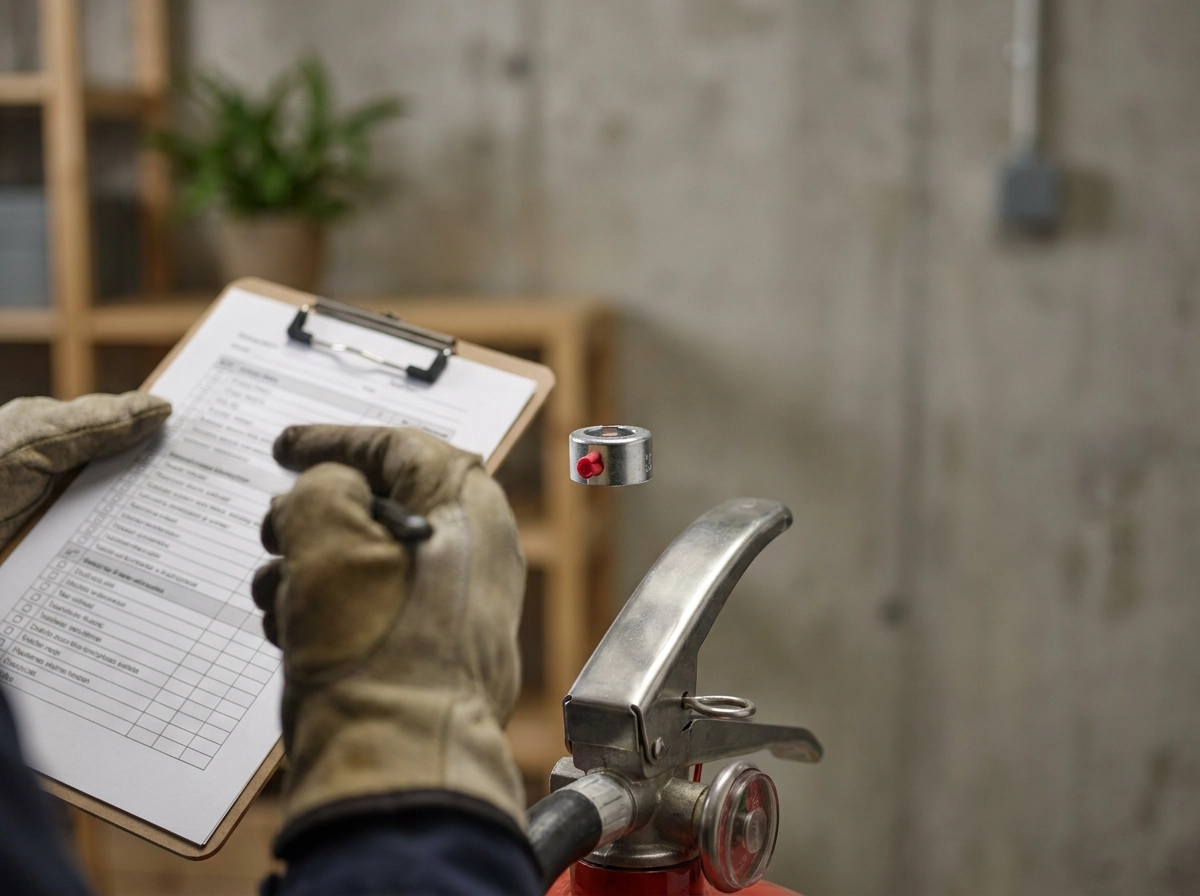
The process begins with full disassembly of the valve assembly. Technicians remove the valve and inspect the seat for wear, pitting, or deformation. A compromised valve seat prevents a reliable pressure seal during discharge, and that defect produces no external signal whatsoever.
All O-rings and gaskets are removed and evaluated; best-practice service replaces them regardless of apparent condition to eliminate a potential failure mode rather than judge it visually.
The dip tube is pulled and examined for corrosion, cracks, or blockage. This component is the delivery path for the agent. A blocked or cracked dip tube can cause an extinguisher to hold pressure and read normal on the gauge while failing to discharge agent when activated. For a detailed breakdown of which components trigger documentation requirements during service, see Fire Extinguisher Inspection Requirements: What Must Be Documented and When.
The dry chemical agent itself is removed and evaluated for moisture absorption, caking, and contamination. Degraded agent clumps, flows poorly through the dip tube, and discharges inadequately or not at all. This contamination is undetectable without emptying the cylinder.
With the cylinder empty, technicians examine interior walls for pitting, corrosion, or liner damage. Findings here can flag structural concerns before the unit reaches its 12-year hydrostatic test interval.
Halon extinguishers require an additional step: agent recovery using EPA-compliant certified equipment before disassembly begins. This is a regulatory requirement specific to Halon, adding procedural and equipment demands beyond standard dry-chemical service.
Once all inspections are complete, the unit is reassembled using fresh components, recharged to manufacturer specifications, and documented. Fire extinguisher recharge is a standard deliverable of every completed 6-year service, not a separate add-on.
Documentation Requirements: What the Durable Label Must Show
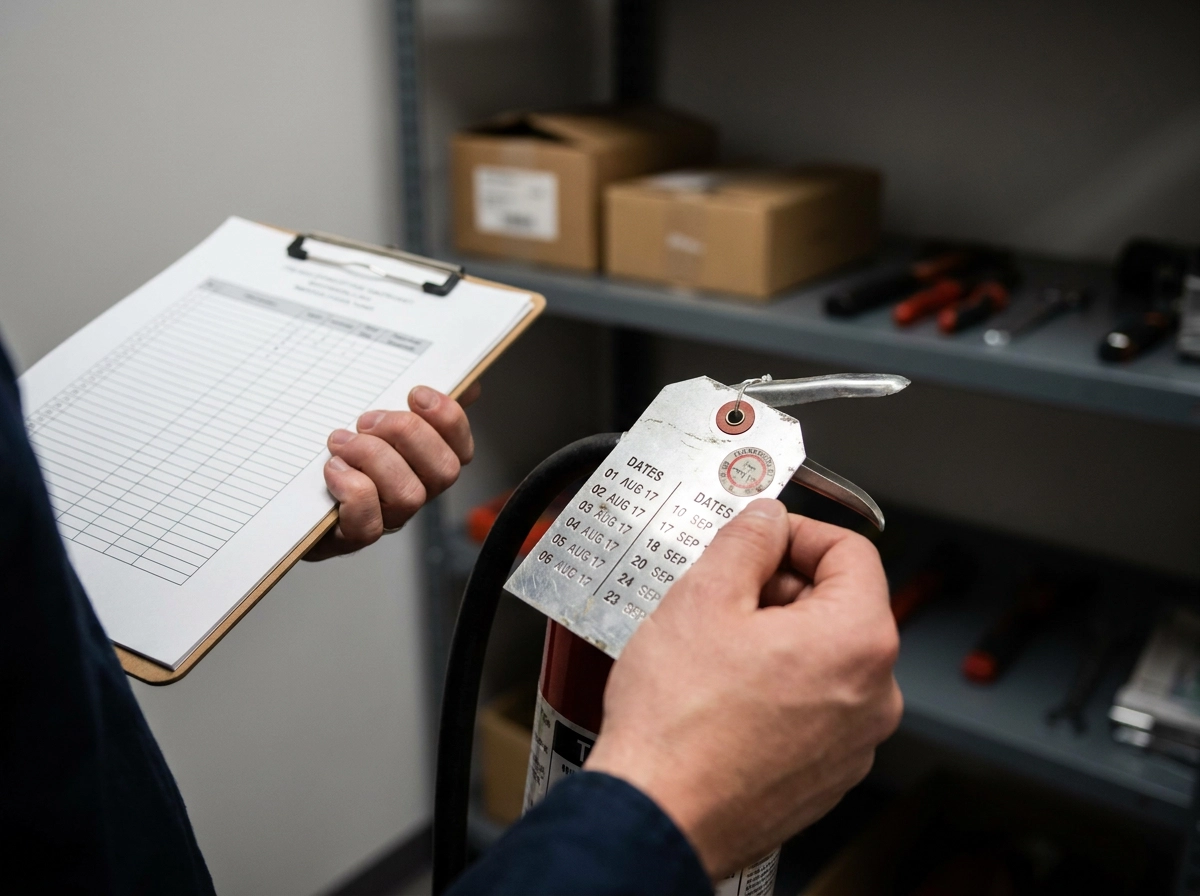
Completing the physical work is only half the compliance obligation. NFPA 10 requires that every successful 6-year internal examination be documented on a durable label physically affixed to the extinguisher. An invoice in your files or a technician's verbal confirmation does not satisfy this requirement. If the label is not on the unit, the examination does not count for compliance purposes.
What the label must include:
At minimum, required label details include the examination date; a fully compliant label from a reputable provider will also include the technician's certification number and service company name.
Missing required fields creates a compliance gap that an authority having jurisdiction (AHJ) can cite during inspection.
Why documentation carries legal weight
During fire marshal inspections, insurance audits, or post-incident liability investigations, the durable label is the primary evidence that the work was done. An undocumented teardown is treated the same as a skipped one. There is no evidentiary distinction.
Record retention is your responsibility
Do not rely solely on your service provider's records. If you change providers, those records may be inaccessible. Maintain your own internal copies of all service documentation for every unit, organized by serial number or location.
The label resets the compliance clock
The examination date on the durable label is the reference point that triggers the next 6-year internal examination interval and determines when 12-year hydrostatic testing falls due. For government and institutional facilities managing large inventories, accurate label dates are foundational to forward scheduling. First Response Fire Protection Services provides complete label documentation and service records on every teardown, which is directly relevant to the documentation standards government clients require for state and federal contract compliance.
The Liability Exposure When the 6-Year Service Gets Skipped
That documentation gap carries consequences that extend well beyond a failed inspection.
When a fire occurs and post-incident investigation reveals that an extinguisher failed due to a degraded dip tube, collapsed O-ring, or caked agent, the absence of a 6-year service record places direct liability on the facility operator. The argument that the unit "passed every annual inspection" does not hold; annual checks do not examine internal components, and investigators and opposing counsel both know it.
Insurance carriers generally scrutinize maintenance records following fire-related losses. Documented gaps in required maintenance, including missing 6-year teardown records, can complicate or jeopardize a property claim. Facilities should consult their insurer or broker about how fire extinguisher compliance documentation affects policy coverage.
In California, the exposure is compounded. Facilities in Southern California are subject to both NFPA 10 requirements and CSFM enforcement, and fire marshals conducting Authority Having Jurisdiction (AHJ) inspections may check for 6-year compliance documentation. Facilities with California fire extinguisher placement and signage obligations already on their radar should treat 6-year teardown records as part of the same compliance posture. Violations flagged during AHJ inspections can require corrective action, potentially including removing non-compliant units from service.
The cost comparison is straightforward. A properly documented 6-year teardown is a fixed, schedulable expense. A liability claim, insurance dispute, or code violation citation is not.
How to Evaluate a Fire Extinguisher Maintenance Provider
Knowing the liability stakes clarifies what to look for when selecting a service provider. In California, the evaluation starts with two distinct credentials that are easy to verify and easy to overlook.
Individual technicians must hold a current OSFM Certificate of Registration before performing any maintenance work. Separately, the company itself must carry a CSFM concern license authorizing it to perform fire extinguisher servicing for a fee. These are not the same credential. A certified technician working for an unlicensed company is still operating outside California law. Confirm both before authorizing any 6-year teardown.
Beyond credentials, ask the provider a direct technical question: what gets replaced during a 6-year teardown, and what only gets inspected? A qualified technician will immediately describe O-ring and gasket replacement, agent removal and evaluation, dip tube inspection, and cylinder interior examination. A vague answer, or one that conflates "checking" with "replacing," is a signal that the service may not constitute a complete internal examination under NFPA 10.
Documentation quality is the third filter. A properly completed 6-year service produces a durable label on the unit with the examination date, technician name and certification number, and company name, plus a written service record noting any deficiencies and corrective actions taken. An invoice alone does not meet this standard.
For facilities managing multiple units, including schools, government buildings, and commercial properties, ask specifically how the provider tracks unit-level service history and flags upcoming 6-year and 12-year intervals across a mixed fleet. Interval tracking should be proactive, not reactive.
First Response Fire Protection Services holds current OSFM certification and CSFM licensure, maintains authorized Amerex distributor status, and provides complete documentation on every 6-year teardown, making it a qualified option for Southern California facilities conducting this evaluation.
Budgeting and Scheduling Fire Extinguisher 6-Year Maintenance Across a Facility
Once you've confirmed your provider is qualified, the next step is building a realistic schedule and budget across your full equipment inventory.
6-year teardowns run on unit-specific clocks, not facility-wide schedules. Each extinguisher's compliance interval is based on its manufacture date or last documented teardown, independent of your annual inspection cycle. A facility with 40 units may have 40 different 6-year deadlines spread across multiple years.
Inherited equipment with incomplete service records requires immediate attention. If a unit has no documented 6-year history, treat it as overdue. Don't wait for an AHJ inspection to surface the gap. The cost of a planned service call is predictable. The cost of a compliance violation during an audit is not.
Budget differently for teardowns than for annual inspections. A 6-year service includes a full recharge as a built-in component. The unit is emptied, internally inspected, and refilled before being returned to service. That bundled cost is higher than an annual inspection line item, but it eliminates any need to budget a separate recharge during that interval.
Use annual inspections as a scheduling tool. Ask your provider to flag each unit's last documented 6-year date during every annual visit, then build a rolling 12-month forward schedule for units approaching or past their interval. This converts a reactive compliance problem into a managed maintenance calendar.
Mixed-unit facilities carry a compounding budget consideration. The 6-year internal examination and the 12-year hydrostatic test are separate NFPA 10 milestones. Any unit hitting year 12 requires both services simultaneously; budget line items should reflect that combined cost rather than treating them as equivalent to a standard teardown.
Conclusion: Treat the 6-Year Teardown as a Compliance Milestone, Not a Line Item to Negotiate
Once your budgeting and scheduling framework is in place, the remaining work is straightforward: verify, act, and maintain discipline on the compliance calendar.
Start with documentation, not assumptions. Verify that every stored-pressure unit carries a legible durable label with the last 6-year examination date, undocumented is the same as overdue.
Schedule overdue units now. Waiting for the next annual inspection cycle or an AHJ visit to surface the gap is a liability position, not a compliance strategy. If the date isn't confirmed on the unit, the unit isn't in compliance.
Confirm both OSFM technician certification and CSFM company licensure before authorizing any teardown work in California.
Lock the intervals into your maintenance calendar as fixed line items. Six-year fire extinguisher maintenance is a code obligation under NFPA 10, not a discretionary service. Facilities that budget for it consistently avoid the far costlier outcomes: code violations, pulled units, and liability exposure after a loss event.
First Response Fire Protection Services holds current OSFM certification and CSFM licensure and serves Southern California. Contact us to schedule a 6-year internal examination or to audit your facility's current compliance status.