Fire Extinguisher Compliance for School Districts: What OSHA, Title 19, and Your Facilities Team Must Align On
California schools face one of the most complex compliance environments of any facility type, and a surface-level approach to OSHA fire extinguisher requirements simply will not hold up under scrutiny.
Unlike a single-occupancy commercial building, a school district operates dozens of structures simultaneously, each with its own hazard profile: cafeteria kitchens, science labs, maintenance yards, and multi-story classroom wings. Satisfying Cal/OSHA Title 8, Title 19 (OSFM), and NFPA 10 across all of them requires more than annual service calls. It requires a coordinated compliance program built around your specific facilities, your internal team, and a certified service provider who understands the full regulatory stack.
This post breaks down exactly what that looks like. You will learn which regulatory frameworks apply and where they overlap, what each hazard zone on your campus demands, how to manage documentation at scale, and why a mobile inspection program is the most practical path to keeping every building in simultaneous compliance.
Why Schools Are a Distinct Compliance Problem
A typical commercial building presents a single compliance unit: one address, one occupancy type, one documentation file. A California school district is something categorically different. A mid-size district routinely operates 20 to 40 structurally separate buildings across one or more campuses, and each building requires its own independent compliance documentation under Cal/OSHA Title 8 and Title 19 of the California Code of Regulations. That documentation burden does not scale linearly; it compounds.
The inspection exposure compounds equally. An Authority Having Jurisdiction can conduct a single inspection that covers the entire district, meaning a non-compliant portable classroom at the far edge of campus carries the same citation risk as the main administration building. One building out of compliance puts the whole operation at risk.
Responsibility for that compliance is rarely held by a single person. In most districts, it is distributed across in-house maintenance crews, a facilities or business director managing vendor contracts, and outside service contractors performing annual maintenance. These groups frequently operate without a shared documentation workflow. Service reports get filed in isolation, monthly inspection logs go unrecorded at the building level, and no one holds a complete picture of district-wide compliance status before an AHJ visit arrives. For a more detailed look at how this fragmentation plays out across multi-site operations, the analysis in Managing Compliance Across Multiple Buildings and Sites is directly applicable.
The occupancy mix within a single campus further complicates placement compliance. A cafeteria kitchen, a science lab, a custodial storage room, a classroom corridor, and an administrative office each carry distinct fire hazard classifications with different extinguisher type and travel-distance requirements. A placement strategy that satisfies one zone will not automatically satisfy another.
Cal/OSHA enforcement data identifies missing maintenance records and improper extinguisher placement among citation triggers across employer categories, and school districts are not exempt from that pattern. Most district administrators underestimate how frequently these violations result in formal citations.
Three Regulatory Frameworks, One Compliance Obligation
That compliance exposure doesn't come from one regulatory gap. It comes from three separate frameworks that govern different aspects of the same obligation, and satisfying any one of them does not satisfy the others.
Cal/OSHA Title 8 Section 6151 governs distribution standards for California employers: maximum travel distances by fire class, minimum unit ratings for multi-story buildings, and monthly inspections documented on service tags. This is the framework most facilities teams know first, and it is the one Cal/OSHA uses to issue citations.
Title 19 (California Office of the State Fire Marshal, OSFM) governs a different question entirely: who is legally permitted to perform fire extinguisher service. Under California's Title 19 regulations, administered by the OSFM, any person servicing portable fire extinguishers must pass a written exam, provide evidence of experience, and maintain an adequate inventory of testing equipment before being issued a Certificate of Registration. This distinction matters for districts evaluating fire extinguisher inspection services, because a vendor can appear fully qualified while failing this specific credential requirement.
NFPA 10 (Standard for Portable Fire Extinguishers) is the nationally recognized technical standard that California fire codes incorporate by reference for installation, inspection, and maintenance specifications. It supplies the technical floor that both Cal/OSHA and OSFM rules build upon.
The critical structural point is this: these three frameworks do not duplicate each other. Cal/OSHA addresses placement and documentation frequency. Title 19 addresses who performs the service. NFPA 10 addresses how the service is technically executed. A school can have compliant placement under Section 6151 and still face an invalid compliance record because the service provider lacked OSFM registration. Government facilities face a structurally similar layered problem, which is examined in depth in Why Government Facilities Face a Harder Compliance Problem.
Before signing any service contract, request the provider's OSFM registration number and verify it against the OSFM public database.
Cal/OSHA Fire Extinguisher Requirements Every District Must Know
Title 8 Section 6151 is where the specific numbers live, and districts that don't know them by heart create placement gaps that show up immediately during an AHJ walkthrough.
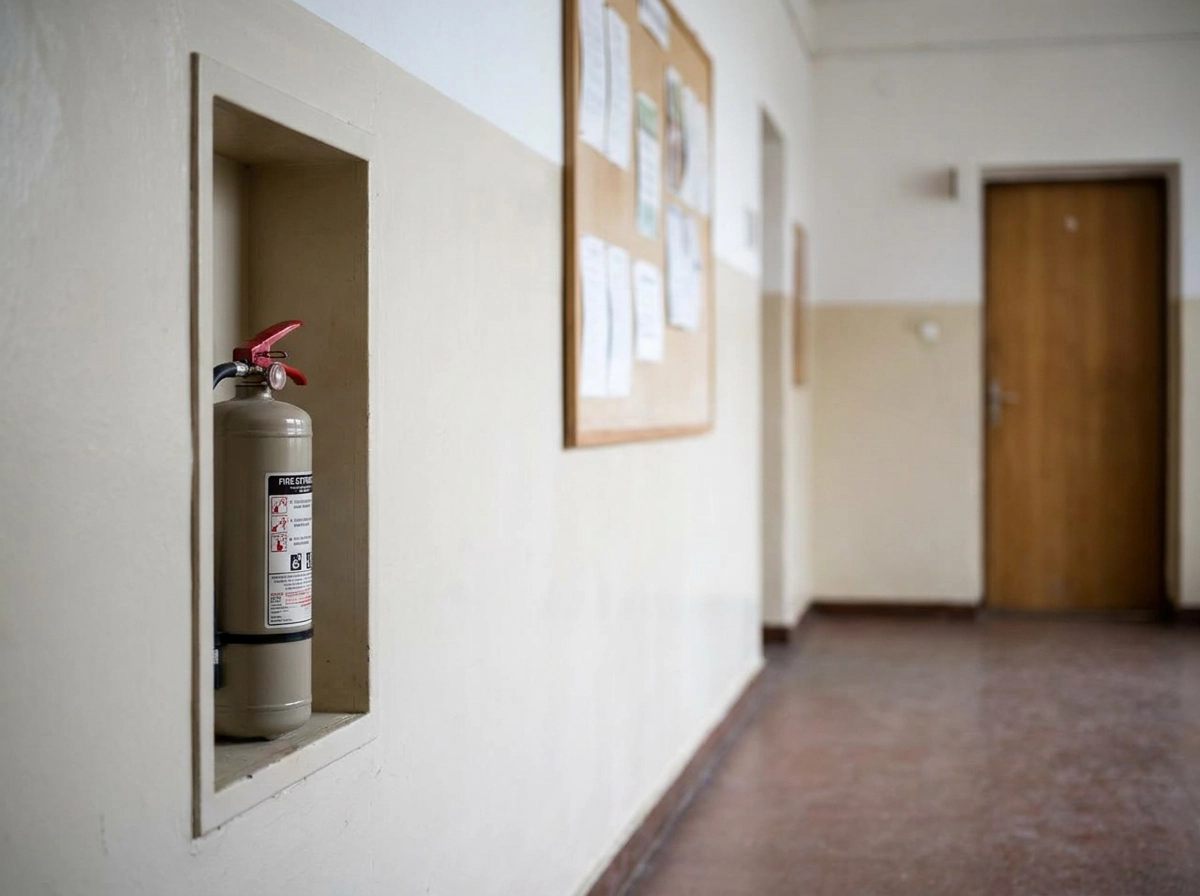
Travel distance rules apply to every occupied building on campus. Class A extinguishers (covering ordinary combustibles like wood, paper, and textiles) must be accessible within 75 feet of any point in the space. Class B extinguishers, covering flammable liquids, tighten that standard to 50 feet. These distances govern classroom corridors, administrative offices, and general-use spaces across the entire campus footprint, not just the structures a facilities team thinks of as "main buildings."
Multi-story buildings carry an additional placement requirement beyond travel distance. Every floor must have at least one 2A-rated extinguisher, with at least one unit positioned adjacent to each stairway at that floor level. This applies to every multi-story structure on district property. A two-story portable classroom building, a multi-floor gymnasium, and the main administration building are all subject to this rule independently. For guidance on California placement, mounting, and signage requirements facility managers must know, the specifics extend well beyond travel distance alone.
Monthly visual inspections are mandatory, not discretionary. Trained personnel must check each unit every month, confirming it is accessible, charged, undamaged, and in its designated location. The inspector's date and initials must be recorded on the service tag. Those tags are subject to AHJ review, so a missed month is a documented gap, not just an oversight.
Annual professional maintenance is a separate and higher obligation than monthly inspection. A trained, licensed technician must service each unit every year, including recharge where applicable. Hydrostatic testing of cylinders follows a longer cycle, ranging from every 5 to 12 years depending on cylinder type, and must be documented with a traceable service record.
Section 3220 creates a documentation obligation that exists apart from service tags. Districts must maintain a written fire prevention and emergency action plan that incorporates monthly inspection logs, annual maintenance records, and employee training documentation. Missing this plan during an AHJ inspection is a citable violation even when every extinguisher on campus is physically compliant.
Federal OSHA fire extinguisher requirements under 29 CFR 1910.157 set a baseline, but Cal/OSHA Title 8 is the controlling standard for California employers. Where the two conflict or where California is more specific, the California standard governs. Districts must be built to the California requirement, full stop.
School-Specific Hazard Zones and What Each One Requires
Those travel distance rules from Section 6151 apply uniformly across California workplaces, but a school campus concentrates every hazard class on a single property. Each zone carries its own compliance requirements, and the gaps compound quickly across a large district.
Cafeteria Kitchens (Class K): The Tightest Standard on Campus
Commercial cooking with oils and fats is a Class K hazard, and the placement rule is unforgiving: a wet chemical extinguisher must be within 30 feet of all cooking equipment. That is the most restrictive travel distance under Cal/OSHA Title 8 Section 6151. In a large cafeteria kitchen with cooking lines on multiple walls, a single unit near the door will not satisfy this requirement. Larger layouts need multiple K-class units placed to cover every cooking station within that 30-foot radius.
Classroom Corridors and Academic Spaces (Class A)
Classroom corridors default to Class A coverage (established in the previous section), with the added stairway-adjacent placement requirement for multi-story buildings. Understanding which fire extinguisher classes your building actually requires prevents under-placement in stairwell zones.
Custodial and Maintenance Storage (Class B): A Commonly Missed Zone
Flammable liquids including cleaning solvents appear in nearly every custodial closet, creating a Class B hazard. California Code of Regulations Section 6151 requires a Class B extinguisher within 50 feet wherever flammable or combustible liquids are in use. These storage rooms are consistently overlooked during district-wide audits, making them a reliable citation source.
Science Labs (Class B, C, and D)
Science labs require the most careful extinguisher selection on campus. A single room may contain flammable solvents (Class B), energized electrical equipment (Class C), and reactive metals such as sodium or magnesium (Class D). No single multipurpose ABC unit addresses all three. Facilities teams must assess each lab's actual chemical and equipment inventory to determine whether a specialty Class D unit must be added.
Portables, Administrative Buildings, and Maintenance Shops
Portable classrooms carry the same placement and inspection obligations as any permanent building. Administrative offices default to Class A coverage. Maintenance shops with vehicle fuel storage introduce Class B hazards and potentially Class K hazards if heated fluid work occurs; these spaces are frequently miscategorized as simple Class A environments during initial assessments.
What Title 19 Actually Requires from Your Service Provider
Knowing what equipment your buildings need is only half the problem. The other half is ensuring the provider you hire is legally authorized to service it.
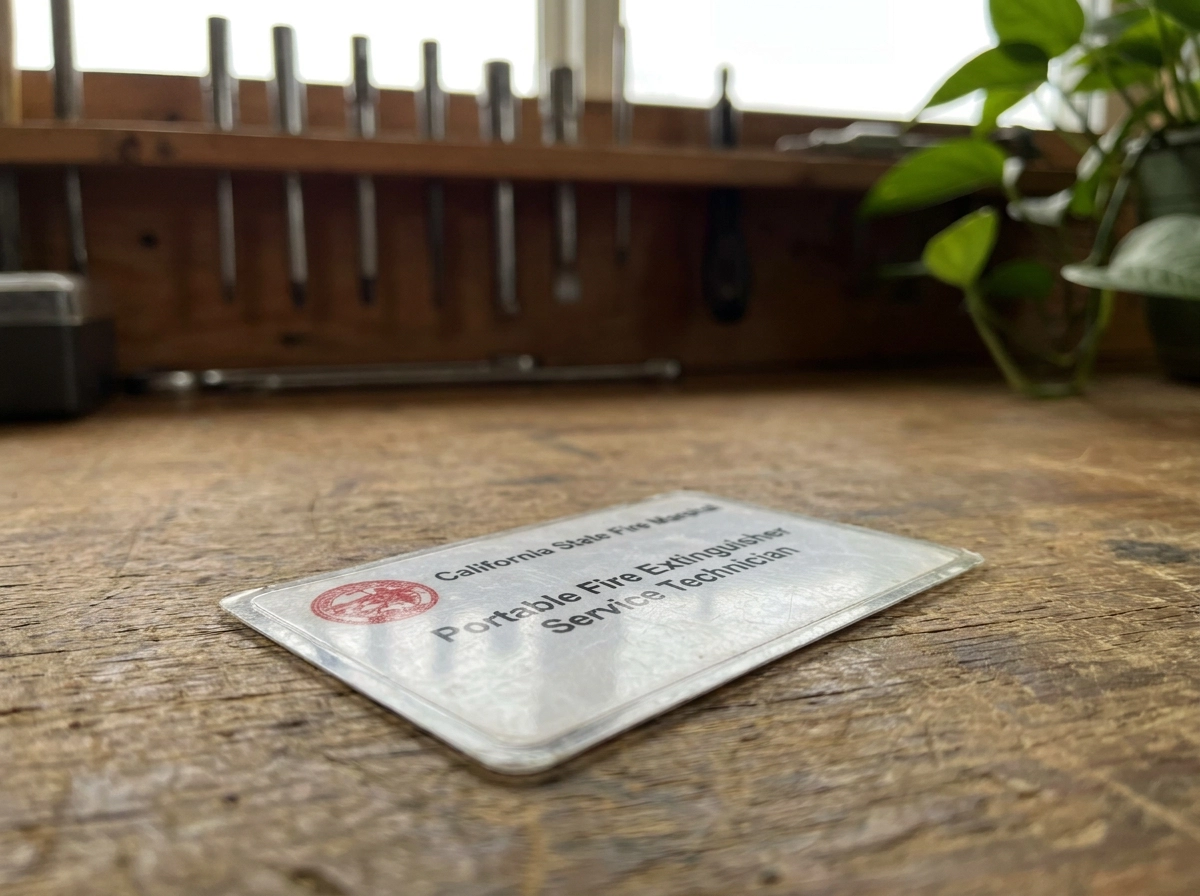
Under California's Title 19 regulations, administered by the OSFM, any person servicing portable fire extinguishers must pass a written exam, provide evidence of experience, and maintain an adequate inventory of testing equipment before being issued a Certificate of Registration. This is a statutory licensing requirement, not an industry credential or voluntary certification.
Certification is individual, not corporate. The OSFM issues Certificates of Registration at the technician level. Each person performing service must pass a written exam, demonstrate experience, and maintain adequate testing equipment before OSFM issues their individual certificate. When you sign a district contract, the company name on the invoice is not what matters for compliance purposes. The credentials of the technician who physically touches your extinguishers are what Title 19 measures.
Reciprocal agreements cover service gaps. Per Section 595.5(d), a licensed concern that is not authorized to perform specific acts, such as hydrostatic testing of low-pressure cylinders or high-pressure requalification, must have documented reciprocal agreements on file with OSFM from licensed concerns that are authorized. If your provider cannot produce that documentation for hydrostatic testing, your cylinder testing records may not constitute valid compliance under Title 19, even if the physical work was completed.
Service documentation should be traceable to an OSFM-registered technician; confirm credentials before work begins to ensure records will satisfy AHJ review.
First Response Fire Protection Services holds current OSFM certification and operates as a CSFM-licensed provider. For Southern California districts, that means every service tag and maintenance report First Response generates is inspection-valid documentation under Title 19. Details on how First Response structures service programs for government and institutional clients are available on the government contracting services page.
Managing Documentation Across a Multi-Building Campus
Having confirmed your provider holds valid OSFM credentials, the next challenge is structural: valid service records only protect you if they exist for every unit, in every building, without gaps.
Each building requires its own independent compliance file. That means service tags on individual units, a building-level inspection log, and documented records of any maintenance, recharge, or hydrostatic testing performed in that structure. A service report filed for the gymnasium does nothing for the portable classroom two lots away.
The scale compounds quickly. A district tracking hundreds of individual units across dozens of buildings faces rolling annual service cycles and hydrostatic testing windows that reset from the last service date on a unit-by-unit basis. Without a centralized tracking system, units quietly fall past due. The hydrostatic gap is particularly easy to miss because the cycle is long and the triggering date differs unit by unit.
The AHJ does not apply different standards based on building prominence. The portable classroom at the back of campus receives the same documentation review as the main administration building. Every occupied structure on district property is subject to inspection, and the citation risk is uniform.
Monthly inspection logs are where most districts accumulate their most preventable violations. Cal/OSHA Title 8 requires monthly visual inspections documented with the date, the inspector's identity, and the condition noted for each unit. A missed month is a citable gap regardless of whether the extinguisher is physically functional. The log is the record of compliance; the hardware condition alone is not sufficient.
The master compliance matrix is your audit defense document. Organize it by building, room, serial number, extinguisher classification, last service date, and next required service interval. This single document lets you confirm district-wide status at a glance and produce organized records the moment an AHJ inspector arrives.
Contracting annual fire extinguisher inspection services through one OSFM-certified mobile provider resolves the scheduling fragmentation. A single provider working across all campus buildings produces one unified service record set, eliminating the building-by-building coordination problem and ensuring consistent documentation format across every compliance file the district maintains.
Aligning Your Facilities Team: Maintenance, Administration, and Outside Contractors
Even a well-maintained compliance matrix is only as reliable as the people feeding information into it. In most California school districts, fire extinguisher compliance responsibility is silently divided across three groups: the maintenance crew managing day-to-day building operations, the business or facilities director approving vendor contracts, and the outside service contractor performing annual maintenance. None of the three is formally designated as the compliance owner, and that ambiguity is where documentation failures originate.
When these groups operate without a shared workflow, the consequences are predictable. Monthly inspection logs go unrecorded because custodial staff were never trained to complete them. Service contractor reports land in a business office inbox and never reach the maintenance supervisor. No single person can confirm district-wide compliance status 48 hours before an AHJ visit.
The liability for those gaps belongs to the district, not the contractor. Cal/OSHA Section 3221 requires the employer to identify, by name or job title, who is responsible for maintaining fire prevention equipment and systems. The contractor's service report satisfies the annual maintenance record; it does not satisfy the employer's obligation to maintain a written fire prevention plan or to document employee training. If monthly inspections were skipped or training was never refreshed, that is a district citation, regardless of how thorough the contractor's annual visit was.
Maintenance and custodial staff who perform monthly visual checks must be trained to do so correctly and that training must be documented. Section 3221 requires employers to apprise employees of fire hazards and to review relevant fire prevention plan elements upon initial assignment. Annual refreshers are the practical standard for keeping that documentation current.
The coordination structure that resolves this is straightforward. Assign one district-level compliance contact with three defined responsibilities: maintaining the master compliance matrix, receiving and filing every service report from the outside contractor, and confirming that building-level staff are completing and logging monthly inspections. For broader context on how these obligations interact across regulatory frameworks, the Government Facility Fire Extinguisher Compliance: OSHA, Cal/OSHA and NFPA 10 Requirements Explained resource covers the layered employer obligations in detail.
One final variable that directly affects that contact's workload: a certified mobile provider who services all campus buildings in a single scheduled visit produces one consolidated service record set. A provider who schedules buildings individually produces fragmented files that require manual reconciliation, multiplying administrative effort with no compliance benefit.
Preparing for an AHJ Inspection at a School Facility
Once your team coordination model is running, the next test is whether it holds up under external scrutiny.
An AHJ inspection at a school is a full records review, not a walkthrough. The inspector will pull service history on individual units, confirm that monthly inspections were logged and dated, and verify that annual maintenance was performed by a CSFM-licensed provider. A single unit with an incomplete service record creates a documentable violation, even if every other extinguisher on campus is in perfect condition.
The most common citation triggers in school environments follow a predictable pattern:
Service tags that are missing, illegible, or do not reflect current annual service
Class K extinguishers positioned more than 30 feet from cooking equipment in cafeteria kitchens
Extinguishers that are inaccessible or obstructed
Gaps in monthly inspection logs, including missed entries or unsigned dates
The AHJ will also review employee training documentation, which your written fire prevention plan under Cal/OSHA must include. A district with fully serviced extinguishers and no documented training program is still citable. Training records must be on file, they must be current, and they must identify which employees received instruction. The Section 3221 documentation obligations covering how that training program should be structured and assigned are addressed in the Aligning Your Facilities Team section above.
Run an internal pre-audit well ahead of any anticipated AHJ review. Use a building-by-building checklist that confirms extinguisher placement against the travel distance requirement for each hazard class present in that space: 75 feet for Class A areas, 50 feet for Class B, and 30 feet for Class K kitchen zones. Walk every building, not just the main campus structures. Portable classrooms and maintenance facilities are subject to the same standards.
Any unit found out of placement, missing a tag, or past due for service should be corrected immediately. Correcting deficiencies before an inspection is far less disruptive than responding to a formal citation.
Retaining First Response Fire Protection Services as your CSFM-licensed provider gives your district third-party documentation that is AHJ-ready from the start. Service reports identify each unit by building location and serial number, giving the inspector a traceable record that confirms certified maintenance across your entire inventory.
Why a Coordinated Mobile Service Program Is the Only Practical Solution
Resolving AHJ findings after the fact is the expensive version of compliance. The structural fix is upstream: replacing a patchwork service model with a single coordinated program before gaps accumulate.
A district managing fire extinguisher inspection requirements through a mix of in-house tasks and occasional vendor calls will reliably produce fragmented records at multi-building scale. Different vendors use different formats, building-level files stay isolated, and no one holds a district-wide view until an AHJ inspector asks for one. A single OSFM-certified mobile provider resolves the fragmentation described in the documentation section above.
The service scope matters as much as the structure. A qualified mobile provider covers the full compliance spectrum: annual inspection and fire extinguisher service documentation, 6-year teardown maintenance, 12-year hydrostatic testing coordination, recharging, and equipment replacement for any unit that fails service criteria. Districts do not need to manage separate vendor relationships for each of these intervals; one provider, one record system, one point of accountability.
Equipment replacement introduces a secondary procurement problem that an authorized distributor relationship resolves directly. As an authorized Amerex distributor, First Response supplies properly rated, California-compliant replacement units at the point of service. When a unit fails its 6-year teardown and cannot be returned to service, the district receives a code-compliant replacement immediately, without initiating a separate purchasing cycle.
For districts subject to SDVOB procurement preferences, First Response's certified Service-Disabled Veteran-Owned Business status supports compliant vendor selection under applicable state and local purchasing guidelines. Districts with SDVOB set-aside requirements or preference policies can satisfy both compliance and procurement obligations through a single contract.
When administrative overhead and citation risk are weighed against the cost of structured annual service, a coordinated program is the more efficient choice for most districts.
Conclusion: Building a Compliance Program That Holds Up at Any Campus
A coordinated service program addresses the operational problem. What follows is the compliance architecture that makes it hold up under scrutiny.
Verify your service provider's OSFM credentials first. Request the registration number and confirm it against the OSFM public database before any work begins. Under California's Title 19 OSFM certification requirements, service records generated by an uncertified provider may not constitute valid compliance documents, meaning physically serviced equipment can still produce a failed AHJ inspection.
Map every campus building by occupancy type and hazard class. Start with cafeteria kitchens, science labs, and custodial storage, each with its own travel-distance rule, detailed in the School-Specific Hazard Zones section above. A hazard misclassification in any one area is a citation waiting to happen.
Build a master compliance matrix. Track every extinguisher unit by building, room location, classification, serial number, last service date, and next required service interval. Without a centralized matrix, gaps in annual service or hydrostatic testing cycles accumulate silently.
Assign a single district-level compliance contact. This person owns the master matrix, coordinates the annual service provider schedule, confirms that monthly inspections are being logged by building staff, and maintains the written fire prevention plan required under Cal/OSHA Section 3220. Distributed responsibility without a single accountable contact is how documentation gaps survive undetected.
Run an internal pre-audit well ahead of any anticipated AHJ inspection. Confirm travel distances are met for each fire class in every building, check that service tags are current, and resolve any placement or documentation gaps before the inspector arrives. Corrective service costs far less than a citation and corrective action order.