What the Fire Extinguisher Inspection Tag Actually Tells You — and What Happens When It's Missing
Most facility managers treat a fire extinguisher inspection tag as a formality, a small laminated card hanging from a red cylinder that someone checks off during an annual walkthrough. That assumption is exactly what turns a minor oversight into a cited deficiency during an AHJ inspection. The tag is not decorative. It is the primary compliance artifact that experienced AHJ inspectors typically turn to as an early indicator of compliance status, and every field it contains carries regulatory weight under NFPA 10 and California fire code.
Understanding what a fire extinguisher inspection tag must document, and what happens when it is blank, incomplete, or expired, transforms routine equipment management into a genuine risk-control practice. A missing tag does not simply suggest disorganization; it signals to an inspector that the extinguisher may never have been properly serviced.
In this guide, you will learn how to decode every field on the tag, which inspection intervals must be reflected in the documentation, how to conduct your own compliance self-audit, and what certified technician credentials actually mean for the paperwork attached to your equipment. By the end, a small cardstock tag will look a great deal more significant than it did before.
What the Inspection Tag Actually Is (and Why Auditors Go to It First)
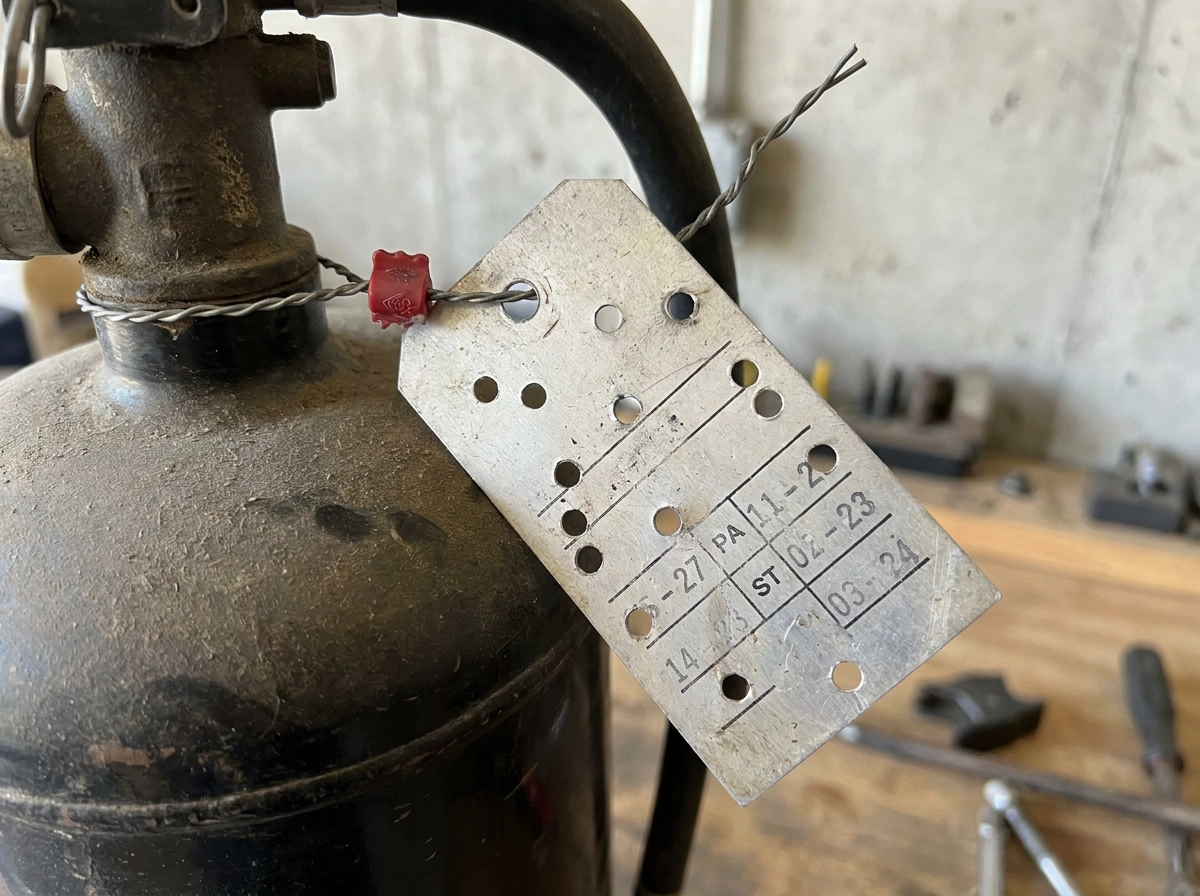
The fire extinguisher inspection tag is the primary compliance artifact under NFPA 10 and California fire code. It is the physical proof, attached directly to the unit, that a qualified technician performed the required service. Not a printout in a binder. Not a digital record on a shared drive. The tag on the extinguisher itself.
That distinction matters because experienced AHJ inspectors typically turn to the tag as an early indicator of compliance status during a facility walk-through. Before checking pressure gauges, mounting brackets, or clearance distances, they look for the tag. It functions as the first pass/fail indicator in any compliance audit: present and current means the conversation continues; missing or expired means a deficiency notice is already forming.
The tag bridges a critical gap. An extinguisher can look perfectly functional on the wall and still be treated as uninspected equipment if the tag is absent or illegible. Regulators evaluate documented service history, not physical appearance. Annual professional inspection and certification must be proven, not assumed.
Facility managers who understand this function gain a practical advantage: the tag becomes a self-audit tool. Walking the inventory before an AHJ visit and reading each tag against known service intervals lets you identify overdue units and schedule corrections on your timeline rather than a regulator's.
One important distinction applies here. Both the at-equipment inspection tag and the annual inspection record kept in your maintenance files are required. The file record supports historical documentation; the tag is the portable, at-the-unit proof that must be physically present whenever an auditor walks your facility.
The Regulatory Framework Behind the Tag: NFPA 10 and California Title 19
That tag exists because two regulatory layers require it, and in California, both apply simultaneously.
NFPA 10, the Standard for Portable Fire Extinguishers, is the nationally recognized benchmark governing all inspection, maintenance, and testing (ITM) activity for portable extinguishers across the U.S. It mandates that every inspection, maintenance procedure, and test be documented and that a tag or label be affixed directly to the extinguisher immediately following each service event. For a deeper look at how NFPA 10 sets the technical floor for inspection requirements, the standard's scope covers everything from frequency intervals to what a qualified technician must verify.
California fire code, administered through the Office of the State Fire Marshal (OSFM), incorporates NFPA 10 and layers additional state-specific requirements on top. California facilities must satisfy both frameworks; meeting only the federal standard is not sufficient. Under California's licensing framework, a tag bearing no verifiable CSFM license number is treated as a compliance deficiency. The specific fields this licensing requirement affects are detailed in the next section.
NFPA standards also follow regular update cycles, meaning adopted requirements can shift between editions. Facilities across Southern California should confirm their service provider references the edition currently adopted by their local Authority Having Jurisdiction (AHJ) for full OSHA and NFPA 10 compliance, since working from a superseded edition can leave documentation gaps that an AHJ will cite.
Every Field on a Fire Extinguisher Inspection Tag, Decoded
Knowing which regulations govern the tag is the foundation; knowing what each field on that tag must say is how you put that knowledge to work.
Service date is the first field an AHJ examiner reads. It records the month and year service was performed, and a date older than 12 months indicates the unit is overdue and is likely to be cited as a deficiency during an AHJ inspection. No other field on the tag produces a faster compliance failure.
Technician name and license/certification number confirms that a qualified individual performed the work. In California, that means a CSFM-licensed technician. An unlicensed name, or a blank where the license number belongs, is treated as a deficiency in its own right, separate from any question about the extinguisher's physical condition.
Type of service performed tells the auditor which service level was completed. The three categories under NFPA 10 carry distinct documentation weight: an annual inspection, a 6-year internal maintenance teardown, and a 12-year hydrostatic pressure test. Each requires its own notation; marking "inspection" when a teardown was due does not satisfy the requirement. For a full breakdown of what each service level must document, see our guide to fire extinguisher inspection requirements: what must be documented and when.
Next service due date converts the tag from a backward-looking record into a forward-looking compliance marker. Once that date passes without a new tag in place, the unit is non-compliant regardless of its apparent condition.
Company name and contact information supports traceability requirements and links the tag to a verifiable, licensable service provider. A tag with no company name cannot be traced and will be cited accordingly.
Pressure and condition observations appear on many tags as recorded gauge readings or pass indicators. A blank in that field, where a reading is clearly expected, signals an incomplete inspection record to any auditor reviewing the unit. Our fire extinguisher service team documents all required observations so no field is left blank.
Required Inspection Intervals: What the Tag Must Reflect Over Time
Those decoded fields only tell the full story when you understand the service intervals they track. NFPA 10 and California fire code establish four distinct compliance events, each leaving a specific mark on the documentation record.
Annual Inspection Every 12 months, a licensed technician performs a visual and operational check confirming the extinguisher is in its designated location, accessible, fully charged, and free of physical damage. This produces the tag entry AHJ inspectors scrutinize most often during facility walk-throughs.
6-Year Internal Maintenance Teardown Stored-pressure dry chemical extinguishers and certain other types require a full internal examination every six years from the manufacture date or last documented maintenance date. The technician disassembles the unit, inspects internal components, replaces parts as needed, and recharges it. Per NFPA 10 requirements, this service must be documented on a separate durable label affixed to the cylinder, distinct from the annual inspection tag. A unit past its six-year interval with no teardown notation is a cited deficiency.
12-Year Hydrostatic Test Most cylinders require pressure testing every 12 years to verify structural integrity. The test date and pressure values must be stamped on the cylinder or documented per NFPA 10, and the tag should reference that hydrostatic testing was performed.
Monthly Visual Checks NFPA 10 requires a responsible party to conduct monthly visual checks. These do not generate a new tag, but facilities must maintain a separate monthly log. An AHJ may request that log alongside the tag during an audit, including for government-occupied buildings covered under contracts like those First Response fulfills for government clients.
A facility manager who knows this interval schedule can look at any tag and immediately identify what service event comes next and when it is due.
What Happens When the Tag Is Missing, Incomplete, or Expired
Knowing the required intervals is only half the equation. What those intervals produce, a current, complete tag, determines how your facility stands up when an AHJ walks through.
A missing tag is not a technicality. An inspector treats any extinguisher without a tag as uninspected equipment, regardless of physical condition. A fully charged, undamaged extinguisher with no tag fails the audit on the spot.
The enforcement sequence escalates quickly. A cited deficiency triggers a formal written notice requiring corrective action within a timeframe set by the AHJ, often 30 days, though this varies by jurisdiction. Unresolved citations can produce fines, conditional operating permits, or orders that put a facility's certificate of occupancy at risk.
Insurance exposure deserves attention. Many commercial property and liability policies reference fire protection maintenance compliance; facility managers should review their specific policy language. A pattern of non-compliant tags can complicate claims handling and give an insurer grounds to challenge renewal terms. Before a loss event this risk is invisible; after one, it becomes the focus of the claims file.
In litigation, the tag is evidence. In fire loss investigations, documentation of regular service is routinely scrutinized; an absent or expired tag may be interpreted as evidence that required maintenance was not performed.
Incomplete tags carry the same weight as missing ones. Blank fields, such as an absent technician certification number or unspecified service type, constitute a deficiency under applicable code. If you are building or auditing your inventory from scratch, the guidance on building a compliant, hazard-matched extinguisher inventory is a practical starting point for ensuring every unit is properly equipped and properly documented.
A Facility Manager's Self-Audit Checklist Using the Inspection Tag
Knowing the consequences of a deficient tag is only useful if you can spot the problem before an auditor does. Run this walk-through before any AHJ visit or internal compliance review.
1. Confirm every tag is physically present. Move through each extinguisher location on your inventory list and verify a tag is attached to the unit. A missing tag is an immediate action item, regardless of the extinguisher's apparent condition.
2. Check the service date against today. If the most recent inspection date is more than 12 months old, that unit is overdue. Flag it for service scheduling before anything else on the tag gets reviewed.
3. Verify the technician's license number is recorded. A blank license field is a documentable deficiency. In California, take the number listed and verify the license number is current by contacting the CSFM or checking state licensing resources. An expired or absent license number means the tag does not satisfy California's licensing requirements.
4. Confirm the service type matches the extinguisher's age. If a unit is more than six years from its last internal maintenance teardown, that service should appear on the tag. If manufacture date or the last hydrostatic test stamp is approaching the 12-year mark, schedule that testing proactively rather than waiting for a citation.
5. Log every finding in writing. Record each unit's location, tag status, service date, license number, and any deficiency noted. A written walk-through log demonstrates due diligence to an AHJ and gives a certified technician a clear picture of what needs attention when you call for service.
Retain prior tags in your maintenance files, as they form a traceable service history that supports both regulatory compliance and any insurance or liability review that may arise.
What Fire Extinguisher Inspection Certification Actually Means for the Tag
Once your self-audit confirms which tags need attention, the credential behind the replacement tag matters as much as the tag itself.
In California, technicians performing fire extinguisher service are required to hold current OSFM certification, a state-level professional requirement. When a licensed technician signs a tag, the certification number recorded alongside that signature is a professional attestation. It confirms the inspection met the requirements of NFPA 10 and California fire code, and it creates a verifiable, auditor-facing compliance record. A signature alone, without a valid license number, carries no regulatory weight.
Before allowing any provider to tag your equipment, request proof of current CSFM licensure. A tag completed by an unlicensed individual does not satisfy the regulatory requirement. An AHJ will cite it as non-compliant, placing your facility in the same position as if no inspection had been performed.
First Response Fire Protection Services technicians hold current OSFM certification and operate under a CSFM contractor license. Every tag placed on a customer's equipment reflects a credential that is documentable, verifiable, and built to withstand AHJ review.
The certification standard exists for a direct reason: missing a deficiency on a fire extinguisher can have life-safety consequences. Requiring technicians to demonstrate tested knowledge of NFPA 10 and California fire code before they can legally sign a tag ensures the compliance call on your equipment is made by someone qualified to make it.
Turn a Small Tag Into a Compliance Asset
Knowing what a certified technician's license number means on a tag is only useful if you act on that knowledge across your entire inventory.
That means treating the inspection tag as a live compliance document, not a routine label. An AHJ's first move during a facility walk-through is to examine those tags, and in a fire incident or insurance claim, the tag becomes evidence. A complete, current, properly signed tag protects the facility; a missing or expired one documents neglect.
Running the self-audit checklist from the previous section before your next AHJ visit is the fastest way to identify gaps.
If any tag is missing, incomplete, expired, or bears no license number, that unit is non-compliant regardless of how it looks on the wall. Those extinguishers need attention from a CSFM-licensed technician before your next audit, not after.
First Response Fire Protection Services performs NFPA 10 and California fire code compliant annual inspections, 6-year maintenance teardowns, and 12-year hydrostatic testing throughout Southern California. Every tag placed by our OSFM-certified technicians reflects a verifiable compliance credential built to withstand AHJ scrutiny. Contact the team to schedule service and ensure your entire inventory carries a clean compliance record.
Conclusion
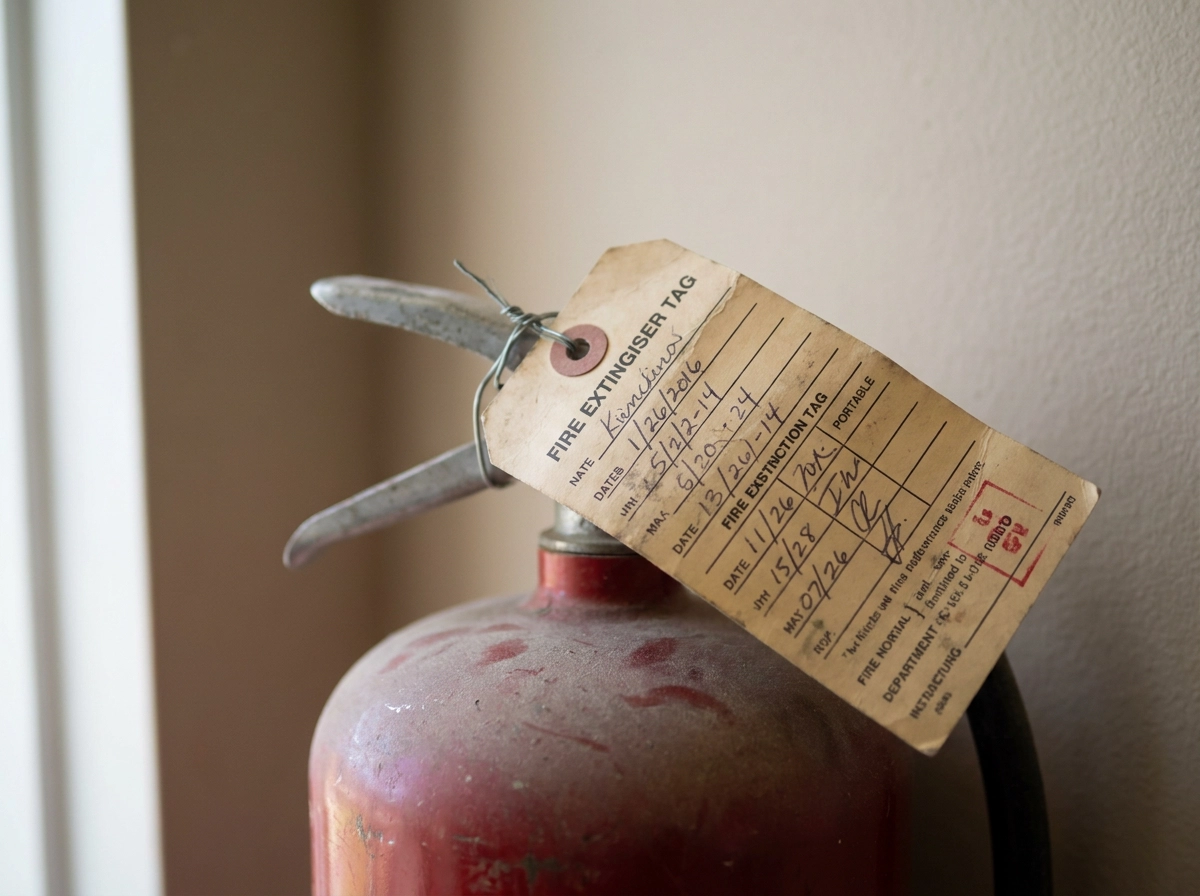
A fire extinguisher inspection tag is never just a label. It is a legal record, a compliance credential, and your first line of defense during an AHJ audit or insurance investigation. Every field matters, every interval is regulated, and a missing or expired tag signals neglect regardless of what the extinguisher looks like physically.
The bottom line is straightforward: keep tags present, current, and signed by a licensed technician. Treat each tag as a living document that reflects the true condition of your fire safety program.