Why Monthly Fire Extinguisher Inspections Matter for Your Facility
A fire extinguisher hanging on your wall is only useful if it actually works when you need it. That is where monthly fire extinguisher inspections come in, and if you manage a facility in California, this is not something you can afford to overlook.
Many facility managers assume that having extinguishers on-site is enough. In reality, California law under Title 8, Section 1922 of the California Code of Regulations requires regular inspections to confirm that every unit is charged, accessible, and ready to perform. Skipping these checks puts people at risk, exposes your organization to serious liability, and can even affect your insurance coverage.
This guide breaks down everything beginners need to know about monthly fire extinguisher inspections. You will learn the legal difference between an inspection and a service, why these checks are a strict legal requirement in California, what a proper inspection actually covers, and how to keep your facility compliant and your equipment ready for any emergency. Whether you are new to facility management or simply need a clearer understanding of your obligations, this post covers it all.
Inspection vs. Service: Two Different Things Under California Law
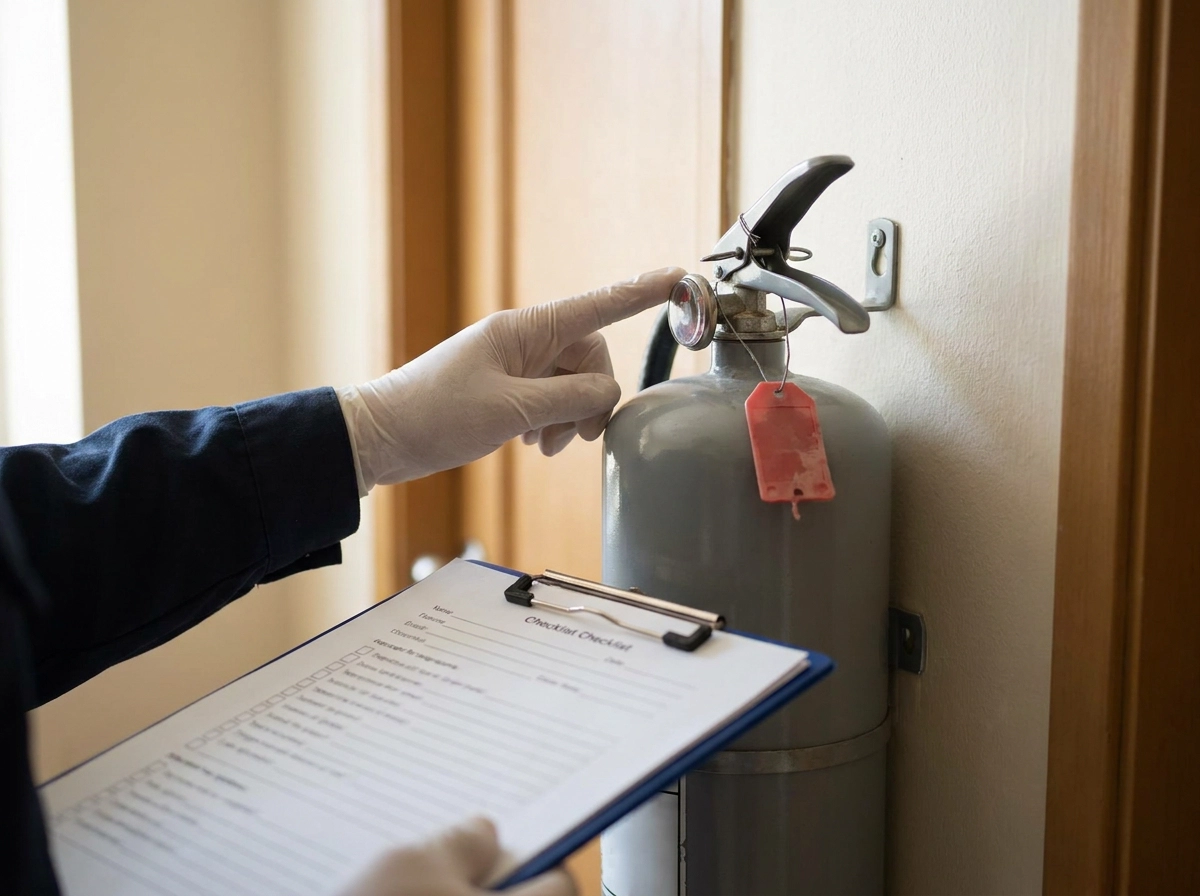
Under California Code of Regulations, Title 8, Section 1922, an inspection is a quick visual check confirming that an extinguisher is in its designated location, fully charged, not actuated or tampered with, and free of visible physical damage. It is not a mechanical procedure.
Service is something different entirely. It covers charging, recharging, internal inspection, repair, and hydrostatic testing, and must be performed at least annually by a person licensed or registered by the California Office of the State Fire Marshal (OSFM). For a deeper look at what that annual visit involves, see Annual Professional Inspection & Certification.
Conflating the two terms is where most compliance failures begin. Assuming that a completed annual service satisfies the monthly inspection requirement is a regulatory misreading, and California OSHA cites employers for exactly this gap. The monthly check exists because problems develop between service visits: pressure loss, physical damage, missing tamper seals, and relocated equipment are all conditions a once-a-year visit cannot reliably catch.
The distinction also defines who does what. Licensed technicians must perform service work. Under certain conditions, facilities may designate trained staff to conduct and document monthly inspections, which can simplify compliance without compromising it.
They Are a Legal Requirement, Not a Recommendation
Once that inspection-versus-service distinction is clear, the next question is straightforward: is any of this actually required? The answer is unambiguous.
California regulations require that portable fire extinguishers shall be inspected monthly, or at more frequent intervals. That mandatory language applies to virtually all California workplaces and facilities. NFPA 10 independently establishes the same monthly baseline, aligning national consensus standards with California's regulatory framework.
Compliance is not optional, and the word shall carries legal weight with no discretionary reading.
The regulation also specifies where extinguishers must be placed, and every placed unit falls within the monthly inspection scope:
One 2A-rated extinguisher per 3,000 square feet of floor area
No point in the protected area more than 75 feet from the nearest unit
At least one extinguisher per floor in multi-story buildings
One extinguisher adjacent to each stairway at every floor level
A five-story building requires at least one extinguisher per stairway at each floor level, meaning stairwell compliance alone can account for a significant share of your total unit count, all subject to monthly checks. Facilities unsure whether their current program meets these standards can review First Response's Compliance and Certifications to understand what code-compliant servicing looks like in practice.
Monthly Checks Catch Equipment Problems Before They Become Emergencies
Beyond the legal mandate, there is a practical reality: fire extinguishers can become unserviceable at any point between annual services, and a unit that fails when someone needs it is no better than no unit at all.
Pressure loss happens gradually. Slow leaks, temperature cycling, and valve degradation can drop a gauge out of the operable range. A monthly check catches this before it matters.
Physical damage from facility activity is routine and unpredictable. Forklifts, hand carts, and foot traffic in warehouses or loading areas can dent, displace, or discharge an extinguisher on any given Tuesday, not during your annual service window.
Corrosion, denting, and nozzle blockages develop gradually and are invisible unless someone looks. Monthly visual checks let trained staff flag a deteriorating unit for replacement before it is pulled off the wall during an actual fire.
Missing safety pins or broken tamper seals in high-traffic areas signal accidental or intentional actuation. That unit requires immediate recharging regardless of when it was last serviced. Reviewing fire extinguisher inspection requirements and what must be documented helps facilities understand exactly what to log when these issues are found.
Placement gaps created by renovations or equipment moves can push a unit outside the required travel distance. As established in the legal requirements above, monthly walkthroughs are the only reliable way to catch these coverage failures before an inspector, or a fire, does.
Skipping Inspections Creates Serious Liability Exposure
Equipment failures are one risk. The legal and financial consequences of missing inspections are another category entirely.
When a fire causes property damage, injury, or loss of life, investigators will pull inspection records. If monthly checks were skipped, the facility operator faces significant civil liability. When a facility operator fails to meet the monthly inspection mandate codified in Title 8, that documented non-compliance can be used to establish breach of a known regulatory duty in fire-related civil litigation.
Cal/OSHA enforcement adds a separate layer of exposure. Employers are regularly cited for fire extinguisher inspection and recordkeeping violations under Title 8. Penalties scale with violation severity and willfulness, and Cal/OSHA citations carry monetary consequences that compound with each unresolved violation.
Insurance carriers increasingly require documented fire safety compliance as a condition of coverage. A gap in monthly inspection records can complicate or invalidate a fire-related property claim at exactly the moment coverage is needed most.
Schools, healthcare buildings, government properties, and retail spaces face heightened duty-of-care obligations. In litigation, undocumented compliance is difficult to defend regardless of actual equipment condition.
A consistent monthly inspection log with technician signatures and dates creates a defensible paper trail. Review your fire safety compliance action plan and confirm your records are current. For government and institutional facilities, Cal/OSHA and NFPA 10 documentation requirements are non-negotiable, and gaps carry compounding risk.
Proper Records Keep You Ready for Audits and Inspections
Beyond liability exposure, incomplete inspection records create a direct compliance problem when auditors arrive.
California OSHA compliance audits routinely include review of fire extinguisher inspection logs. A fully charged, undamaged extinguisher does not save a facility from a citation if the inspection record is missing. Auditors flag incomplete documentation independently of equipment condition.
What every inspection record must capture: Under Title 8 and NFPA 10, each entry requires the date of inspection and the identity (initials) of the inspector. Every unit in the facility needs its own entry. A simple log template covering those fields satisfies the requirement.
Service providers like First Response issue dated inspection reports with every visit, eliminating the need for facility staff to build and maintain their own recordkeeping systems from scratch.
Government facilities face a higher documentation bar. State and federal contract audits apply additional scrutiny to fire safety records. First Response holds government contracts as a certified Service-Disabled Veteran-Owned Business and understands exactly what those clients require.
Consistent records also serve internal planning. A complete inspection history across all extinguisher units lets facility managers anticipate upcoming service needs and build a compliant, hazard-matched extinguisher inventory, budget accurately for recharging or replacement, and flag units approaching 6-year maintenance or 12-year hydrostatic testing intervals before those deadlines create compliance gaps.
Functioning Extinguishers Save Lives, But Only When Maintained
Records confirm you're compliant on paper. But compliance alone doesn't stop a fire.
Portable extinguishers are designed to suppress incipient-stage fires -- but only when they are fully charged and accessible. A discharged, blocked, or damaged extinguisher provides zero suppression capability. It doesn't slow the fire. It doesn't buy time. It simply fails.
Monthly inspections address this directly. They confirm extinguishers are still in their designated locations and haven't been blocked by stacked inventory, parked equipment, or facility modifications. This is a common concern in high-activity work areas, where operational activity can encroach on extinguisher mounting points between annual service visits.
There's a secondary benefit that's easy to overlook: visibility. When staff see inspections happening regularly, it reinforces awareness of where extinguishers are located and signals that fire safety is actively managed. That awareness supports training retention in ways that a once-a-year service visit cannot.
For facilities where staff have completed PASS training (Pull, Aim, Squeeze, Sweep), this matters especially. A practiced response requires a functioning tool. If an employee reaches for an extinguisher during an incipient fire and finds it inoperable, the training doesn't compensate. Equipment readiness is the prerequisite; everything else follows from it.
Your Insurance Coverage May Depend on It
Equipment readiness protects lives in the moment. But insurance coverage protects your facility's financial future, and that coverage may hinge on the same inspection records.
Many commercial property policies reference applicable fire codes as conditions of coverage. If a fire loss occurs and records show extinguishers were not maintained per code, that gap may complicate your claim -- consult your broker to understand your specific policy terms.
The inspection log you maintain for Cal/OSHA compliance serves double duty as evidence of due diligence for your insurer.
Consistent compliance documentation demonstrates risk management discipline. Ask your broker or underwriter whether your fire protection maintenance records factor into your renewal review.
Loss control representatives who conduct pre-loss surveys may assess fire extinguisher condition and placement -- another reason a documented monthly program is worth maintaining.
A professionally documented monthly inspection program through a licensed provider like First Response creates a clear record of due diligence. That record supports fire-related claims, strengthens your position in coverage disputes, and gives your broker concrete evidence of compliance during renewal negotiations.
What a Professional Monthly Inspection Actually Covers
Understanding what actually happens during a compliant monthly inspection makes it easier to verify your provider is doing the job correctly.

Each visit confirms the following:
Location and accessibility: The unit is in its designated spot, unobstructed, and has not been moved or removed since the last check.
Pressure gauge: Reads within the operable range, typically the green zone.
Safety pin and tamper seal: Both intact and undisturbed; any breakage requires immediate corrective action.
Physical condition: No visible dents, corrosion, leakage, or nozzle blockages.
Operating instructions label: Legible and facing outward.
Discharge status: The unit has not been actuated or partially discharged.
Mounting hardware: Wall bracket or hanger is secure.
First Response technicians perform every inspection under current OSFM certification. Each completed visit produces a dated inspection record for the unit, giving your facility the documented proof of compliance it needs for audits, citations, and insurance reviews. You can learn more about the full scope of fire extinguisher service First Response provides across Southern California.
For schools, industrial sites, and government properties managing large inventories across multiple buildings or floors, First Response can build a structured monthly program that covers every unit on a consistent schedule, with records organized by location for straightforward reporting.
California-Specific Requirements Facility Managers Must Know
Knowing what to inspect is only part of the picture. California's regulations also dictate exactly how many extinguishers you need, where they must be placed, and who is legally authorized to service them.
Title 8, Section 1922 of the California Code of Regulations is the controlling authority for portable fire extinguishers in California workplaces. It establishes both the monthly inspection mandate and the annual service requirement.
Key requirements every facility manager must verify:
Coverage ratio: As established earlier, one 2A-rated extinguisher per 3,000 sq ft, with no point more than 75 feet from the nearest unit. Placement reviews must confirm these ratios are still met after any renovation or furniture reconfiguration.
Multi-story buildings: As noted above, one extinguisher per floor plus one adjacent to each stairway at every level. Stairwell compliance alone -- one extinguisher per stairway at each floor level -- can account for a significant share of a multi-story facility's total unit count.
Licensed servicing: Annual service must be performed by a person licensed or registered by the California Office of the State Fire Marshal. A provider without that credential does not satisfy this requirement regardless of work quality.
Broad applicability: Title 8 covers commercial buildings, schools, government properties, industrial facilities, and healthcare sites. If you manage a California facility, these rules apply to you.
Keep Your Facility Compliant and Your Equipment Ready
Monthly inspections under Title 8, Section 1922 are a legal mandate, not a best practice, and they serve a function that annual service cannot replicate. As established above, annual service and monthly inspection serve different functions -- and both are required.
Gaps in your inspection records create direct exposure. In Cal/OSHA audits, incomplete documentation creates a citable violation regardless of equipment condition.
Take this action now: audit your inspection program. Confirm you have a signed log for every extinguisher unit covering the past 12 months. Identify any units or locations where documentation is missing or incomplete.
If your current program has gaps, or if you lack a structured monthly schedule entirely, the time to correct that is before an audit or incident, not after.
First Response Fire Protection Services is a licensed, OSFM-certified provider serving facilities throughout Southern California. Contact First Response to establish a monthly inspection program that delivers consistent coverage, proper documentation, and code-compliant service across every location you manage.
Conclusion
Monthly fire extinguisher inspections are not optional paperwork. They are a legal requirement under California law, a critical line of defense against equipment failure, and a documented record that protects your facility from liability, audit penalties, and insurance disputes.
Three things every facility manager should take from this post: missing inspection logs create immediate exposure, annual service alone does not satisfy Title 8 compliance, and proper documentation is just as important as equipment condition.
Your facility deserves a program built on consistency, not guesswork. When inspections are scheduled, documented, and performed by licensed professionals, you gain something more valuable than compliance; you gain confidence that your equipment will perform when it matters most.
Contact First Response Fire Protection Services today and build an inspection program that keeps your facility protected, your records complete, and your team ready for whatever comes next.