Amerex Fire Extinguishers for Business: Models, Ratings, and Why Your Distributor Matters
Purchasing the wrong fire extinguisher is not just an inconvenience. It is a compliance failure and a maintenance problem rolled into one decision. Yet every year, business owners and facility managers select extinguishers based on price or availability alone, without considering agent type, UL rating, or whether the unit can even be serviced after it leaves the shelf.
An Amerex fire extinguisher has represented the industry standard for portable fire suppression since 1971, and for good reason. The product line covers every recognized fire class, meets NFPA recommendations, and carries UL or FM Global ratings under established ANSI standards. But none of that performance translates into real protection if the wrong model ends up on your wall.
This post works through the decisions that actually matter: matching agent chemistry to your specific hazards, reading UL ratings correctly, selecting the right Amerex model for your occupancy type, and understanding why your purchase channel affects serviceability and warranty just as much as the unit itself. If you manage fire protection for a commercial facility, what follows will change how you approach the next purchase.
Why the Wrong Extinguisher Creates Two Problems at Once
A fire extinguisher for business is not a commodity item, and treating it like one creates two distinct problems simultaneously: an operational hazard and a compliance gap. These problems are independent of each other, which means both can exist even when neither is immediately visible.
The operational hazard is agent chemistry. Deploy the wrong agent class on the wrong fire and you may make the situation worse. A standard ABC dry chemical unit used on a commercial grease fire can cause violent splatter, spreading burning oil rather than suppressing it. A water-based unit applied to energized electrical equipment creates a shock hazard. The fire extinguisher class you choose for your facility determines whether the unit is an asset or a liability in the moment it is actually needed.
The compliance problem is more subtle and arguably more expensive. NFPA 10 requires that each extinguisher be correctly rated for the specific hazard it covers. A unit can pass every visual inspection and still represent a code violation if it is misspecified for the space. A clean tag does not fix a wrong agent class or an insufficient UL rating.
Box stores and online commodity channels compound both problems. Their inventory skews heavily toward ABC dry chemical units in a narrow range of sizes, with no evaluation of occupancy type, hazard class, or whether a local authorized service provider can service the unit when mandatory intervals arrive. Purchasing there feels like a decision made; it is actually a decision deferred.
That deferred decision surfaces at the 6-year internal maintenance teardown and again at the 12-year hydrostatic test. Both intervals are mandatory under OSHA 29 CFR 1910.157. A unit with no service history and no authorized provider creates a maintenance dead end at exactly those points. The selection decision and the service relationship are inseparable from the first purchase.
The sections that follow address each part of the specification process in sequence: agent classes, UL rating methodology, key Amerex models by occupancy type, mandatory service intervals, and what buying through an authorized distributor actually changes across the full compliance lifecycle.
Fire Classes and Agent Types: Getting the Chemistry Right First

Agent class is the first variable to get right, and it determines whether an extinguisher can actually suppress the fire in front of it. The UL rating discussion that follows only becomes meaningful once this decision is made correctly.
Class A covers ordinary combustibles: wood, paper, cloth, and plastics. This is the baseline hazard in virtually every occupied commercial space. Water-based and dry-chemical agents work here by cooling the burning material and interrupting the combustion reaction at the fuel surface. Almost every office, retail space, school, and storage facility has a Class A exposure.
Class B covers flammable liquids and gases, including gasoline, solvents, and propane. The suppression requirement here is fundamentally different. Cooling the fuel surface does nothing useful; the fire is sustained by vapors rising off the liquid, and water application can scatter burning fuel and accelerate spread. Foam or dry-chemical agents work by suppressing vapor release and blanketing the fuel to prevent re-ignition. Applying a water extinguisher to a Class B fire is not just ineffective; it actively worsens the situation.
Class C is the most commonly misunderstood designation. It does not describe a fire type or a quantified hazard size. It is a pass/fail certification confirming that the extinguishing agent is non-conductive and will not create a shock hazard on energized equipment. Critically, per NFPA guidance, a Class C rating is only assigned to extinguishers that already carry a Class A or B rating. There is no standalone Class C unit. When specifying for a space with electrical equipment, look for the C suffix on an ABC-rated unit, not a separate product category.
Class D applies to combustible metals, including magnesium, titanium, and sodium. These are niche but non-negotiable hazards in machine shops, battery manufacturing, and similar facilities. Class D extinguishers are tested on specific metals, and the label must list exactly which metals are covered. A unit tested for magnesium is not automatically appropriate for sodium. Model selection in Class D environments is not a preference; it is a specification requirement.
Class K covers commercial cooking oils and high-temperature grease fires. The wet-chemical agent in a Class K unit is a distinct chemistry from dry-chemical ABC agents, tested specifically on fryer fires at commercial operating temperatures. A standard ABC unit will not meet code for a commercial kitchen hood suppression application, regardless of its rating numbers.
For a detailed breakdown of how each class maps to real occupancy types, Fire Extinguisher Classes A, B, C, D and K: Which Type Does Your Facility Actually Need? covers the full decision framework.
The practical takeaway: determine the hazard class present in each area of your facility before any other selection variable enters the conversation. Getting that wrong makes every downstream decision, including UL rating, cylinder size, and placement, irrelevant.
UL Ratings Decoded: What the Numbers on the Label Actually Mean
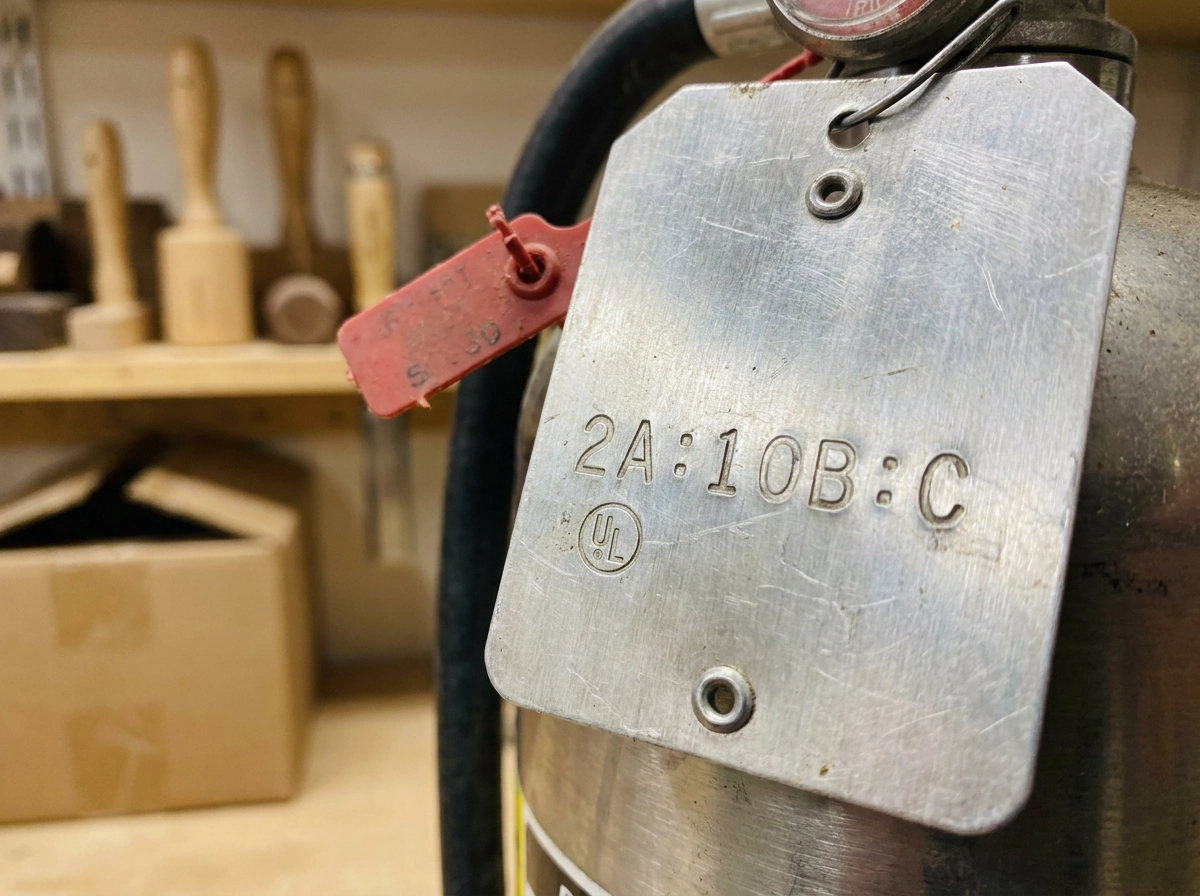
Once you've confirmed the correct agent class for each area of your facility, the next question is how much extinguishing capacity the label actually represents. The rating numbers on the UL listing aren't arbitrary scores; each one maps directly to a physical test result.
Class A ratings are expressed as water equivalents. Each 1A unit corresponds to approximately 1.25 gallons of water, so a 4A-rated unit is roughly equivalent to 5 gallons applied to burning ordinary combustibles. The test is concrete: a 2A rating requires extinguishing a crib built from 112 wooden sticks on a 10x10 ft panel; a 3A rating steps up to 144 pieces on a 12x12 ft panel. Every number on the label has a corresponding pile of wood it had to put out.
Class B ratings map to fuel pan area. A 1B rating was earned by extinguishing a 2.5 sq ft pan of burning flammable liquid. A 10B rating is tested against approximately 25 sq ft of burning liquid, roughly 31 gallons of heptane. The safety margin built into a 10B unit is substantially larger than a simple 10x multiplier suggests.
Class C and Class K carry no numeric rating. The Class C and K designations were covered in the agent-class section above; in the rating context, the key point is that neither carries a numeric value. For a deeper look at how these designations interact with occupancy type, the breakdown of fire extinguisher classes A, B, C, D, and K by facility type covers the selection logic in detail.
A higher rating number is not automatically the right answer. NFPA 10 ties required ratings to calculated travel distances and hazard levels. A unit with a higher A or B rating may exceed those requirements while also exceeding the weight a typical operator can handle. Placing an oversized unit at a spacing that no longer meets code creates its own compliance problem. Rating selection is a calibration exercise, not a race to the highest number.
All Amerex fire extinguishers are tested and listed by Underwriters Laboratories or FM Global per ANSI/UL standards. That consistent third-party certification makes the numbers on one Amerex model directly comparable to another and provides the documented baseline an authorized service technician needs when verifying compliance at your annual inspection.
Selecting the Right Amerex Model for Your Occupancy
With the agent class and rating framework in place, the next step is mapping that knowledge to actual models. Amerex has manufactured portable fire extinguishers since 1971, and the product line is built around specific hazard profiles rather than a universal solution. That depth is exactly why selecting the right unit requires more than pulling something off a shelf.
Office and Retail Occupancies
For general office and retail environments, the Amerex ABC dry chemical line is the practical default. The ABC designation means the agent, monoammonium phosphate, is rated for Class A, B, and C fires. That coverage handles the hazard mix found in most commercial spaces: ordinary combustibles, incidental flammable liquids, and energized equipment.
The Amerex B500 ABC dry chemical unit is one of the most widely specified models for this segment. It is wall-mountable, fits standard brackets, and its ratings align with the hazard densities found in office suites, retail storefronts, and light-assembly spaces. For most light commercial occupancies, it is the starting point in any specification conversation.
Flammable-Liquid Environments
Warehouses, automotive service bays, and fuel-handling areas require a different approach. Higher B-rated units handle larger fuel-surface hazards, but when Class A combustibles are minimal or absent and re-ignition prevention is the priority, Purple K (potassium bicarbonate) dry chemical is the appropriate agent. Potassium bicarbonate is more effective than monoammonium phosphate on flammable-liquid fires and does not introduce the same cleanup or compatibility concerns in those environments.
Class A-Only Environments
Where chemical residue is unacceptable, the Amerex Model 240 is the relevant unit: a 2.5-gallon water extinguisher rated 2A, with a 45-55 foot stream reach and a 55-second discharge time. It is appropriate for Class A-only environments such as paper storage or textile areas. One common misconception worth correcting: server rooms are a Class C hazard, not Class A-only. Water on energized equipment creates a shock hazard, so the Model 240 is not appropriate there regardless of its discharge reach.
Mixed-Hazard Light Industrial
When both Class A and Class B hazards coexist, the Amerex Model 254 AR-AFFF foam unit addresses both in a single cylinder. At 6-liter capacity and rated 2A:10B, it delivers a 10-12 foot spray range with a 30-second discharge. Mixed-hazard light industrial environments, where combustible materials and flammable liquids share the same floor space, are its intended application.
Commercial Kitchens
A commercial kitchen requires a Class K wet-chemical unit mounted within the hood system in addition to any portable units in the space. An ABC dry chemical unit does not satisfy this requirement, regardless of its rating. This is one of the most consistent specification errors found in kitchens that have never had a professional assessment.
Lithium-Ion Battery Hazards
Lithium-ion battery fires present a distinct challenge in warehouses, retail charging stations, and fleet operations. Amerex has published guidance on this hazard class through its learning center, and standard ABC units are not the complete answer. An authorized distributor can review your specific energy storage configuration and recommend the appropriate approach. For technical specifications and documentation relevant to your facility type, the Resources and Documentation available through First Response is a practical starting point.
OSHA Requirements and Service Intervals Your Extinguisher Program Cannot Skip
Selecting the right model gets you to the starting line. Keeping your facility compliant requires meeting three mandatory service intervals, every one of them non-negotiable under federal and state law.
Monthly visual inspections are the floor, not the ceiling. OSHA 29 CFR 1910.157 requires that every portable fire extinguisher in a commercial workplace be visually inspected monthly. OSHA has explicitly rejected requests to reduce that frequency to quarterly, confirming there is no flexibility in the schedule. Inspection records must be retained for a minimum of 12 months and must be available if a regulator asks. The employer bears direct responsibility under 1910.157(e)(1); delegating the task informally to maintenance staff without a documented process does not satisfy the requirement.
Annual maintenance must be performed by a licensed technician. In California, that means a technician holding current CSFM (California State Fire Marshal) licensure. A thorough inspection performed by an unlicensed provider still creates a compliance exposure because the credentials, not just the work, are part of what regulators verify. Detailed guidance on what a compliant annual professional inspection covers in California is worth reviewing before your next service cycle.
Dry-chemical extinguishers require a 6-year internal teardown. At the six-year mark, the unit must be fully disassembled, the dry chemical agent inspected or replaced, and the cylinder, valve, and internal components examined before reassembly. This is not a field task that a general maintenance contractor can perform; it requires proper training and access to the manufacturer's service documentation. When recharging or hydrostatic testing is performed, the six-year clock resets from that date, making accurate service records essential for tracking when the next interval falls due.
Hydrostatic pressure testing is required at 12-year intervals. Cylinders that fail hydrostatic testing must be removed from service immediately and cannot be recharged. Units purchased through non-authorized channels frequently lack the manufacturing documentation needed to establish when the 12-year clock started, creating a traceability gap at the first hydrostatic interval.
At scale, this becomes a compliance program. A facility managing 20 or more extinguishers across multiple hazard classes has three overlapping service calendars running simultaneously. Missing a tag, allowing a service date to lapse, or having a single unit with an illegible record is enough to generate a citation during an OSHA or fire marshal inspection, even if the extinguisher itself is fully functional. An ongoing relationship with an authorized service provider is what keeps all three intervals current across the entire inventory.
Authorized Distributor vs. Box Store: What the Purchase Channel Actually Changes
A box-store or online purchase gives you a physical cylinder at the lowest acquisition cost. It does not give you a hazard assessment, a correctly specified agent class, a UL rating matched to your occupancy, or a service provider who can perform the 6-year teardown and 12-year hydrostatic test when those intervals arrive. The unit looks identical on the shelf. The compliance gap it creates is invisible until an inspector finds it.
What authorized distributors actually have access to
NFPA 302 Annex E requires that persons performing maintenance and recharging meet qualifying criteria that include either factory training and brand-specific certification, or certification by an authority acceptable to the AHJ, or state/local licensure, and that they have the manufacturer's servicing manuals, correct tools, and genuine replacement parts on hand. General retail channels do not stock Amerex service documentation or manufacturer-spec components. Authorized Amerex distributors do. That access is what makes the 6-year internal teardown a routine service call rather than a dead end.
Warranty traceability has real financial weight
Amerex extinguishers carry manufacturer warranties; purchasing through an authorized distributor ensures the purchase is documented in a traceable service record that supports any future warranty claim. A unit with no documented purchase history creates immediate ambiguity at the first service interval. When a technician cannot establish the unit's origin, the warranty question and the service record question surface simultaneously, and both create cost.
Specification errors cost more than the unit itself
The most common expensive outcome of commodity purchasing is discovering the wrong agent class or insufficient UL rating at the first professional inspection. At that point the facility owes replacement units, a potential compliance citation, and a documented gap in inspection records. Correct initial specification by a knowledgeable distributor eliminates that scenario before it starts. For Amerex Sales through an authorized source, the specification conversation happens before the purchase, not after.
Supply chain that supports Southern California
Amerex's regional distribution infrastructure means authorized Southern California distributors have faster access to inventory for recharges and replacements than commodity channels relying on generic national stock.
The total cost of ownership gap between authorized and commodity purchasing widens at every service interval. A unit with no service history, no local authorized provider, and no warranty documentation costs more to maintain correctly over a 12-year hydrostatic cycle than a properly sourced unit purchased right the first time.
The Real Cost of Getting the Specification Wrong
The compliance and operational hazard gaps described earlier carry concrete financial consequences that are worth quantifying.
UL rating deficiencies follow this pattern exactly. NFPA 10 Table 6.2.1.1 specifies minimum extinguisher ratings by occupancy hazard level: Extra Hazard occupancies require a minimum 4A rating; Ordinary Hazard requires 2A. A 2A unit in a 4A-required location is objectively non-compliant regardless of how recently it passed annual inspection. A fire marshal or OSHA inspector will cite the deficiency against the current requirement, not the prior inspection record.
Agent-class errors are more serious. A standard ABC dry chemical unit cannot substitute for a Class K wet-chemical unit in a commercial kitchen application, code requires the correct chemistry, and no ABC rating compensates for the wrong agent class.
Facilities that skip professional specification at purchase frequently encounter this compound problem at their first certified inspection: replacement units are needed, a compliance citation may follow, and the inspection record now documents the gap. That documentation does not disappear.
The correct sequence is straightforward: hazard assessment first, agent class and UL rating second, model selection third, purchase through an authorized distributor who initiates the service record at point of sale. For a practical framework on keeping the full compliance program current once the right units are in place, the Fire Safety Compliance Action Plan: What Your Facility Must Do Right Now covers the ongoing obligations in detail. Retrofitting compliance after a citation costs more, in every measurable way, than specifying correctly at the start.
What an Authorized Amerex Distributor in Southern California Provides
Following the correct procurement sequence closes the specification gap. What it does not do is create an ongoing service relationship. That requires a provider with the licensing, training, and product access to handle every mandatory interval that follows.
First Response Fire Protection Services is an authorized Amerex distributor serving Southern California. Every unit sold through First Response is backed by the Amerex manufacturer warranty chain. Every service performed is carried out by OSFM-certified technicians with access to Amerex service documentation and genuine replacement parts, which matters at the 6-year teardown when substitute components are not an acceptable workaround.
The company was founded by a firefighter with over 30 years of hands-on experience, beginning with military service and continuing through 28 years as a full-time paid firefighter. That background changes the nature of the specification conversation. Guidance on agent selection and model sizing reflects direct knowledge of how fires behave in real occupancies, not a reading of the product catalog.
The service scope covers the complete compliance lifecycle: initial hazard assessment and model specification, sales, annual inspections, 6-year internal maintenance teardowns, 12-year hydrostatic testing, and recharging. A single service relationship handles every mandatory touchpoint from initial purchase through the full hydrostatic cycle, with no gaps in traceability between intervals.
For government facilities, First Response holds certification as a Service-Disabled Veteran-Owned Business (SDVOB). State and federal contracts carry documentation, certification, and procurement compliance requirements that exceed standard commercial accounts. The SDVOB designation, combined with authorized distributor status, positions First Response to meet those requirements without additional qualification steps.
For property managers, facility managers, and school districts managing multiple buildings, the starting point is a site-specific hazard assessment, not a product list. The correct Amerex extinguisher for a school kitchen is a Class K wet-chemical unit. The correct choice for a server room turns on electrical safety and residue tolerance. The correct choice for a vehicle maintenance bay depends on flammable-liquid exposure and available operator training. Learning how a certified mobile fire extinguisher service reduces your compliance burden explains how that assessment process works across a multi-building portfolio.
Takeaways: What to Do Before You Buy Another Extinguisher
The guidance above adds up to a straightforward procurement sequence. Follow it in order and the common failure points disappear before they become inspection citations or liability gaps.
Start with fire class identification, room by room. Before comparing models or prices, walk each area of your facility and identify what is burning if a fire starts there. Ordinary combustibles, flammable liquids, energized electrical equipment, commercial cooking oils, and combustible metals each require a different agent. The UL rating number on any unit is only meaningful after the agent class is confirmed correct for that space. A highly rated unit with the wrong agent is a compliance gap, regardless of the tag on the handle.
Read the rating numbers accurately. The Class A and B rating scales were detailed in the UL ratings section above; the key takeaway here is that a higher number reflects a larger tested hazard, not simply a bigger fire, and buying by label without understanding the scale leads to under-protected areas that pass visual inspection and still fail during a fire.
Buy through an authorized Amerex distributor. That purchase path ensures correct initial specification, manufacturer warranty traceability, and a service provider with access to Amerex documentation for the 6-year internal teardown and 12-year hydrostatic test. A commodity unit with no service history does not get cheaper to own over time; it gets harder and more expensive to maintain correctly.
If your facility is in Southern California and you have any uncertainty about whether your current extinguishers are correctly specified or currently compliant, contact First Response Fire Protection Services. A professional assessment before your next inspection cycle costs far less than discovering a misspecification during one.
Conclusion
Fire extinguisher selection is not a purchasing decision; it is a safety and compliance decision with real consequences. Choose the wrong agent class and the unit fails at the moment it matters most. Misread the UL rating and your facility carries gaps that no inspection tag will catch. Skip authorized channels and you lose warranty traceability, proper service access, and the documentation your compliance program depends on.
The right extinguisher, correctly specified, properly installed, and serviced on schedule, is one of the most cost-effective safety investments a business can make. The wrong one simply looks like the right one until a fire proves otherwise.
If your Southern California facility needs a professional specification review or compliance assessment, contact First Response Fire Protection Services today. Getting it right before your next inspection is always the better option.