Exit Sign and Emergency Light Testing in California
A failed exit sign or emergency light can turn a routine power outage into a life-safety hazard. In California, fire agencies expect building owners and facility managers to prove these devices work when normal power disappears. The compliance rhythm is straightforward but unforgiving: perform a monthly 30-second function test and an annual 90-minute battery test. Those two checks form the core of California emergency lighting requirements, and they are only as reliable as the records that document them. This guide explains how to run both tests correctly, identify the prerequisites and known gaps to check before you start, and understand why the International Fire Code and California Fire Code describe the annual duration differently even though the result is functionally the same. You will also learn what the Authority Having Jurisdiction expects in a written log, who may perform the testing, how quickly failed units must be repaired, whether exit signs follow the same rules as emergency lights, how long records must be kept, and which questions the published rules leave open. By the end, you will have a practical testing calendar and recordkeeping approach your local fire agency can review with confidence.
Two Tests, Two Intervals: How California Handles Emergency Lighting Compliance
California property owners must keep exit signs and emergency lighting working, and the local fire agency, the Authority Having Jurisdiction (AHJ), expects documented proof that units still work when normal power drops. The duty splits in two: a monthly functional test of at least 30 seconds, and an annual test that holds the unit on battery for at least 90 minutes. Two Southern California fire agency documents, the North County Fire Protection District template and the City of Banning report, each specify both intervals; confirm whether your local AHJ cites the same schedule. Both use the same enforcement model: the owner keeps written records, the AHJ reviews them. Neither is vendor marketing, so they reflect how fire agencies judge compliance. Two points need local confirmation: the adopted code edition and section your AHJ cites (sources reference both the International Fire Code and the California Fire Code), and whether exit signs follow the same test procedure as emergency lights.

Before You Start: Prerequisites and Known Gaps
Close five gaps before the first test.
Confirm your AHJ. Ask the fire agency with jurisdiction, in writing, for the code edition and section number it enforces. Cite that reference in your log.
Inventory the units. List every exit sign and emergency light by unit ID or location. Note whether each is battery backed or fed by a generator or inverter, and pull the manufacturer's test instructions.
Start the log now. Both source documents require written records kept for AHJ review; a log begun mid-year leaves gaps that are hard to explain.
Assign the work. Neither source states who may perform the tests. Verify the local expectation before tasking staff or a contractor. Our fire safety compliance action plan covers scheduling.
Learn the mechanics. Find each unit's test button and its breaker or disconnect. Decide how long the building can tolerate an intentional lighting interruption, then coordinate tenants and schedule around operating hours.
The Monthly 30-Second Function Test
With your inventory and log in place, this is the simplest part of the routine. Run it roughly every 30 days. Within that same three-to-five-week window, steady short-interval testing, the same logic behind Monthly Checks Catch Equipment Problems Before They Become Emergencies, catches failures early.
Activate the unit using the manufacturer's method, typically the test button on the housing. Watch the lamp output itself, not the status indicator. Record the start and end times. The unit must reach full brilliance and hold it for the entire 30 seconds. It fails if it does not light, appears dim, or loses full brightness early. Service, repair, or replace it and write the corrective action into the log.
Batteries have finite lifespans and can fail without warning. A charging indicator does not prove the lamp will light when normal power drops.
The Annual 90-Minute Battery Test
As established above, the annual test proves the unit can carry its rated runtime on battery alone.
Interrupt normal power: disconnect the source or open the breaker feeding the unit. Follow the manufacturer's procedure; some units require a true power interruption rather than a test-button press.
Confirm the unit is not receiving line power before timing starts; a partially energized circuit invalidates the result.
Run at normal illumination for at least 90 minutes (1.5 hours). Record measured runtime, not just pass or fail.
Restore power. Confirm the unit returns to charging and the indicator reads normal. Complete repairs and note the completion date. For follow-up timing tied to how deficiency severity drives follow-up service, keep the log current.
IFC 1.5 Hours vs California Fire Code 90 Minutes
One Southern California fire agency template has been noted to cite the International Fire Code's 1.5-hour requirement, while another cites the California Fire Code's 90-minute requirement, the durations are identical. Your test does not change either way.
Neither document reviewed for this article printed a CFC or IFC section number; confirm the adopted section with your AHJ. When an inspector, insurer, or auditor asks for your code reference, request the adopted edition and section from your local fire agency.
One log covers both formats. Record unit ID or location, date, time, tester name, results, deficiencies, reason for failure, corrective action, and repair completion date.
Do not let the citation question stall the work. Run the 90-minute test as scheduled and confirm the citation separately. Staying on schedule matters more than the label, as why the schedule matters explains for the rest of your fire protection equipment.
Recordkeeping: The Log Your Fire Agency Will Ask For
Whichever citation your AHJ adopts, the log is what proves the work happened. Both fire agency documents require the owner to keep written records available for review by the Authority Having Jurisdiction.
The Banning report sets the baseline: unit identification or location, date and time of test, tester name, results, deficiencies noted, corrective actions, and completion dates. Banning's log includes a repair completed field; confirm whether your local template adds a reason-for-fail column, and include both in your log as good practice.
Keep the unified log current with both monthly and annual entries, recording actual runtime on the annual entry as covered above. The same principle applies to fire extinguisher inspection documentation, where the record proves the service occurred.
Best practice: one log per building, entries written at the time of the test rather than recreated weeks later, and a copy stored where a responding crew or inspector can find it.
Who Enforces This and How Records Are Reviewed
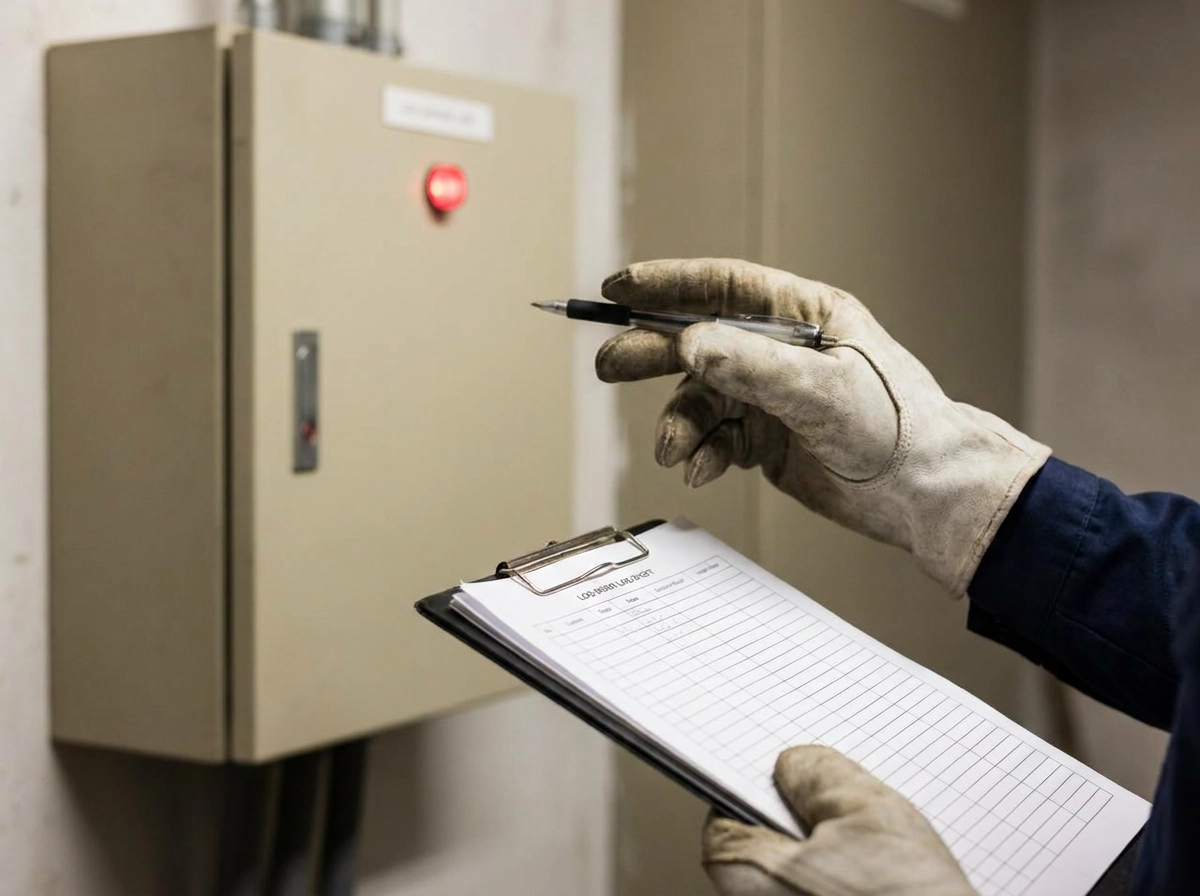
Your log matters only if it matches what the local fire agency sees on site. In practice, reviewers typically request the log by location, spot-check entries against wall units, and look for gaps in monthly tests, but confirm your AHJ's specific review approach.
As noted earlier, the scheduling window keeps tests roughly monthly. Skipping months leaves an obvious hole.
Record corrective action, not a checkmark: who tested the unit, when, what failed, and what was repaired, keeping that line consistent monthly. Ask any provider to confirm in writing whether exit sign and emergency light testing is in scope. Read How to Evaluate a Fire Extinguisher Maintenance Provider.
Questions the Published Rules Do Not Answer
Even a well-kept log can miss requirements the published documents never address. The source documents define intervals, duration, and record fields, but they leave operational questions open. Treating those gaps as settled is how compliance problems start.
Where a source is silent, the accurate answer is to ask your AHJ. Writing a plausible-sounding rule into your own log is riskier than documenting that the local requirement was confirmed in writing.
Four gaps surface most often: record retention, who may perform the tests, how quickly a failed unit must be repaired, and whether exit signs follow the same procedure as emergency lights. Treat them as a checklist for your next call or email to the fire agency, and file the written answer with the building's fire protection records.
How Long Must Test Records Be Kept?
Retention is one of those gaps. The source documents reviewed for this article do not state how long test records must be kept, so there is no sourced number to quote.
As a practical recommendation (not a sourced regulatory requirement), many property managers retain logs for the life of the building or at least the current year plus the prior year, extended whenever an insurer, agency, lease, or internal policy requires more.
Whatever you choose, write the retention period on the log form itself. That tells whoever files the records exactly what to keep and for how long, and removes the guesswork later.
Who Is Allowed to Perform the Testing?
With retention settled, ask who may run the checks. The source documents reviewed for this article focus on what the test must show and what to record, but do not state who may perform it. Treat this as a local question; confirm with your AHJ.
In practice, staff often handle the monthly 30-second function test, while a qualified contractor handles the annual test, which requires interrupting power to the unit. Record the tester's name on every entry; both templates include a tester field, making that person part of the official record.
If staff test, give them the manufacturer's procedure and simple written steps. If a contractor tests, confirm their scope covers exit signs and emergency lights, not fire extinguishers alone. For regulated facilities, What Title 19 Actually Requires from Your Service Provider explains documentation expectations.
How Fast Must a Failed Unit Be Repaired?
Once a test identifies a failure, the repair clock starts. The Banning report says deficiencies must be corrected without delay, but it does not define that term in days, hours, or inspection cycles. A practical approach is to make the failed unit safe and record the deficiency immediately. If parts are on hand, complete the repair before closing the log entry. If a battery, lamp, or board must be ordered, note the deficiency, the date it was found, and the scheduled repair. Update that same log entry with the completion date once the work is done. Because the source documents do not address interim measures, ask your AHJ whether the failed unit must be removed, covered, or flagged while you wait.
Do Exit Signs Follow the Same Rules as Emergency Lights?
Exit signs raise a related question the sources leave open. The source documents reviewed for this article do not set out a test procedure specifically for exit signs, so the emergency lighting rules should not be assumed to transfer without local verification.
Exit signs serve the same purpose as emergency lights, marking the egress path when normal power drops, and most owners test them on the same monthly and annual schedule.
Confirm with your AHJ how your exit signs are powered. Battery-backed signs, signs on the same circuit as nearby lights, and signs powered another way can each point to a different test method.
Record exit sign results in the same log as emergency lights, using the same unit ID, date, result, and corrective action fields, so a reviewer sees one consistent record.
Conclusion: Calendar Both Tests and Keep the Log Current
With exit signs logged alongside every light, the final step is scheduling. Build the calendar now: run the monthly function test inside a three-to-five-week window, and set the annual 90-minute battery test on a fixed date with the power interruption planned ahead of time.
Keep the unified log current with all required fields. For the annual test, write down the measured runtime rather than a simple pass mark.
Contact your AHJ to close the open questions addressed in the FAQ subsections above: retention period, who may test, how fast repairs must be finished, and whether exit signs follow the same procedure as emergency lights.
Keep fire protection records together. First Response Fire Protection Services provides CSFM-licensed, OSFM-certified annual fire extinguisher inspections, 6-year maintenance, 12-year hydrostatic testing, recharging, and Amerex equipment sales for California property managers, school districts, and government agencies, and can help you stay on schedule for the equipment in its scope.