How Fire Extinguisher Inspections Work in California
Most California property managers learn the hard way that a fire extinguisher inspection is not a generic maintenance task. It is a licensed, regulated procedure with statutory deadlines, certified technicians, and approved-lab requirements. The Office of the State Fire Marshal (OSFM) is the licensing authority for portable extinguisher servicing and sales in California, so the person who inspects your equipment must meet state standards. A "Concern license" is required for any company that services, charges, or maintains extinguishers for a fee, and technicians must pass a written exam and maintain proper testing equipment.
This tutorial breaks down how fire extinguisher inspection actually works in California. You will learn what an inspection covers, how the annual, 6-year, and 12-year intervals differ, who is legally allowed to inspect or service extinguishers, and what approved-lab labels and equipment requirements mean. We also cover what happens during a professional inspection, how Title 19 and OSFM bulletins apply, a compliance checklist for property managers, school districts, and agencies, why a licensed California provider matters, and next steps for facility managers.
What a Fire Extinguisher Inspection Actually Covers
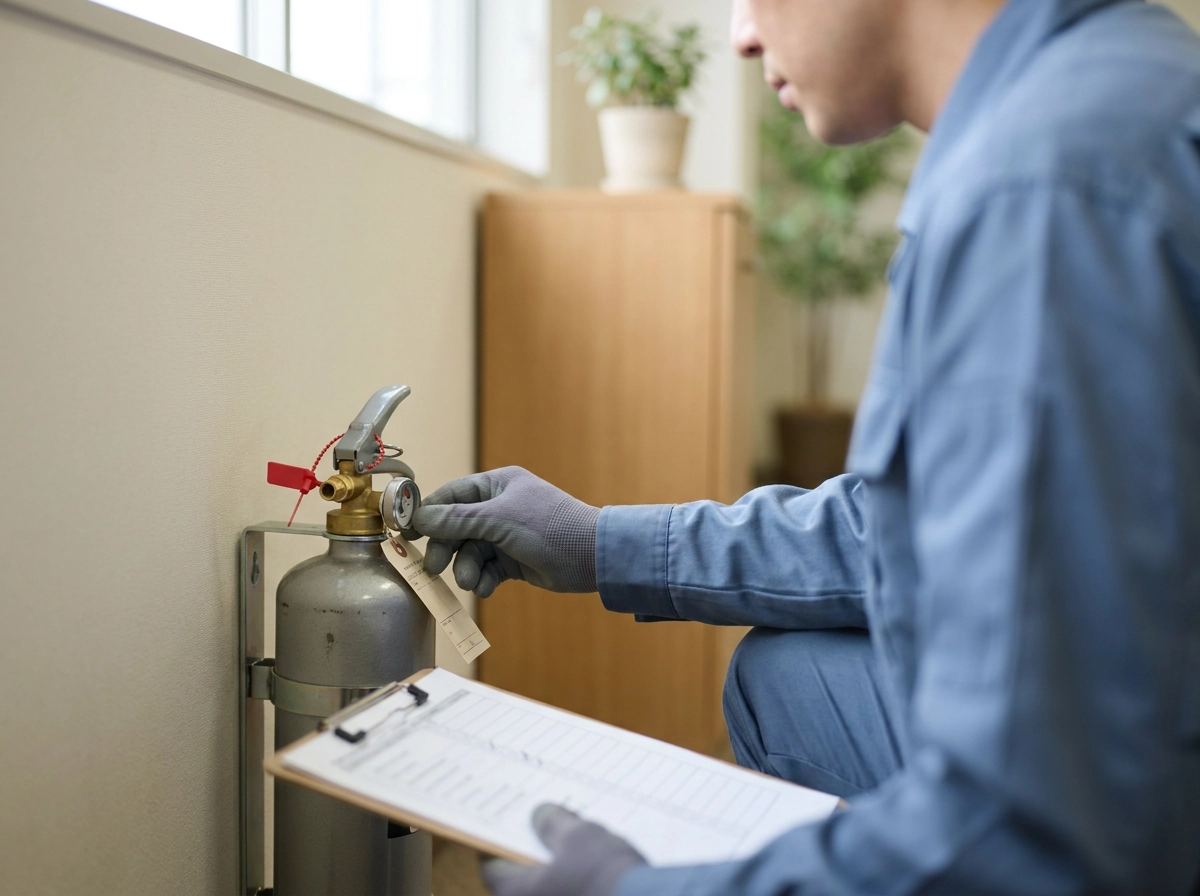
A portable fire extinguisher inspection is a visual, non-invasive check of a unit's condition, location, and readiness. It is not maintenance, which opens the valve assembly, and it is not hydrostatic testing, which pressure-tests the cylinder. Managers routinely use the three terms interchangeably, and that habit causes missed service deadlines.
Physical readiness. The technician confirms the extinguisher sits in its designated location at the correct mounting height, that nothing blocks access or visibility, and that signage is present. The pressure gauge needle must sit inside the operable range, and the tamper seal must be intact.
Condition. Inspectors look for corrosion, dents, or damage to the shell and valve; a cracked, obstructed, or debris-filled hose and nozzle; and a legible inspection tag with service history attached to the unit.
Labeling. California's OSFM Fire Extinguisher Program requires every portable extinguisher to meet the standards of an OSFM-approved testing laboratory and to display that lab's label. A missing or unreadable label is a red flag, not a formality. Our inspection checklist walks through what gets verified at each stage.
What an inspection is not. An inspection does not substitute for maintenance or hydrostatic testing a unit is already due for.
Annual, 6-Year, and 12-Year Intervals, Explained
Beyond the visual check comes the calendar. Annual fire extinguisher inspection is the baseline most California properties use to confirm every unit is in place, charged, and ready.
At six years, the work goes deeper. The 6-year maintenance teardown opens the valve assembly and examines internal components. The teardown interval addresses components that a surface check cannot reach. For stored-pressure dry chemical and dry powder units, California regulations require the cylinder be emptied and given full maintenance at that mark.
At 12 years, First Response performs hydrostatic testing, a pressure test of the cylinder shell, as required under California regulations for applicable extinguisher types. Confirm the applicable unit categories against the current Title 19 Chapter 3 text.
These intervals reflect the cycles most compliance calendars are built around. Confirm the exact statutory wording in Title 19 Chapter 3 before citing a section number for any interval, and treat our Title 19 compliance guide as a starting point.
Plan ahead: stagger install dates so teardowns and hydrostatic tests do not all land in the same quarter, and track every unit by manufacture date rather than its purchase or installation date.
Who Is Legally Allowed to Inspect or Service Extinguishers in California?
California's licensing framework operates at two levels, the company and the individual technician.
Company level. Per OSFM, a Concern license authorizes a business to service, charge, or maintain extinguishers for a fee, and a separate application is required for each business location. Multi-site portfolios buying from one vendor should confirm the license tied to the location actually doing the work.
Technician level. Ask for each technician's Certificate of Registration, not just the company license.
Statute. Title 19 §560(a) bars anyone from servicing or maintaining portable extinguishers without first submitting a signed application and documents and undergoing a physical inspection. Confirm the full text before quoting it, since available extracts are truncated.
For procurement, keep the entity-level license for your servicing location plus each technician's Certificate of Registration on file. A general business license proves none of this. For a fuller vetting framework, see Start With Licensing, Not Marketing.
Approved-Lab Labels and the Equipment Requirements Behind Them
A license tells you a company passed review. The equipment behind it determines whether your extinguishers get fixed on the spot.
The approved-lab label requirement, already noted above, is also one check a facility manager can make independently. Confirm the approved-lab label is present and legible on every unit, that check requires no tools and no opened hardware.
Those same equipment-and-parts standards mean a fully stocked technician is better positioned to complete corrective work without a return visit. Technicians who carry the required inventory are better positioned to complete corrective work without a return visit. Licensing is also reviewed at the business-location level; California defines a licensed concern as operating at a fixed location (Cal. Code Regs. Tit. 19, § 557.12). For the full provider standard, see What Title 19 Actually Requires from Your Service Provider.
What Happens During a Professional Inspection

Once those credentials and labels check out, here is how a licensed provider actually runs the visit.
A licensed provider's inspection begins before anyone arrives on site. A current asset list with location, type, size, and manufacture date lets the technician sort units due for an inspection only from those due for a 6-year teardown or 12-year hydrostatic test, which cuts the number of site visits.
On site, the technician walks the list, locating every extinguisher and verifying mounting, signage, clearance, and gauge pressure. Condition findings such as corrosion, damaged seals, or blocked access are recorded per unit.
Each unit is then tagged and logged with the service date and service type performed. The property receives a service record it can produce during fire inspections, insurance reviews, or internal audits.
Units that fail may need recharging, a replacement hose or valve, or removal from service for a teardown or hydrostatic test.
Annual inspections anchor the calendar, while 6-year and 12-year milestones are tracked against each unit's manufacture date so nothing expires quietly between visits.
Title 19, OSFM Bulletins, and What Actually Binds You
Tagging units is only half the compliance picture. The regulatory framework behind the tag is where paperwork meets enforceable law.
Title 19 is the regulation set governing portable extinguisher servicing in California. Title 19 is updated through California's standard administrative rulemaking process; check the OSFM Title 19 Development page for active proceedings.
Watch the scope of new rulemaking. OSFM lists a 2026 rulemaking on Automatic Fire Extinguishing Systems Certification (Section 100), which concerns fixed systems rather than portable extinguishers. Headlines about it should not change how you treat handheld units.
Bulletins are guidance, not law. OSFM's 2026 list includes IB-26-006 on the Rusoh Eliminator Fire Extinguisher (dated 08-05-2026) and IB-26-007 on Lithium-Ion Battery Safety (dated 08-28-2026). OSFM states bulletins are informational and not legally binding.
Currency check: the Laws and Regulations PDF linked from the OSFM extinguisher program page is dated 2022 (rev. 1). Verify you are reading current text before relying on a specific citation, and defer to your Authority Having Jurisdiction on local interpretation.
Use bulletins as early warning about equipment and hazard trends. Use Title 19 and your AHJ as the compliance baseline. Then ask your provider how they track regulatory updates between contract renewals.
Compliance Checklist for Property Managers, School Districts, and Agencies
With Title 19 and your AHJ as the baseline, this checklist turns the rules into a repeatable routine. A written fire safety compliance action plan helps you assign owners and deadlines instead of tracking it all in your head.
Build the inventory. List every extinguisher with location, type, size, manufacture date, and last service date. Manufacture dates drive 6-year and 12-year milestones, note the earlier section for details.
Verify credentials. Keep the provider's license for the business location that services you, plus a Certificate of Registration for each technician who works on your units. Confirm the OSFM-approved lab label on every extinguisher during walkthroughs.
Calendar three milestones per unit. Annual inspections, 6-year maintenance teardowns, and 12-year hydrostatic testing. Tracking each unit separately keeps due dates from clustering in one quarter or slipping past renewal.
Keep records on site. Tags and service reports support fire inspections, insurance reviews, and internal audits, and they document equipment history if performance is questioned after an incident.
Public entities. School districts and agencies often need a vendor with verifiable licensing and current certification.
Next, confirm your provider meets the same standard.
Why a Licensed California Provider Matters
The checklist above only holds up if the vendor behind it executes it.
Credentials in place. First Response holds the required CSFM Concern license and current OSFM technician certification.
One vendor for the full cycle. Compliance stays with one contractor instead of splitting across vendors who may never talk to each other.
With the qualifications confirmed, the remaining step is scheduling the work.
Next Steps for California Property and Facility Managers
With a credentialed provider in place, the remaining work is administrative, and it is where most compliance gaps start.
Refresh your inventory. Refresh your inventory as described in the checklist above.
Verify the paper trail. Confirm credentials per the checklist before your next service visit.
Build a rolling calendar. Lock in annual inspections for the coming year, then map teardown and hydrostatic test dates unit by unit so service needs are spread across the calendar.
To schedule inspections, recharging, or replacement equipment anywhere in Southern California, contact First Response Fire Protection Services in San Jacinto. One visit can cover multiple milestones when the inventory is current, so start there.
Conclusion
With those pieces in place, the remaining step is scheduling. Contact First Response Fire Protection Services in San Jacinto to arrange inspections, recharging, or replacement equipment anywhere in Southern California. One visit can cover multiple milestones when your inventory is current. Start today, and turn compliance from a surprise expense into a managed, predictable program.