Fire Extinguisher Placement Rules Riverside County Facility Managers Must Follow
Placement violations catch Riverside County facility managers off guard precisely because they have nothing to do with service schedules. A unit can be fully charged, currently tagged, and inspected on time and still draw a deficiency notice the moment a storage rack extends a walking path or a renovation closes off a corridor. Keeping tags current is necessary; it is not sufficient.
NFPA 10 fire extinguisher placement rules govern three specific conditions: maximum travel distance by extinguisher class, mounting height, and signage visibility. California Title 19 reinforces these requirements with its own specifications. A violation in any one of these areas can result in a deficiency citation, even when the unit passed its last annual inspection with no issues.
This guide walks through each placement requirement in practical terms. You will learn how to measure travel distance correctly, what mounting heights apply to different extinguisher weights, which signage standards apply, and how to conduct a pre-inspection audit that accounts for the operational changes that create most violations in the first place.
Why Placement Violations, Not Expired Tags, Are the Leading AHJ Deficiency in California
Placement is a frequently cited fire extinguisher deficiency in California AHJ inspections, and unlike an expired tag, a placement violation can exist even when the unit is fully charged and currently serviced.
Both NFPA 10 and California Title 19 treat placement as an independent compliance variable. California Title 8, Section 1922 mandates that travel distance from any point in a protected area to the nearest extinguisher not exceed 75 feet, and that standard operates regardless of service status. An inspector can cite a facility for placement alone, with no other deficiency present.
The underlying problem is behavioral. Most facility managers audit extinguisher placement only when inspection tags come due, typically once a year. That creates a recurring window of potential non-compliance: any furniture relocation, equipment addition, storage reorganization, or building renovation can push travel distances past code maximums or obstruct a unit without anyone recognizing the violation until the next inspection cycle. For a thorough look at how compliance obligations layer across these triggers, the Fire Safety Compliance Action Plan: What Your Facility Must Do Right Now covers the operational framework in detail.
The core distinction is this: placement is a facility operations issue, not a maintenance issue. Layout changes, not inspection schedules, are the primary trigger for re-verification. A missed inspection is a service failure; a furniture move that blocks an extinguisher or extends a travel path is an operational change with immediate compliance consequences.
Riverside County facility managers who internalize this distinction can catch placement violations on their own terms, before an AHJ inspector arrives.
Which Occupancies in Riverside County Are Required to Have Fire Extinguishers
Understanding which properties fall under mandatory requirements is the starting point for applying placement rules correctly.
California's fire extinguisher requirements cover a wide range of occupancy types. For practical purposes, if a building is operated commercially, institutionally, or as multi-unit residential housing, portable fire extinguishers are mandatory under California code.
The primary exemption is narrow: one- and two-family dwellings are not required to have portable fire extinguishers under California law. That exemption covers very little of Riverside County's managed property base. The county's mix of logistics facilities, retail centers, medical offices, school districts, apartment complexes, and government buildings means that nearly every property a facility manager is responsible for carries mandatory extinguisher requirements.
Occupancy classification does more than determine whether extinguishers are required; it also determines which extinguisher classes apply, and that directly shapes which travel distance rules govern placement. Those are fundamentally different placement grids. For a deeper look at how occupancy type maps to extinguisher class selection, the California placement, mounting, and signage requirements facility managers must know covers that matching process in detail.
For facility managers overseeing mixed-use buildings or properties undergoing tenant improvements, occupancy classification must be re-evaluated any time a space changes use or hazard level. A suite that converts from general office to a medical clinic, or a storage room reclassified to accommodate flammable materials, triggers a full re-evaluation of extinguisher class, quantity, and placement, not just a tag update.
NFPA 10 Fire Extinguisher Placement: Maximum Travel Distance by Extinguisher Class
Once occupancy classification determines which extinguisher classes a space requires, the next variable is where those extinguishers must be positioned. NFPA 10 governs this through travel distance, and the definition matters: travel distance is measured along normal paths of travel from any point in a protected area to the nearest appropriate extinguisher. It is not the straight-line distance between two units measured on a floor plan. That distinction changes every compliance calculation, because walking-path distance always exceeds straight-line distance in real floor plans.
Class A (ordinary combustibles: wood, paper, textiles): Maximum travel distance is 75 feet. This is the governing standard for offices, retail spaces, schools, and most commercial occupancies in Riverside County.
Class B (flammable and combustible liquids): Maximum travel distance ranges from 30 to 50 feet, depending on hazard level and the extinguisher's listed rating. Lower-rated units require shorter travel distances, which means extinguisher selection and placement are interdependent decisions; choosing an undersized unit for a space forces closer spacing.
Class C (energized electrical equipment): Class C is not a standalone rating. A Class C designation is only assigned to extinguishers that already carry a Class A or Class B rating. Travel distance compliance is determined entirely by the accompanying A or B classification, not by a separate Class C standard.
That last point explains a compliance risk that catches many facility managers off guard. Adding a storage rack, a partition wall, or a large piece of equipment does not move any extinguisher. It extends the walking path from the far corner of the affected area to the nearest unit, often silently pushing travel distance past the code maximum. A space that was compliant before a layout change may not be compliant after it. Reviewing your fire safety compliance action plan after any physical change to a space, not just at the next inspection cycle, is what keeps that violation from appearing on an AHJ report.
How to Measure Travel Distance Correctly During a Facility Audit
Knowing the maximum distances means nothing if you measure them incorrectly. These five steps translate the code requirements into a repeatable field procedure.
Step 1: Trace the walkable path, not the straight line. Start at the installed extinguisher and identify the farthest occupied point within its coverage zone. Trace that path along actual aisles and corridors, routing around walls, fixed equipment, and built-in storage. A straight-line measurement through a partition is not a valid measurement under NFPA 10.
Step 2: Measure with a tool, not your eyes. Walk the traced path with a measuring wheel or laser distance tool. In large open floor plans, visual estimation consistently underestimates actual travel distance. For example, a warehouse bay that looks like 60 feet often measures closer to 80 once you route around racking and equipment. Eyeballing costs compliance.
Step 3: Verify the class matches the hazard at the farthest point. Physical proximity does not equal coverage. A Class B-only unit positioned 25 feet from a Class A combustible storage area does not satisfy the Class A travel distance requirement for that area. Confirm that the extinguisher class addresses the primary hazard present at the measured endpoint, not just the nearest hazard to the unit itself.
Step 4: Document every measurement and flag exceedances. Record the measured travel distance for each extinguisher location. Flag any point that exceeds 75 feet for Class A coverage or the applicable 30-to-50-foot limit for Class B coverage based on the unit's listed rating. Written records also support the kind of routine accountability that your monthly visual inspection process should reinforce between formal audits.
Step 5: Re-trace after any layout change. After a furniture move, storage addition, or partition installation, re-trace travel paths from the affected area. Prior measurements are valid only for the layout they documented.
The most efficient approach is auditing before a change is made, not after. If a planned renovation will push travel distance past the maximum, an additional extinguisher can be specified and budgeted before construction begins rather than added reactively after an AHJ citation.
Mounting Height Requirements Under NFPA 10 and California Title 19
Travel distance compliance tells you whether an extinguisher is where it needs to be on the floor plan. Mounting height compliance tells you whether occupants can actually retrieve it once they get there. Both are cited independently.
The weight-based height tiers under NFPA 10 and California Title 19 are straightforward:
Extinguishers weighing 40 lbs or less (gross weight): the top of the unit must not exceed 5 feet from the floor. This covers the majority of dry chemical and CO2 units found in commercial offices, retail spaces, and educational buildings.
Extinguishers weighing more than 40 lbs (gross weight): the top of the unit must not exceed 3.5 feet from the floor. The lower limit keeps heavier units within safe lifting range for a broad range of users.
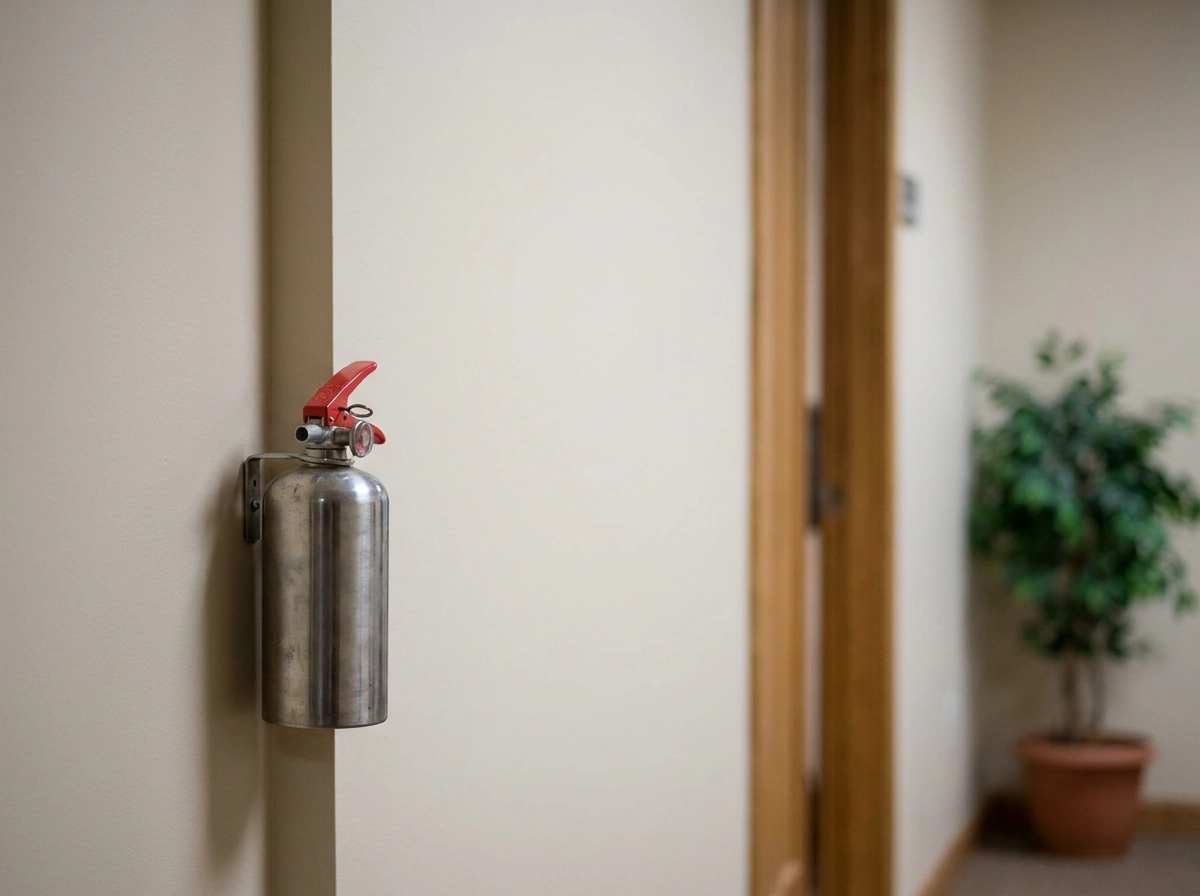
All extinguishers regardless of weight: the bottom of the unit must be at least 4 inches off the floor. Wall brackets and recessed cabinet installations must both be verified against this minimum clearance, not just the top-height limits.
The intent behind these thresholds is accessibility. Any building occupant, regardless of physical stature, must be able to reach and remove the unit quickly under stress. An extinguisher mounted even a few inches too high is a placement deficiency on its own, independent of charge status or inspection currency.
Cabinet installations require a separate verification pass. The extinguisher must remain within the applicable height limits after it is mounted inside the cabinet, not just when it sits on a bracket. The cabinet door must open fully without striking adjacent furniture, shelving, or equipment. Nothing should be stored or staged in front of the cabinet itself.
The most common source of mounting height violations is not original installation error. It is operational change: a facility remodels and installs shelving that raises the effective bracket position, or maintenance replaces an older lightweight unit with a heavier model without dropping the bracket to the 3.5-foot maximum. For government and institutional properties with stricter oversight requirements, the Government Facility Fire Extinguisher Compliance: OSHA, Cal/OSHA & NFPA 10 Requirements Explained resource covers how these height standards intersect with federal obligations.
Verify bracket height any time a unit is replaced with a different model, not only during scheduled inspections.
Fire Extinguisher Signage Requirements: Visibility and Identification Standards
Signage governs whether occupants can find an extinguisher before they try to reach it. Both are enforceable under NFPA 10 and California Title 19, § 3.29, and both generate independent citations.
Visibility is a code requirement. Extinguishers must be conspicuously located and plainly marked along normal paths of travel. If a unit is visible from the direction of approach without any supplemental aid, that satisfies the requirement. The problem is that most facilities are not static.
When Supplemental Signage Is Required
When building layout, shelving, or equipment prevents direct visibility, the code does not allow the obstruction to stand uncorrected. Instead, it requires adequate visible directional signs indicating extinguisher location. Directional arrow signs, illuminated signs, or photoluminescent markers guide occupants to the unit whenever an extinguisher is not readily visible.
This matters operationally: an extinguisher that is correctly mounted and within travel distance can still generate a citation if its signage is missing or blocked.
Signage as a Separate Deficiency
Because extinguisher visibility is a distinct code requirement from charge status and service history, an obstructed or missing sign can be noted as a deficiency alongside, or separately from, placement and height findings. Signage compliance has its own line on the inspection checklist.
Common Failures in Riverside County Facilities
Three patterns repeat across commercial and industrial properties in this region:
Post-painting removal: Signs are taken down before a paint crew works and never reinstalled.
Shelving installations: New shelving units are placed adjacent to or in front of existing signs, blocking them from view.
High-piled storage: Stacked inventory in warehouse and distribution facilities obscures both the extinguisher and its identification marker simultaneously.
For facilities with high-rack storage or multiple occupancy zones, signage should be audited on its own schedule, separate from extinguisher service visits. A charged, inspected unit hidden behind a pallet rack with no visible signage is still a cited deficiency.
How Furniture Moves, Renovations, and Equipment Additions Create Placement Violations
Signage failures often reveal a larger pattern: the facility changed, but the fire extinguisher compliance review did not. The same operational blind spot that leaves signs blocked by new shelving also leaves extinguishers stranded behind rearranged workstations and relocated equipment.
Furniture rearrangements are among the most underestimated sources of travel distance violations. Placing a large workstation cluster between an extinguisher and the far corner of an open office can push the walking path past 75 feet without moving the unit an inch. The extinguisher stays on the wall, the tag stays current, and the violation still exists on the day of an AHJ inspection.
In warehouse and manufacturing settings, the risk compounds. Adding racking systems, machinery, or industrial equipment changes both the physical travel paths and the hazard classification of specific zones. When a previously low-hazard area is reclassified by the introduction of flammable liquids, the tighter Class B travel distance requirements apply, a fundamentally different coverage grid than the space previously required. Either change, travel path or hazard class, can independently trigger a placement deficiency.
Building renovations introduce a structural version of the same problem. Adding partition walls, closing off corridors, or converting an open floor plan into private offices can split a single compliant coverage zone into two non-compliant ones, each requiring its own extinguisher. The original unit didn't move; the geometry of compliance changed around it.
Tenant improvements in multi-tenant commercial buildings are a particularly frequent source of violations in Riverside County. A new tenant's buildout may block an existing extinguisher, redirect travel paths, or introduce hazard classes not present in the prior occupancy, often without triggering any fire extinguisher placement review as part of the permit process.
The governing principle is consistent: any physical change that alters walking paths, adds obstructions, shifts storage configurations, or changes hazard levels requires placement re-verification before the change is finalized, not at the next annual inspection. Facility managers who add a placement audit step to their project checklists for moves, renovations, and equipment installations catch these violations before an AHJ inspector does.
Placement Considerations for High-Risk Occupancy Types Common in Riverside County
Those operational triggers apply across all facility types, but certain occupancies in Riverside County face structural placement challenges that go beyond what any single renovation or furniture move creates.
Industrial and warehouse occupancies commonly require Class B and Class C coverage alongside Class A, because flammable liquids and energized equipment are present throughout the work floor. At higher hazard ratings, Class B travel distance can compress to the 30-foot end of the 30-to-50-foot range, which significantly increases the number of units required per square foot compared to a standard office. Adding racking systems or processing equipment tightens those distances further.
Educational facilities, including K-12 schools and community colleges, face a different problem: frequency of change. Classrooms converted for evening programs, hallways used for seasonal storage, and gymnasium setups for events all shift walking paths and create obstructions. Facility managers should treat any classroom or corridor reconfiguration as a placement audit trigger, not just a scheduling item.
Health care and ambulatory health care facilities require accessible extinguishers even when corridors are partially narrowed by medical equipment, gurneys, or temporary staging. AHJ inspectors in these settings evaluate travel distance and unobstructed access at the same time; a unit that is technically within distance but physically blocked by a portable IV stand will still draw a citation.
Retail and mercantile occupancies are most vulnerable during seasonal inventory buildups. A holiday display positioned in front of or beside an extinguisher can block both visibility and access simultaneously, creating a temporary violation that is easy to miss during a routine walkthrough.
Apartment and residential board-and-care facilities must place extinguishers within travel distance of all common areas and at mounting heights accessible to residents who may use wheelchairs or mobility aids. Height compliance is not just a code box to check; it is a functional requirement for the actual population using the space.
Government and institutional facilities represent a substantial share of Riverside County's property base and carry dual compliance obligations. Managers overseeing state or federally owned buildings should verify whether California Title 19, applicable federal standards, or both govern placement requirements. For a detailed breakdown of how those frameworks intersect, see Government Facility Fire Extinguisher Compliance: OSHA, Cal/OSHA & NFPA 10 Requirements Explained.
A Pre-Inspection Placement Audit Checklist for Riverside County Facility Managers
Regardless of occupancy type, the same core placement variables apply across every facility. Use this checklist before each scheduled inspection, and any time a layout or operational change affects your floor plan.
Travel Distance Verification Verify travel distance does not exceed 75 ft for Class A or 30-50 ft for Class B, walk the path, don't estimate.
Mounting Height Check Confirm mounting heights against the weight-based thresholds detailed in the audit steps above, and flag any bracket adjusted during a recent remodel or unit swap.
Visibility and Signage Check Each extinguisher must be directly visible from the direction of approach or identified by an approved marker, such as a directional arrow, illuminated sign, or photoluminescent marker. Confirm the sign itself is unobstructed.
Obstruction Check No furniture, equipment, merchandise, or stored materials should occupy the clear zone in front of any unit. Cabinet doors must open fully without interference from adjacent shelving or equipment placed nearby.
Post-Change Trigger Review Identify every facility change since the last placement audit: furniture moves, new equipment, storage additions, renovations, tenant improvements. Flag every affected coverage zone for re-measurement before the next inspection, not after.
Class Match Verification Confirm the extinguisher class at each location still matches the primary hazard present. Occupancy changes and equipment additions are the most common triggers for a mismatch that goes unnoticed between inspections.
Document and Date the Audit Record each location's compliance status, measurements, and any corrective actions taken. A written or digital record demonstrates due diligence if a violation is cited between scheduled inspections. Facility managers supporting government properties can review how First Response structures compliance documentation for government clients.
When Placement Questions Require a Licensed Fire Extinguisher Professional
The pre-inspection checklist gives facility managers a solid self-audit framework, but some placement questions require more than a tape measure and a clipboard.
When a travel distance calculation lands within a few feet of the 75-foot Class A limit or the 30-to-50-foot Class B range, a field verification by a CSFM-licensed technician is the appropriate next step before an AHJ inspection. Borderline measurements that look compliant on paper can fail when an inspector traces a slightly different walking path.
Class and rating selection is where self-audits most commonly fall short. A facility manager can position a unit at a code-compliant location while installing the wrong extinguisher class for the hazard present. A placement-compliant but hazard-non-compliant installation still results in a citation. Licensed technicians evaluate the hazard, select the correct class and listed rating, and confirm the two align before a unit is ever mounted.
First Response Fire Protection Services provides placement reviews as part of its inspection and maintenance work throughout Riverside County. The company's technicians hold current OSFM certification and work regularly with the AHJ inspection standards applied across Southern California, giving them practical familiarity with how local inspectors measure and cite violations, not just how the code reads.
For renovations and buildouts that require new extinguisher locations, professional involvement before installation avoids a specific and avoidable cost: bracket relocation or cabinet reinstallation after an inspector flags incorrect placement. Getting the location, mounting height, and unit selection right the first time is consistently less expensive than correcting them post-inspection.
Facility managers overseeing government or institutional properties have an additional consideration. First Response is a certified Service-Disabled Veteran-Owned Business (SDVOB) with documented experience fulfilling state and federal contracts. When procurement compliance and fire code compliance must be satisfied simultaneously, that credential matters.
Placement Compliance Is an Operations Responsibility, Not Just an Inspection Item

A fully charged unit with a current tag can still generate a deficiency notice the moment a renovation closes off a corridor, a storage rack blocks sightlines, or a new piece of equipment extends a travel path past the code maximum. The inspection schedule did not change. The facility did.
Three habits close that gap:
Add a placement audit trigger to every facilities project checklist. Furniture moves, equipment installations, tenant improvements, and partition work all require a re-verification of travel distance, mounting height, and signage before the project is closed out, as detailed in the audit steps above.
Measure travel distance along actual walking paths, as detailed in the audit steps above, rather than estimating straight lines.
Verify mounting heights and signage independently of charge and tag status, these are separate compliance variables, each with its own citation line.
Riverside County facility managers who internalize NFPA 10 and Title 19 as spatial standards, not just a service calendar, are the ones who walk out of AHJ inspections without deficiency notices. The rules governing travel distance, mounting height, and visibility do not reset when a technician signs the tag; they reset every time the facility changes.
When a layout change leaves coverage in question, consult a CSFM-licensed professional before the AHJ visit. A proactive placement review is a routine line item. Emergency corrective work following a cited deficiency is not.
Conclusion
Fire extinguisher compliance in Riverside County comes down to four fundamentals: correct travel distance, proper mounting height, visible signage, and consistent re-verification whenever a facility changes. Placement violations drive AHJ deficiencies because facilities evolve while compliance awareness often does not.
The facility managers who pass inspections without citations treat NFPA 10 and Title 19 as spatial standards embedded into daily operations. They audit after renovations, measure walking paths instead of estimating straight lines, and verify signage and height separately from service records.
Start today by adding a placement audit trigger to every upcoming facilities project. If a layout change raises coverage questions, schedule a review with a CSFM-licensed professional before your next AHJ visit. Proactive compliance protects occupants, avoids costly corrective work, and keeps your facility running without interruption.