What Fire Extinguisher Service Means in California?
In California, a fire extinguisher mounted on the wall is not automatically a compliant one. The Office of the State Fire Marshal licenses and certifies the portable extinguishers serviced and sold here, and Title 8 requires monthly inspections plus service at least once a year by a licensed or registered professional. Miss a step, and a routine audit becomes a citation.
That is why fire extinguisher service in California is a defined, regulated process rather than a paper trail. Service and inspection are legally distinct tasks, licensing applies per business location, and technicians must pass a written exam and maintain approved equipment before they can register with the state. Placement rules, recordkeeping requirements, and 6-year and 12-year maintenance milestones all shape how your program should run.
This tutorial walks you through each of those areas: who may legally service extinguishers, how often inspection and service are required, placement rules that affect your plan, the records auditors ask for, what happens during a professional visit, how to evaluate a licensed provider, and a closing compliance checklist you can act on.
Service and Inspection Are Not the Same Thing
California's Title 8 regulations define "service" and "inspection" as two separate acts, and the distinction matters at audit time.
Service, as the Office of the State Fire Marshal (OSFM) defines it, covers charging, recharging, inspecting, repairing, and hydrostatic testing of portable extinguishers. Inspection is the narrower task: a quick check that the unit sits in its assigned place, has not been actuated or tampered with, and shows no obvious damage.
That gap drives who may legally do the work. Monthly checks fall into the quick-check category; the regulation requires them at least monthly but does not specify who within the organization may perform them. Anything California calls service must be handled by a State Fire Marshal-licensed or registered person.
Many vendors blur the words on tags and invoices. Ask two questions of any paperwork: what work was performed, and who performed it?
Confusion here is expensive. A building can show twelve months of documented inspections with no annual service, and annual service is the first record an inspector or insurer requests. See Inspection vs. Service: Two Different Things Under California Law for how these obligations diverge in practice.
Who Is Legally Allowed to Service Extinguishers in California
California's Office of the State Fire Marshal (OSFM) is the licensing and certification authority for portable extinguishers serviced and sold in the state. Units must meet the standards of an OSFM-approved testing laboratory and carry that lab's label.
Servicing for a fee requires a concern license. Each business location needs its own application rather than one company-wide approval.
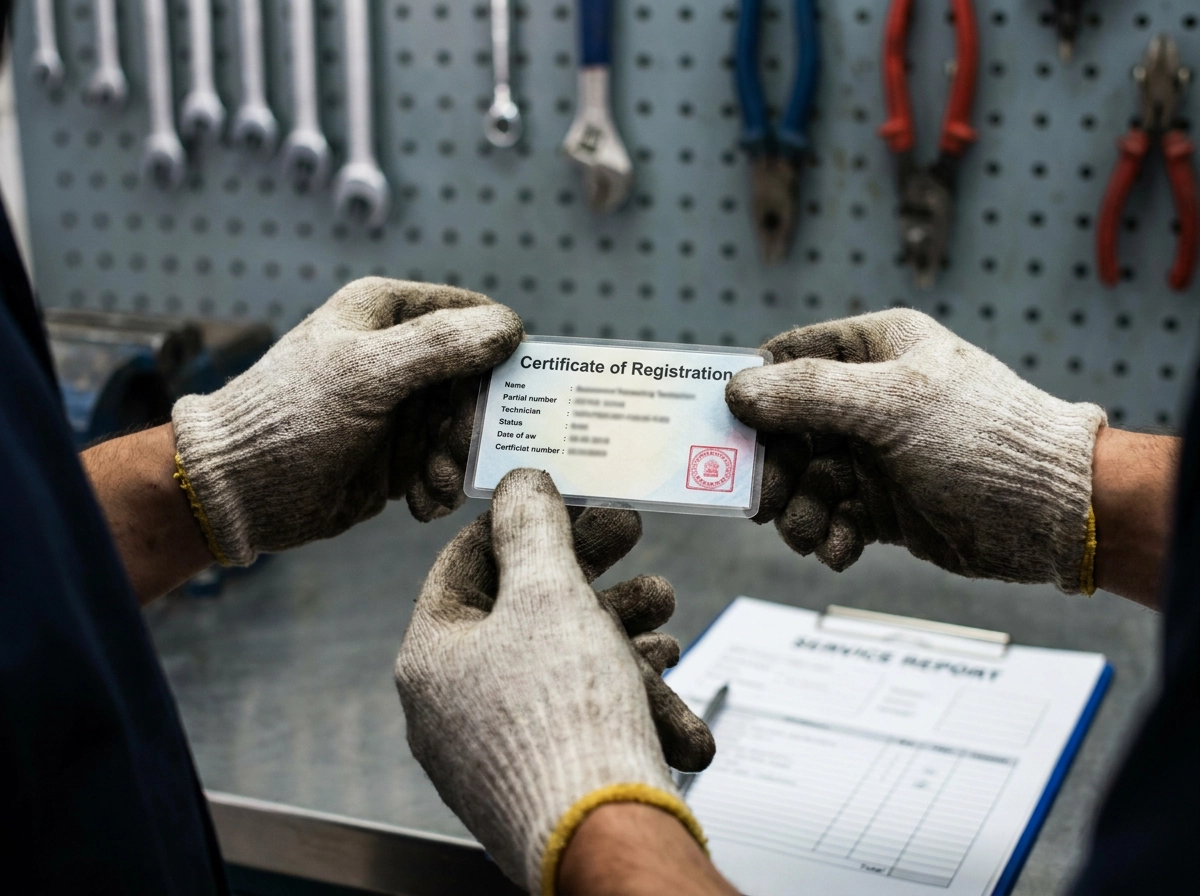
Technicians are registered individually. Before OSFM issues a Certificate of Registration, a technician must pass a written exam, document experience, and maintain adequate testing equipment and replacement parts inventory.
That pairing, a licensed concern staffed by registered technicians, is what separates a compliant provider from a general handyman or maintenance crew.
Verify before you hire: request the license and registration details. As a practical verification step, though not a stated regulatory requirement in the sources reviewed, confirm that the address on the concern license corresponds to the service location. Our guide on how to evaluate a fire extinguisher maintenance provider walks through the questions worth asking.
How Often Extinguishers Need Inspection and Service
Now that the licensing question is settled, frequency is next. Under Title 8 Section 1922, portable extinguishers must be inspected monthly, or at more frequent intervals, and serviced at least annually by a person licensed or registered by the State Fire Marshal.
The monthly check is the quick-check described earlier, placement, no tampering, no obvious damage.
Annual service is the deeper event, covering the charging, recharging, and repair work that keeps the unit functional. Extinguisher models and ratings influence how that work is scheduled, which is worth reviewing in OSHA requirements and service intervals your extinguisher program cannot skip.
One practical recommendation: as a practical matter, a used, discharged, or obviously damaged extinguisher should be recharged or replaced as soon as possible, do not wait until the next scheduled visit.
Regulatory text is revised over time. The OSFM laws-and-regulations PDF carries a 2022 revision label, and the DIR page includes a currency disclaimer, so verify the version in force for 2026 before quoting an interval in a compliance policy.
Placement Rules That Shape Your Service Plan
Frequency is only half the compliance picture. Placement determines whether a unit is actually reachable during a fire, and it is the first thing a technician verifies.
Under California's Title 8 construction safety orders, each floor needs at least one 2A-rated extinguisher, one per 3,000 square feet or fraction, and no point on the floor should be more than 75 feet from a unit. In multi-story buildings, at least one 2A must sit adjacent to each stairway at every floor level. Where more than 5 gallons of flammable liquids or 5 pounds of flammable gas are in use, a 10B-rated unit must be within 50 feet. General occupancies follow applicable placement standards, so confirm which standard governs your building.
Walkthroughs and audits routinely surface a missing unit, a blocked cabinet, or a rating that does not match the hazard. The annual service visit is the practical time to correct those gaps.
Keep a simple floor plan marking each unit's location and rating. The technician then verifies travel distance without hunting for each extinguisher.
Records You Must Keep and Why Auditors Ask for Them
A floor plan answers placement questions. Records answer the next one: how do you know?
Under 19 CCR 574.5, owners must maintain records of all extinguishers inspected, including those found to require corrective action, and retain them until the next required maintenance. That retention window is tied to the next service event, not a fixed number of years.
The publicly posted text of that section is truncated mid-sentence in subsection (b), which covers monthly inspection dating. Confirm the full current requirement through OSFM's Title 19 development page before locking in a log format.
While the regulation does not specify a format, a practical log might capture five elements: the date, the initials of the person checking, the unit identifier and location, the condition observed, and any action taken. Apply the same elements to monthly checks and annual service visits so both align with fire extinguisher inspection requirements for documentation.
Those records are what you produce when a fire inspector, insurer, or internal auditor asks how compliance has been demonstrated.
Ask your provider what documentation they leave behind after a service visit, and whether it maps cleanly to the corrective-action items already in your log.
Why This Matters for Property Managers, School Districts, and Public Agencies
Good records only protect you if someone is actually servicing the units on schedule. OSHA 1910.157 places responsibility for inspection, maintenance, and testing on the employer; while the research does not explicitly address whether contracting transfers that duty, the regulatory structure suggests the obligation remains with the building owner or employer.
Each of your buildings is a separate covered workplace, so maintain a distinct set of service records, tags, and scheduled dates for each location.
Collect OSFM concern license and technician registration details before the first work order. Our guide to set-aside certifications for government buildings explains how procurement considerations play out in practice.
Finally, put monthly checks and annual service on one calendar with one provider for the whole portfolio. Fragmented scheduling is how a unit quietly goes years without service. With ownership and scheduling settled, the next question is what else that calendar has to hold.
Beyond Annual Service: 6-Year and 12-Year Milestones
Annual service is only one tier of the schedule. First Response Fire Protection Services performs 6-year maintenance teardowns and 12-year hydrostatic testing alongside its annual inspections.
For nonrechargeable units, the removal-from-service date is tied to the manufacture date; for rechargeable units, the 6-year and 12-year clocks reset with each maintenance event or hydrostatic test, so verify the service history and label rather than assuming a unit is current. Hydrostatic intervals also differ by extinguisher type, so verify the applicable interval against current NFPA 10 or OSFM guidance rather than relying on a general rule of thumb.
Plan for downtime. Testing takes a unit out of service for a period, so the space needs coverage in the meantime, whether with a spare unit on hand or a temporary swap. Hypothetically, if the only 10B-rated unit in a solvent storage room goes out for testing, that room sits unprotected until it returns.
What Happens During a Professional Service Visit
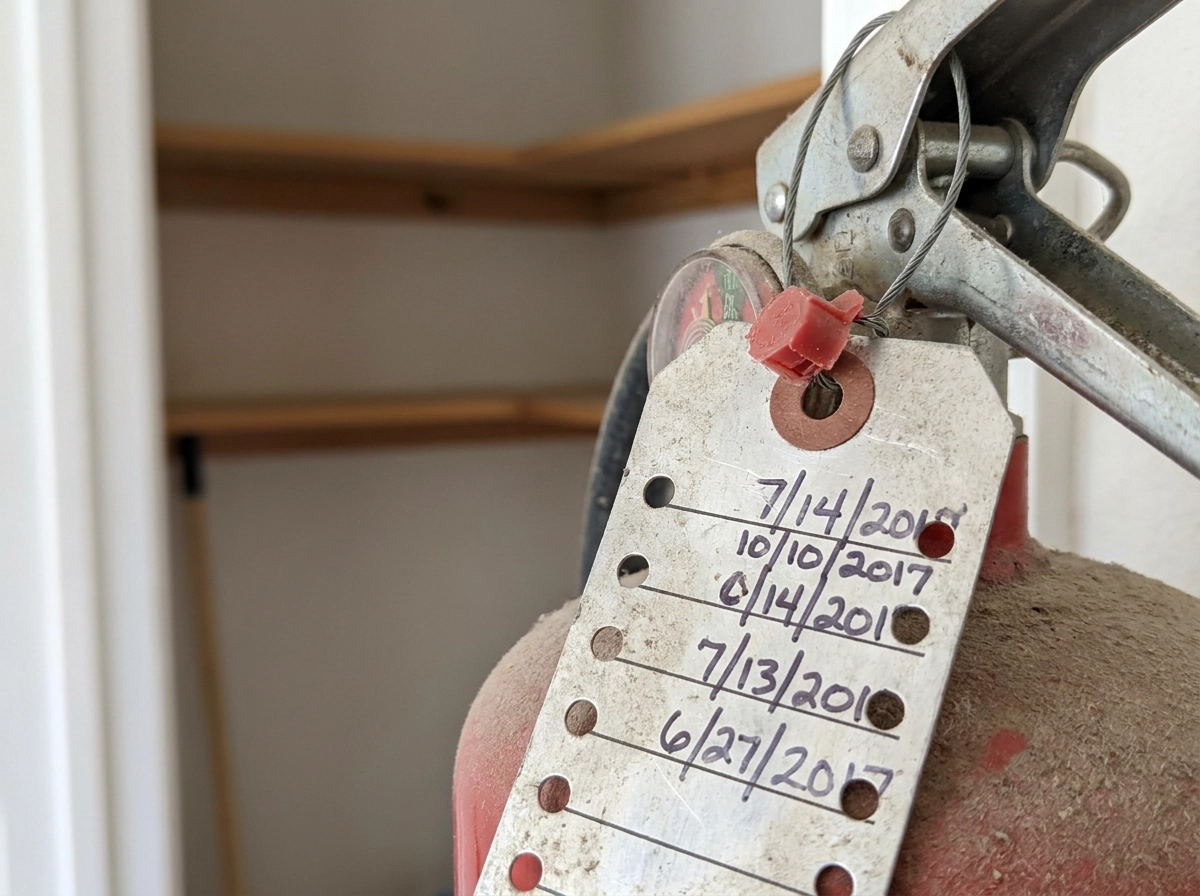
Examining the tag and date stamp only tells you what is due. The visit itself is where documentation meets the physical unit.
Preparation shortens the visit. Pull together your unit list, the previous tags and inspection logs, and a floor plan showing where each extinguisher is mounted. With that in hand, the technician can verify placement and travel distance instead of hunting for units.
Based on standard professional practice (verify against NFPA 10 and applicable OSHA requirements for your jurisdiction), a technician typically checks: the pressure gauge, pull pin and tamper seal, hose, nozzle, and label, then looks for corrosion, dents, and blocked access. Failed units are tagged for corrective action and remain open in your records until resolved, as covered in the Records section.
Clear obstructions before the technician arrives. Keeping cabinets accessible is the building's responsibility, not the service provider's, so assign it to a named staff member.
Before the technician leaves, request the documentation you will file and set the next service date. To know what to have ready beforehand, read What to Do Before Your Next Annual Inspection.
How to Choose a Licensed Fire Extinguisher Service Provider
Once your service report is filed, the next decision is who performs the next visit. Confirm the provider holds an OSFM concern license (per location) and that each technician carries a current Certificate of Registration.
Match scope to your equipment. Annual inspections, recharging, 6-year maintenance teardowns, 12-year hydrostatic testing, and equipment sales from one business mean one point of contact and one set of records. OSFM expects a servicing operation to maintain adequate testing equipment and parts inventory, so ask what the provider keeps on hand and how quickly a failed unit can be returned to service.
Your Compliance Checklist and Next Steps
Turn the guidance above into a written checklist, and treat monthly inspection and annual service as two separate calendar items. A hypothetical example: a facility manager logs a monthly visual check and books the licensed annual visit for the same fixed week each year, so neither task depends on memory.
Keep records on site until the next required maintenance, including open corrective-action items, so an audit request always has an answer. Maintain records as described above.
Before the annual visit, confirm the provider's OSFM concern license and current OSFM technician registration, then match the scope of work to the equipment you own. Recharging and hydrostatic intervals vary by extinguisher type, so the work order should list every model on site.
Use the visit to close placement gaps: at least one 2A-rated unit per floor within 75 feet of travel, one adjacent to each stairway in multi-story buildings, and a 10B-rated unit within 50 feet of flammable liquid or gas use.
Before the technician leaves, set the next service date in writing and record the 6-year and 12-year milestones from each unit's label.
Conclusion
The four compliance habits covered above, separate inspection and service, licensed providers, correct placement and intervals, and audit-ready records, protect both people and buildings. Your next step is simple: schedule service, confirm the provider's OSFM concern license and current OSFM technician registration, and set the next visit in writing before the technician leaves. First Response Fire Protection Services can help you turn a checklist into a safer, audit-ready facility. Take action today.