How to Read a Fire Extinguisher Inspection Report: What Every Line Item Means for Your Compliance Record
Most facility managers treat a completed fire extinguisher inspection report the way they treat a receipt: glance at it, file it, and move on. That approach works fine until an Authority Having Jurisdiction auditor walks through the door and asks you to demonstrate a defensible compliance record. Suddenly, a document you never learned to read becomes the centerpiece of a very uncomfortable conversation.
The truth is, every line on a properly completed NFPA 10 inspection report carries specific meaning. Pressure gauge readings, agent weight documentation, deficiency codes, and maintenance notations are not administrative filler. Each one drives real decisions about re-inspection timing, corrective action deadlines, and your overall compliance posture. Understanding how to work through a fire extinguisher inspection checklist the right way transforms that passive document into an active management tool.
In this tutorial, you will learn exactly what NFPA 10 requires every report to capture, how to interpret pass/fail findings and condition observations, what the numbers on pressure gauges actually mean, and which report elements AHJ inspectors examine first. By the end, you will have the knowledge to verify technician thoroughness and protect your facility with confidence.
Why Your Inspection Report Is a Compliance Tool, Not a Receipt
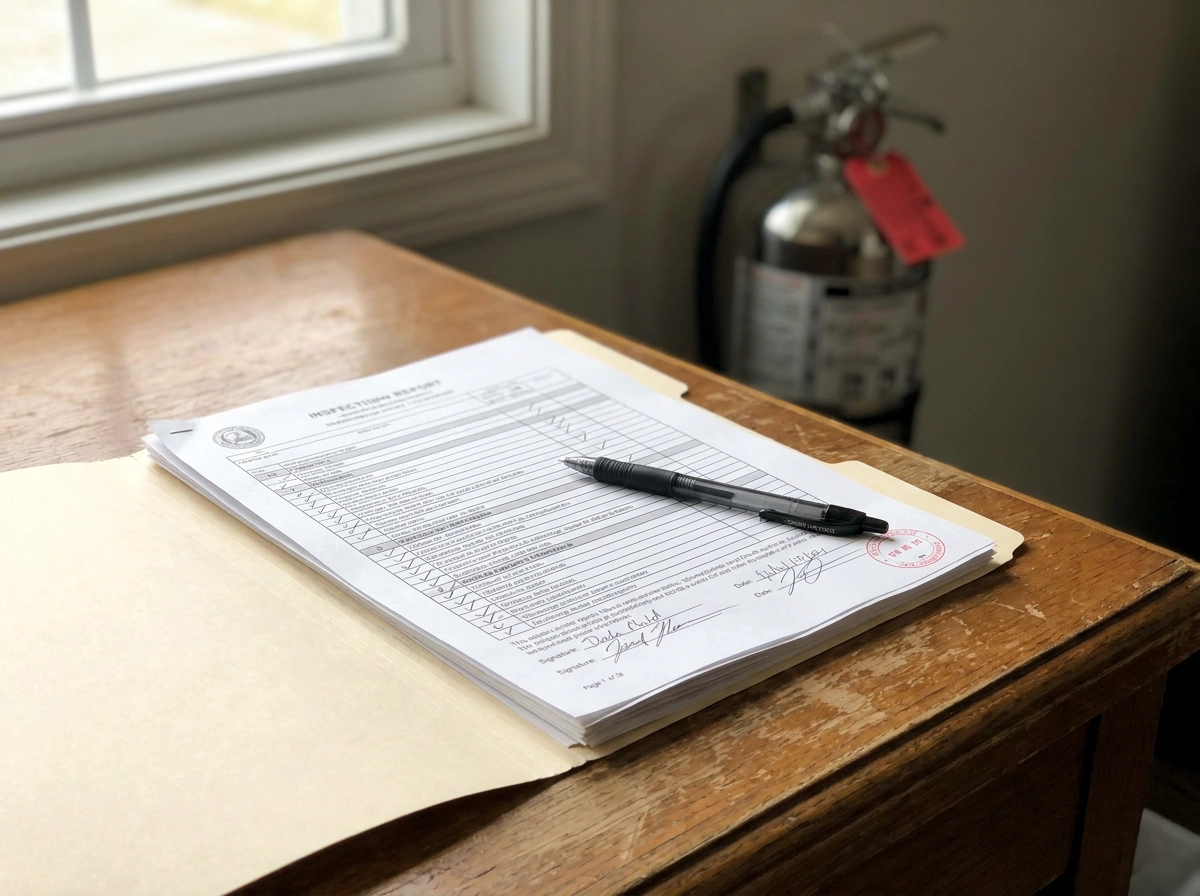
When your fire extinguisher service provider hands you an inspection report, it may feel like a receipt confirming work was done. It is not. Under NFPA 10, that document is a formal compliance record, one that an Authority Having Jurisdiction (AHJ) can demand and audit at any time. If the record is incomplete, inaccurate, or unread, the legal exposure falls on the facility, not the technician who filled it out.
The inspection frequency requirements reinforce this point. NFPA 10: The Technical Standard That Sets the Inspection Floor establishes the baseline obligations, but NFPA 1, Section 13.6.4 mandates monthly fire extinguisher inspections on top of the annual service cycle. That means your facility should be accumulating a new documented record every single month, twelve times per year, for every extinguisher on the property.
Accountability for those records sits with the property owner or designated facility manager, not the service provider. The technician's obligation ends when the inspection is completed and documented. Your obligation, as the responsible party, begins the moment that report enters your files. Government Facility Fire Extinguisher Compliance: OSHA, Cal/OSHA & NFPA 10 Requirements Explained covers the layered regulatory framework in detail, including how federal and state requirements assign record-keeping responsibility to the facility.
A facility manager who reads each report actively can verify that the certified technician completed every required check on the fire extinguisher inspection checklist, identify any deferred maintenance items before they become violations, and catch service gaps while there is still time to correct them.
The alternative is a silent compliance failure. A deferred weight check or an unresolved deficiency notation sitting in an unread file does not disappear. It waits. When an AHJ auditor arrives, that open item becomes a citation, regardless of whether a service visit occurred on schedule. The report was there. Nobody acted on what it said.
What NFPA 10 Requires Every Inspection Report to Document
Knowing your report exists isn't the same as knowing what it must contain. NFPA 10: The Technical Standard That Sets the Inspection Floor draws a precise boundary that shapes everything on your report: Chapter 6 covers installation requirements; Chapter 7 governs ongoing inspection and maintenance obligations. When an AHJ issues a compliance citation for a fire extinguisher already in service, it cites Chapter 7 provisions, not Chapter 6. A service provider documenting to the wrong chapter, or mixing the two, produces a report that can fail an audit even when the physical work was performed correctly.
What a Compliant Report Must Include
A properly completed report documents, at minimum:
Pass/fail status for the overall inspection
Condition observations noting the physical state of each unit
Agent weight or pressure gauge reading, depending on extinguisher type
Service tag notation confirming what service was performed
Technician certification, verifying the inspector holds current credentials
Maintenance deferrals, identifying any items scheduled for a future service interval
Missing any of these fields creates a gap in your fire extinguisher inspection checklist record that an AHJ can treat as an incomplete inspection, regardless of whether the technician physically completed the work.
Electronic Recordkeeping vs. Electronic Remote Monitoring
NFPA 10 draws a meaningful distinction here that many facility managers overlook. Electronic recordkeeping means storing inspection records digitally rather than on paper. Electronic remote monitoring involves a wired or wireless system communicating real-time status from each extinguisher to a central monitoring point; consult your AHJ for any interval implications specific to your jurisdiction.
A digital PDF of your inspection report carries exactly the same NFPA 10 obligations as a paper one. The format of the record does not change what must be documented or how often inspections must occur. If a provider suggests otherwise, that is a compliance red flag worth addressing before your next AHJ review.
Pass/Fail Status and Condition Observations: Reading Beyond the Checkbox
A passing overall status does not mean every observed condition is satisfactory. Technicians record condition observations separately from the pass/fail determination, and a unit can pass the current cycle while carrying notations that signal a developing problem. Those observations are where the real diagnostic value lives.
Common condition observation categories on a compliant fire extinguisher inspection list include:
Physical damage: dents, corrosion, and paint degradation that can compromise cylinder integrity over time
Pull pin and tamper seal integrity: a missing or broken seal indicates possible discharge or tampering, even if pressure reads normal
Label legibility: an unreadable operating label is an NFPA 10 identification failure, not a cosmetic issue
Mounting bracket condition: loose or corroded hardware is a physical hazard independent of the extinguisher's charge status
Pay close attention to notations like "monitor for next cycle" or "noted, no action required at this time." These phrases mean the technician documented an observation but did not escalate it to a deficiency. That distinction matters: the item is now part of the record, and if it recurs or worsens, an AHJ may ask why corrective action was not taken sooner. Treat these notations as scheduled follow-up items, not clearances.
Blank condition observation fields are a separate problem. A technician who leaves those fields empty on an otherwise passing report may have skipped required checklist items entirely. The extinguisher may be functional, but your compliance record now has a documentation gap, and documentation gaps are what AHJ audits expose.
Finally, read reports longitudinally, not in isolation. When the same observation appears on two or three consecutive cycles, that pattern suggests the unit is trending toward a maintenance interval or nearing end of service life. Reviewing how monthly visual inspections feed into the annual record makes this trend-tracking practical rather than burdensome.
Pressure Gauge Readings: What the Numbers and Zones Mean by Extinguisher Type
Stored-pressure extinguishers are the most common type in commercial facilities. They use an analog gauge with a color-coded dial, where the green zone indicates an adequate charge within the manufacturer-specified operating pressure range. A needle in the green zone confirms an adequate charge; it does not tell you the exact pressure. Your inspection report should record a specific numeric reading, not just "in green." A technician who writes only "gauge OK" has given you information that cannot be compared across inspection cycles or defended in an AHJ audit.
CO2 extinguishers require agent weight verification rather than gauge reading. Confirm your report documents weight, not only gauge status, for these units. A report that documents gauge status for a CO2 unit but omits weight measurements is incomplete under NFPA 10. The gauge-type notation on your report must match the extinguisher type; if it does not, the technician applied the wrong verification method.
Dry chemical extinguishers introduce a separate risk. A gauge can read green even when the powder inside has settled into a compacted mass or absorbed moisture, both of which render the agent ineffective. Pressure and agent condition are independent variables. This is why NFPA 10 requires periodic internal maintenance at defined intervals; confirm with your service provider which interval applies to your extinguisher types. For context on why agent type matters beyond pressure, see why choosing the wrong fire extinguisher class is a code violation, and a hazard.
A red-zone reading, whether overcharged or undercharged, is an automatic deficiency. The unit must be removed from service immediately, and the report must document the specific reading, the corrective action taken, and the re-inspection result. A report that flags a red-zone reading but shows no corrective action entry is an open deficiency in your compliance record.
When reviewing your fire extinguisher inspection checklist, confirm that every pressure entry is a specific value and that the verification method recorded matches the extinguisher type on that line item.

Agent Weight Documentation: Why This Line Item Is Non-Negotiable
For CO2 extinguishers, weight is the only reliable charge verification method since these units carry no pressure gauge capable of confirming actual agent content. Certain dry chemical extinguishers also rely on weight as the definitive charge check. A compliant report should record actual weight figures, not just a pass/fail notation, so any loss is visible and comparable across inspection cycles.
Why "weight acceptable" is an incomplete notation. NFPA 10 establishes a tolerance threshold; a report that reads only "weight acceptable" without actual figures prevents you from verifying that threshold was met. Without documented figures, you cannot verify the technician's conclusion or establish a baseline for future comparison.
Trend detection requires multiple cycles. A single weight entry confirms the unit's status on one inspection date. Gradual loss of even a few ounces per year, caused by slow valve seepage, a micro-leak, or improper storage, will not trigger an immediate failure but will compound across inspection cycles. Comparing documented weights from consecutive annual reports is the only way to catch this pattern before the unit crosses the recharge threshold mid-cycle.
For clean agent extinguishers, weight documentation is especially critical. These agents leave no visible residue after a partial discharge; consult manufacturer guidance for the specific verification method required. There is no visible cue to fall back on.
When auditing your fire extinguisher inspection list, confirm that every CO2 and clean agent unit carries a weight entry with actual figures, not a status notation. Facilities with government contracts, where documentation standards are scrutinized closely, should treat this as a minimum threshold. For more on how rigorous documentation supports those environments, see what we offer government clients.
Deficiency Codes and Corrective Action Notations: How to Decode What Went Wrong
Understanding the difference between deficiency categories is the first step in reading this section of your report accurately.
In practice, deficiency notations can be grouped by urgency:
Immediate hazards: The unit must be removed from service. No grace period applies.
Maintenance items: Corrective action is required before the next scheduled inspection cycle.
Monitoring items: The condition is documented and reassessed at the next visit.
Common codes and what they require:
Accessibility obstruction: Prevents the extinguisher from being reached in an emergency; address it before the next inspection cycle rather than deferring it.
Pressure out of range: Unit is removed from service and recharged or replaced before it counts toward required coverage.
Missing or broken tamper seal: Signals possible discharge or tampering; requires internal inspection before the extinguisher returns to service.
Illegible label: Fails NFPA 10 identification requirements; the unit must be relabeled or replaced.
The incomplete report problem
A deficiency code without a corresponding corrective action notation is not a minor paperwork gap. It is an open deficiency on your compliance record. If an AHJ auditor sees a flagged condition with no documented resolution, the inspection visit does not close that finding. The facility owns the liability, regardless of when the technician was on site. Every deficiency code must be paired with a notation stating what was done, by whom, and when.
Deferrals are not deficiencies
A deferral notation indicates the unit is currently compliant but is approaching a service interval, such as an upcoming internal maintenance date. Deferrals should be tracked forward into subsequent reports and matched against your maintenance schedule. Treating a deferral as a resolved item is a recordkeeping mistake that surfaces as a lapsed interval during an audit.
Cross-referencing your fire extinguisher inspection checklist against every deficiency code confirms that each flagged item received documented resolution, not just acknowledgment.
Service Tags, Certification Numbers, and the Fire Extinguisher Inspection Certification Requirement
Beyond deficiency codes, the physical service tag attached to each extinguisher functions as a compact compliance certificate. Under NFPA 10, every tag must document the inspection date and type of service performed. California OSFM regulations impose additional technician credentialing requirements; verify your provider's compliance with your state's licensing authority.
In California, technicians must meet state licensing requirements; First Response technicians hold current OSFM certification. Verifying that the technician who serviced your equipment holds an active, legitimate license closes one of the most overlooked gaps in a facility's compliance record.
The tag also encodes the unit's full service history through punch-outs or printed notations:
Annual inspection notation confirms an external visual and functional check was completed. It does not indicate the extinguisher was opened or internally examined.
6-year maintenance punch confirms the unit was disassembled, internally inspected, cleaned, and reassembled. First Response performs this 6-year internal maintenance as part of its scheduled service program. This is a fundamentally different scope of work than an annual inspection, and the two are not interchangeable.
12-year hydrostatic test date identifies when the cylinder pressure vessel was last tested to manufacturer specifications. A cylinder whose hydrostatic test interval has lapsed should be flagged with your provider to determine whether it may remain in service, regardless of what the pressure gauge currently reads.
If any of those dates are missing from the tag, the corresponding service has either not been performed or was not documented, and both outcomes represent a compliance gap.
Finally, hold the tag next to the written inspection report and compare them line by line. The service type, date, and technician information should match exactly. Discrepancies between the two documents indicate either a documentation error or a service that was recorded but not performed. Either scenario warrants a direct follow-up with your provider before the next AHJ audit.
Re-Inspection Timing: How Deficiency Severity Drives Your Next Service Date
NFPA 10 does not establish a single universal re-inspection interval. The timing of the next required service visit depends on what type of deficiency was identified, what service was performed during the visit, and the specific extinguisher type involved. Stored-pressure, CO2, and pressurized water units each carry different documentation and servicing requirements, so re-inspection logic is not interchangeable across your inventory.
Immediate hazards reset the clock differently than routine maintenance. A pressure reading outside the acceptable range, visible cylinder damage, or a missing discharge mechanism component triggers removal from service immediately. There is no grace period. More critically, a unit pulled from service cannot count toward your facility's required extinguisher coverage while it is out. That coverage gap exists from the moment the unit is removed until it is inspected, corrected, and returned to service. Your report should document both the removal date and the return-to-service date.
Scheduled maintenance intervals follow a defined reset logic. Track the 6-year maintenance date from the service record itself, not the manufacture date; confirm the specific reset logic with your certified provider. A report documenting completed internal maintenance effectively restarts the compliance clock for that unit from that service date forward.
Annual inspections and monthly inspections are separate documentation obligations. Annual inspection records document the 12-month service cycle required under NFPA 10. However, because NFPA 10 requires inspections at intervals not exceeding 31 days, monthly records must exist independently of the annual report. Both must exist independently in your compliance file.
Facility managers who internalize this timing logic can build a forward-looking maintenance calendar directly from their inspection reports, which converts a passive document into an active scheduling tool.
AHJ Audit Readiness: Which Report Elements Inspectors Look for First
AHJ audits begin with paperwork, not extinguishers. When an inspector from the Authority Having Jurisdiction arrives, the first request is typically your inspection records, not a walkthrough of the building. The completeness of your documentation is your initial line of defense, and gaps in the record become findings before a single extinguisher is touched.
What AHJ Inspectors Check First
Inspectors prioritize four elements when reviewing fire extinguisher inspection reports:
Technician certification. If certification cannot be verified against an active registration, the inspection itself may be considered non-compliant.
Inspection date continuity. Auditors look for an unbroken sequence of monthly and annual records. A single missed month is a gap, not a technicality.
Open deficiency status. Any deficiency notation without a documented corrective action represents an unresolved compliance failure on the record, regardless of the unit's current physical condition.
Tag-to-report consistency. The physical service tag and the written report must agree. Discrepancies signal either incomplete service or documentation errors, both of which draw scrutiny.
The Monthly Record Gap Problem
Because NFPA 10 requires inspections at intervals not exceeding 31 days, monthly records must exist independently of the annual report. A facility that produced a thorough annual report but cannot show monthly interval records for the intervening eleven months has an incomplete compliance record.
First Response provides NFPA 10-compliant documentation on every service visit, including technician certification information and complete field entries. Having a CSFM-licensed, OSFM-certified provider on file strengthens the credibility of your audit record from the first page forward.
Building a Defensible Compliance Record From Your Inspection Reports
A defensible compliance record is not a single report. It is a continuous, organized body of documentation proving unbroken inspection coverage, resolved deficiencies, and completed maintenance intervals across every extinguisher in the building.
File by unit, not by date. Use each extinguisher's ID number or location code as the primary filing key. When records are sorted chronologically, a gap for a single unit can hide in plain sight. When records are sorted by unit, any missing inspection cycle or unresolved open deficiency becomes immediately visible.
Cross-reference intervals, not just dates. Annual inspections being current does not mean the facility is fully compliant. The internal maintenance and hydrostatic test cycles are independent obligations. A lapsed hydrostatic interval is a standalone compliance failure regardless of how recently the extinguisher passed its annual check. Pull the service history for each unit and confirm both interval clocks are running on schedule.
Retain records for the full required period. Record retention requirements vary by jurisdiction; confirm the applicable period with your AHJ or service provider, and retain at minimum the full service history for maintenance and hydrostatic work. For a single cylinder, that hydrostatic record can represent more than a decade of documentation. Discarding older records to save storage space can eliminate the only evidence that a required interval was met.
Close gaps before an audit opens them. If any report in your file is missing required field entries, carries an unresolved deficiency notation, or lacks technician certification information, contact your service provider now. Those incomplete records represent open compliance liabilities. Correcting them proactively, while there is time to obtain supplemental documentation or schedule a follow-up visit, is categorically different from trying to reconstruct a paper trail after an AHJ inspector is already on site.
Digital records are acceptable provided they are organized, retrievable, and complete. Switching to electronic storage does not correct missing data fields or undocumented deficiency resolutions. The compliance gap exists in the content, not the format.
From Passive Document to Active Compliance Tool
Once your compliance record is organized and current, the final step is committing to the habit that keeps it that way: reading every report you receive, not filing it unread.
Report literacy is a facility management competency, not a technical specialty. You do not need a fire protection license to verify that required fields are complete, that a deficiency notation has a corresponding corrective action, or that the technician's certification information appears on the tag. What you do need is the discipline to check. An unread report can conceal an open deficiency, a missing weight entry, or a lapsed maintenance interval, and any of those gaps can become an AHJ citation regardless of whether a service visit occurred on schedule.
On every report, confirm these five items before filing:
Pass/fail status with condition observations (not just the overall result)
Pressure gauge reading or agent weight, matched to the correct verification method for that extinguisher type
Deficiency codes paired with documented corrective actions, with no open items left unresolved
Service tag entries that match the written report
Technician certification information, current and legible
If your current reports have gaps, missing field entries, or unresolved notations, First Response Fire Protection Services can help you assess where your record stands. We provide NFPA 10-compliant inspection, maintenance, and recharging services throughout Southern California, with CSFM-licensed, OSFM-certified technicians and complete documentation on every visit. Contact us to review your compliance record and schedule your next inspection.
Conclusion
Reading a fire extinguisher inspection report is a compliance skill, not a formality. Every field entry, from pressure readings and agent weights to deficiency codes and certification information, tells you something specific about your facility's risk exposure and legal standing under NFPA 10.
The key takeaways are straightforward: verify pass/fail status with supporting observations, confirm the correct verification method was applied to each extinguisher type, ensure every deficiency has a documented corrective action, and track your reports longitudinally to see the full picture of your compliance record.
A single overlooked line item can turn a completed service visit into an AHJ citation. You now have the knowledge to prevent that.