How to Read a Fire Extinguisher Label Before You Buy
Before you compare price tags, compare labels. A fire extinguisher can look ready for service and still be the wrong unit for the hazard, the wrong size for the operator, or the wrong class for a commercial kitchen, electrical room, or warehouse. The label carries the facts that marketing copy often blurs. It tells you the fire extinguisher ratings, the agent, whether the unit is rechargeable, and which listing marks apply. In this buyer's guide, you will learn why the label is the document that matters, what the four fire classes mean, and what a rating number actually measures. Then we decode a string such as 2A:10B:C piece by piece: the number before A, the number before B, why C has no number, and why Class D depends on the nameplate. You will also see where agent codes and rechargeable status appear, how UL, ULC, and FM listing marks affect commercial buying, and how to compare two quotes by rating first, listing second, and price last. The goal is simple: confirm the standard and the requirement before you sign.
Why the Label, Not the Brochure, Is the Document That Matters
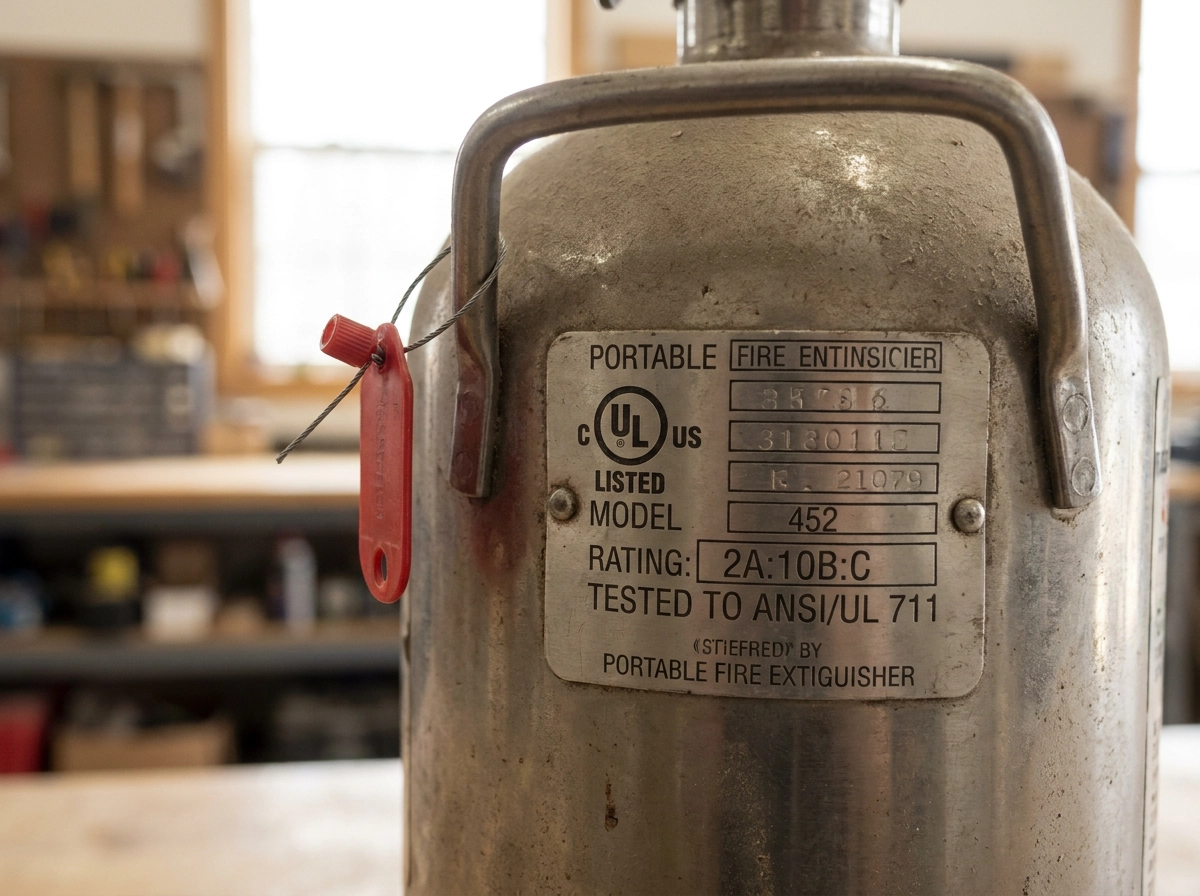
Brochures sell color, cabinet style, and price. The nameplate states what the unit was tested to do, and that tested rating is the only apples-to-apples comparison between two units on a quote sheet.
Portable extinguishers sold in the U.S. are rated through standardized fire tests, so a string like 2A:10B:C means the same thing across brands and models. Two units priced identically can still differ in rating, agent, and service life: one rechargeable, one disposable. Price alone can lock a facility into a replacement cycle.
For property managers, school districts, and government buyers, the label is also what an inspector or authority having jurisdiction (AHJ) reads, not the sales literature. This guide walks the nameplate in the order that matters: rating string, agent code, rechargeable status, then listing marks. For a preview of the buying decisions that follow, see Takeaways: What to Do Before You Buy Another Extinguisher.
The Four Fire Classes Behind Every Rating
The letters in a rating string map to four hazard classes.
Class A: ordinary combustibles, including wood, paper, cloth, cardboard, and trash. Most office, classroom, and storage fires are Class A until something else joins in. See our guide to Class A extinguishers.
Class B: flammable liquids and gases such as gasoline, paint thinner, solvents, cooking oil, and grease. Garages, shops, and commercial kitchens carry the heaviest Class B load.
Class C: energized electrical equipment. The C describes neither size nor capacity; it confirms the agent is nonconductive for use while power is still on.
Class D: combustible metals such as magnesium, titanium, and sodium, which need a specialized agent and are handled separately from the other three.
Match the label's letters to the materials actually in the space. An absent class wastes money; a missing one is an uncovered hazard.
What a Rating Number Actually Measures
The fire extinguisher classes printed on a label tell you what a unit may be used on; the numbers tell you how much fire it was tested to handle. Those numbers come from standardized fire tests, not from tank size, agent weight, or service life. The A number works on a water-equivalency scale (covered in the next section); the B reflects tested flammable-liquid coverage; C is a yes-or-no suitability mark; D is described on the nameplate. Higher ratings tend to mean heavier units, and a model an operator cannot lift and aim is a rating that never gets used.
Decoding a Rating String Like 2A:10B:C
Read the string left to right. Each segment reflects one fire class the manufacturer tested and listed, so a 2A:10B:C unit is not automatically an ABC unit until all three letters appear. A colon, dash, or line break separates the A segment from the B segment; letters after it show additional classes. A missing class letter is a disqualifier: a 10B:C unit was not rated for Class A materials, no matter how large the tank looks. When a seller advertises an ABC rated fire extinguisher, confirm the letters and numbers on the nameplate match, not the slogan. After decoding, check the pressure gauge readings by extinguisher type to confirm the unit is charged.
The Number Before the A
The number ahead of each A (2A, 4A, 6A) describes tested effectiveness on ordinary combustibles, expressed on a water-equivalency scale. Each A represents 1.25 gallons of water, so a 2A unit is rated to perform like roughly 2.5 gallons, and a 4A like about 5.
Higher A ratings generally mean heavier hardware, weigh usability alongside coverage requirement.
Minimums for Class A hazards are commonly cited as 2-A for light and ordinary occupancy and 4-A for extra hazard, with a 75 ft maximum travel distance to an extinguisher. Confirm both against the current edition of NFPA 10 and your AHJ before relying on either.
The Number Before the B
The B number reflects the test-fire performance on flammable liquid hazards and the coverage area under conditions of competent use. Because B effectiveness depends on technique, the rating assumes a competent operator. A higher B number covers a larger test fire; select the rating appropriate to the largest flammable liquid hazard actually present. Do not compare the B number against room square footage. The C segment works differently.
Why C Has No Number
Unlike the B number, C never carries a figure. C is a yes-or-no rating: the unit either was tested for energized electrical equipment or it was not. In practice, the general principle is that agents suited for live electrical equipment must not conduct electricity back to the operator, which is why not all agents carry the C rating. An A or B rating alone does not make a unit safe on live equipment. Before placing an extinguisher near panels, servers, or machinery, look for the C. In practice, once power is shut off, an electrical fire often shifts to a hazard class the other rating letters already cover, which is why multipurpose ABC agents are common in mixed occupancies.
Class D: Read the Nameplate, Not a Number
C at least answers yes or no. Class D does not even give you that.
Combustible metals like magnesium, titanium, and sodium need specialized agents. A standard ABC dry chemical unit is not a substitute for a Class D agent.
With no shared scale, verification comes down to one match: the metal named on the nameplate must equal the metal actually stored or machined in the space. The fire extinguisher inspection checklist verifies that nameplate against the space.
Agent Codes and Rechargeable Status: the Part Buyers Skip
Class D is the exception. For every other class, read the agent code next. It names the agent: multipurpose dry chemical (ABC), regular dry chemical (BC), carbon dioxide, clean agent, water-based, or wet chemical.
The agent code also signals what clean-up the unit leaves behind and whether it is matched to the specific hazard, confirm with your supplier or technician.
Near the agent code, confirm rechargeable status. Rechargeable units can be refilled and move through annual inspection and periodic maintenance and testing schedules per NFPA 10. Disposable, non-rechargeable units are common in consumer channels and are built to be replaced, not serviced. In a commercial facility, that creates recurring replacement and disposal costs.
Both facts are printed on the nameplate. Ask the supplier to confirm agent and rechargeable status from the label before comparing quotes on price.
Listing Marks: UL, ULC, FM, and Why Commercial Buying Differs
The agent and rechargeable status are settled. Now confirm the unit is listed.
In standard U.S. and North American practice, a listed unit carries a mark from a recognized testing laboratory: UL in the U.S., ULC in Canada, and FM Approvals, also widely seen on fire protection equipment. The mark means the design was tested to a recognized standard. Listing is not the same as rating: the mark says the unit was tested, while the rating says what it can do.
Look for the mark on the nameplate, usually near the model number and manufacturer information. If you cannot find one, that absence is information.
Units labelled for residential or household use may not satisfy commercial occupancy requirements, verify with your AHJ.
Compare quotes on which units are listed for commercial use, not on rating strings alone. Hypothetically, two units can both carry a 2A:10B:C rating while only one is listed for your occupancy. Ask for a cut sheet or a photograph of the nameplate with each quote. Documented listing settles more disputes than a sales claim will.
Rating First, Listing Second, Price Last: Comparing Two Quotes
Listing confirms a unit is legitimate. The sequence below confirms a quote is.
Step 1: List the hazards by class. Note overlaps, such as a shop holding both Class A materials and Class B liquids.
Step 2: Match each rating string to that list. A cheaper unit that drops the A rating does not cover the same hazard. It is not a lower price for the same job.
Step 3: Check the listing mark. Confirm the unit is listed for commercial use in that occupancy.
Step 4: Confirm rechargeable status. Disposable units turn a purchase into a recurring replacement cycle with disposal costs attached.
Step 5: Compare price last, on total cost. A unit replaced on a short cycle costs more over time than a rechargeable unit serviced through its full life.
Rating and listing gaps are where two apparently comparable quotes usually differ. Closing them first makes the price comparison honest.
This ordering is reasoning, not a code citation. No standard tells you to shop in this order. But a unit that does not cover the hazard, or is not listed for the space, cannot be made correct by a discount.
Before You Buy: Verify the Standard and the Requirement
A rating says what a unit can do, not that it meets your space's requirement. Occupancy, hazard classification, travel distance, and the AHJ decide that. Table values for minimum size, travel distance, and protected area must come from the current published NFPA 10 edition, not an older reprint or third-party summary. Confirm the edition before quoting it.
A licensed provider walks the space, maps travel distance, and confirms mounting: tops no more than 5 ft for units up to 40 lb, 3 ft for heavier non-wheeled units, 4 in. bottom clearance. Verify locally.
Conclusion: What to Confirm Before You Sign
Read every label in the same order: rating string, agent code, rechargeable status, listing marks. That sequence captures each fact the marketing copy omits.
Then hold each quote to four checks. Confirm the rating string covers every class of hazard present in the space, treating a missing class letter as a disqualifier. Verify the listing mark and that the unit is listed for commercial use, and get rechargeable status confirmed in writing. Check minimum size, travel distance, and protected area against the current NFPA 10 edition and your AHJ before a specification number goes into the bid.
Only then compare price. Use total cost over the service life as the denominator.
Finally, request a nameplate photo or cut sheet with every quote. A supplier who cannot produce one has not given you a comparable bid.