Inside a Mobile Fire Extinguisher Inspection Visit
A fire extinguisher on the wall looks settled until the annual bill arrives and someone asks what the technician actually did. In California, that question carries legal weight. The Office of the State Fire Marshal (OSFM) licenses and certifies the companies that service portable extinguishers, and a concern license is required for each business location that services, charges, or maintains units for a fee. Technicians must pass a written exam and keep approved testing equipment and repair parts on hand.
This tutorial follows a mobile visit from the first call to the paperwork left behind. You will see how a job gets scoped before a truck is scheduled, what a technician establishes on arrival, and why inspection, maintenance, and testing are three distinct tasks in one appointment. We cover what gets documented on site, what a certificate does and does not prove, and what drives an inspection for fire extinguisher price. You will also get five questions to ask before booking and a list of what to hold at the end, so a quote names the units covered, the documentation produced, and the certificate that follows.
Why California Licenses This Work Before Anyone Arrives
California does not treat portable fire extinguisher work as an informal trade. The Office of the State Fire Marshal (OSFM) is the licensing and certification authority for extinguishers serviced and sold in the state. The company that arrives at your property is working inside a state framework, which is why it pays to start with licensing, not marketing before comparing quotes.
Two layers of licensing matter. A Concern license lets a company service, charge, or maintain extinguishers for a fee, and OSFM requires a separate license application for each business location. A provider covering multiple yards across Southern California may therefore hold several. Individual technicians need their own Certificate of Registration, issued only after the applicant passes a written exam, provides evidence of experience, and demonstrates adequate testing equipment plus a repair and replacement parts inventory.
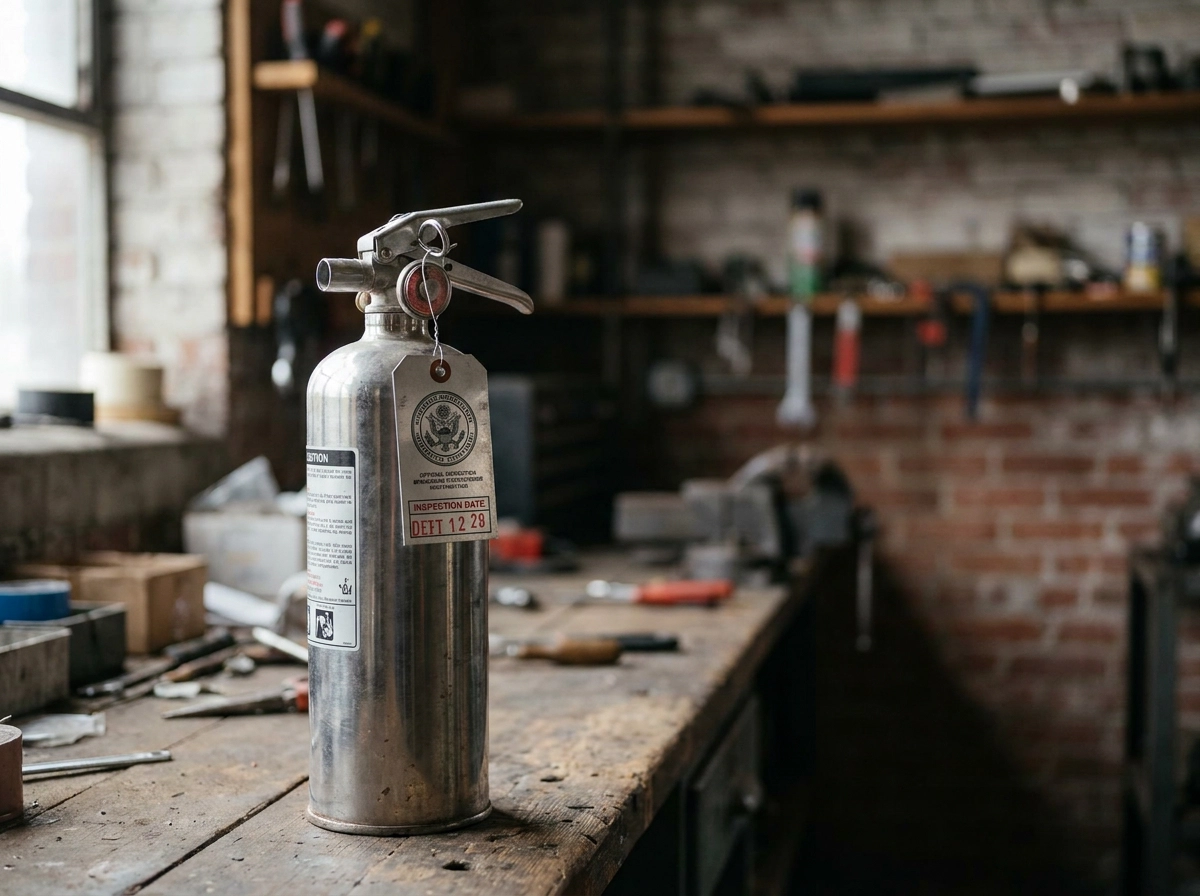
One detail is checkable on sight: extinguishers serviced or sold in California must meet an OSFM-approved testing laboratory's standard and display that lab's label.
A caution for buyers. Treat any claim that inspection and service are two legally distinct activities as something to confirm against current OSFM regulations with your provider, not as a settled fact.
The First Call: What Gets Scoped Before Anyone Schedules a Truck
Licensing settled, the first call is a scoping conversation, not a price quote. Expect the provider to ask about unit count and distribution: how many extinguishers sit in each building, on each floor, and in detached structures, since volume and walking time drive the visit plan. Unit details come next: make, model, size, and agent type, including dry chemical, carbon dioxide, water, and clean agent units, along with any K class units in commercial kitchens. Service history matters too: the last annual inspection date, whether maintenance or hydrostatic testing is approaching, and whether prior tags or inspection logs survive.
Logistics decide scheduling. Gate codes, escort requirements, elevator access, occupancy hours, and restricted areas such as server rooms, kitchens, or fleet vehicles all affect the route and the clock. Then confirm scope in writing: inspection only, or inspection plus maintenance. The second pulls different labor, parts, and possibly off-site testing.
Bring a unit list and any prior paperwork to the call. Our guide to what to do before your next annual inspection covers the prep that keeps the conversation short.
Arrival and Walkthrough: What the Technician Establishes First
The visit begins before any unit is touched. The technician checks in with the on-site contact, reconfirms the scheduled scope, and asks about extinguishers added, removed, or relocated since the last visit.
From there, the walkthrough reconciles paper against reality. Every extinguisher on the documented inventory must be located, and the physical count must match. A mismatch is not clerical: it changes both the price and the record, which is one reason to build a documented fire safety compliance action plan.
Placement and access come next: signage visibility, mounting height, clearance from stored goods, and whether units sit within reasonable travel distance of the hazard. Units of 40 lb or less, for example, mount no more than 5 ft above the floor, and most occupancies cap travel distance at 75 ft, per the extinguisher guidance cited by the City of San Diego.
Each unit's identifying data gets logged: make, model, serial number, size, agent type, manufacture date, last service date, and any existing barcode or asset tag.
Anything that reshapes the plan is flagged before work starts: damaged cylinders, missing pins or hoses, corroded valves, or units buried behind pallets that require a return trip. Only then does unit-by-unit work begin.
Inspection, Maintenance, and Testing Are Three Different Jobs in One Visit
Once the walkthrough identifies each unit's condition, the work itself splits into three distinct tasks. An annual inspection is the visual and functional check: pressure gauge reading, pull pin and tamper seal, hose and nozzle condition, weight, corrosion, and accessibility. It confirms the extinguisher is in place and ready to operate.
Maintenance goes deeper and follows the manufacturer's interval. The unit is opened, examined internally, and reassembled with replacement parts as needed. For a closer look at what that work involves, see Inside the Teardown: What Technicians Actually Inspect.
Hydrostatic testing applies pressure to the cylinder itself. For many units, that work is staged off site or handled by swapping in a serviceable unit so the space is not left unprotected.
Because one visit can trigger all three, ask what the technician is authorized to complete on site that day and what will be scheduled, staged, or swapped. Treat specific time intervals as manufacturer and industry practice to confirm for your units, since unit type, manufacturer instructions, and state requirements govern the schedule.
Each completed task then has to be documented before the technician leaves.
What Gets Documented While the Technician Is Still Standing There
Whichever tasks were completed on site that day, the visit is not done until the record is built. Each unit should leave with a tag or label carrying the service date, the company or technician identification, and the next action due, if any. Treat the sticker as a working record, not decoration, and confirm exact tag requirements with your provider.
Corrective findings belong in writing, not passing conversation. A unit needing a recharge, a new hose, or replacement stays visible to whoever manages the building only when it appears in that record. Under 19 CCR § 574.5, the owner must maintain records of all extinguishers inspected, including those requiring corrective action, and retain them until the next required maintenance.
Confirm the format you will receive: a paper log, digital report, unit-level spreadsheet, or photographs of problem units. Fire Extinguisher Inspection Requirements: What Must Be Documented and When covers the documentation duties in more detail. Ask who holds the file: many providers keep copies and offer digital portals, yet the recordkeeping obligation stays with the owner or facility.
What the Certificate Should Tell You, and What It Does Not Prove
A certificate that lists only a total count proves very little. What you want is unit-level detail: each extinguisher identified by location with its own individual result, not one blanket statement covering the building.
Provider identity should also appear: the servicing company's name, its license information, the service date, and the technician who performed the work. Without them, the document cannot be traced to a certified individual.
Ask for outcomes kept separate. Units that passed, units that passed with noted deficiencies, and units taken out of service pending repair or replacement are three distinct conditions, never merged into a summary line.
The certificate should also state what comes next: the next inspection due date and any interval work the visit surfaced, such as maintenance teardown or hydrostatic testing.
How to read the certification requirement behind each line item walks through that structure. Since certificate and tag content is not standardized by the sources reviewed here, request a sample before you book and confirm the unit level format with your provider. It does not prove unlisted units were inspected or that the site meets current code.
What Actually Drives Fire Extinguisher Inspection Price
A certificate is the deliverable. Price decides whether the visit stays a walkthrough or becomes a project. Five variables do most of the work.
Unit count and spread. Fifty extinguishers in one office suite are cheap to reach; fifty scattered across a campus, several floors, and detached structures are not. Windshield and walking time are real cost.
Unit type. K class kitchen units, CO₂ cylinders, and clean agent units carry different labor, parts, and handling than standard dry chemical models.
Condition. If half the units need recharging, hoses, or gauges, inspection becomes repair work, and repairs are quoted separately from the inspection. See what the NFPA 10 annual fire extinguisher inspection covers and what it costs for the baseline.
Scheduling. After hours access, escorts, remote locations, and phased visits across multiple trips add cost before the first unit is touched.
Documentation. Unit level reporting, asset tagging, and record files are labor. Ask whether they are bundled into the inspection price or billed as a line item.
Knowing the drivers makes the next step easier: reading a quote for what it actually names.
What a Complete Quote Should Name Before You Sign
Price answers how much; the quote answers what. Before you sign, get five items in writing.
Units covered. Request a count by type and location, or an attached site list the proposal references, so both parties agree on which extinguishers are in scope. Ambiguity here becomes a dispute after the visit.
Scope of work. State plainly whether the quote covers inspection only or inspection plus maintenance, teardown, hydrostatic testing, and recharging. Implied scope is unenforceable scope.
Documentation. Name the tags applied, inspection logs kept, and unit level reports issued, plus who retains the records. This recommended practice supports the recordkeeping habits covered in Proper Records Keep You Ready for Audits and Inspections.
Certificate timing. Specify the certificate or report you will receive and when it arrives. A completed visit that produces no documentation leaves you unable to demonstrate compliance later.
Exclusions and change pricing. Ask how parts, recharges, or replacements are quoted and approved once discovered. Treat this as recommended practice for evaluating a proposal, not a legal requirement.
With a complete quote in hand, you can judge the finished visit against it.
Five Questions to Ask Before You Book the Service
Before you sign, get written answers to these five questions.
1. What is your OSFM license number, and do you hold a separate license for the location serving us? OSFM licenses portable extinguisher servicing in California, and requires a separate license application for each business location. A single license does not cover every yard.
2. Are the technicians assigned to our visit OSFM certified, and is that certification current? OSFM issues Certificates of Registration only after a written exam, documented experience, and verified testing equipment and parts inventory. Ask how currency is checked.
3. Is this a mobile on-site visit, and will any units leave the property? If hydrostatic testing is staged off site, ask what serviceable replacement stays in its place so the space is not left unprotected.
4. Which extinguishers does this price cover, and what is excluded? Request the unit list plus the path for quoting repairs or recharges found during the visit.
5. What record or certificate will we hold, in what format, and how quickly? Confirm the format and delivery timing before booking.
With written answers in hand, you can compare proposals on the same terms.
What to Hold at the End of the Visit

The answers to those questions should already tell you what will land in your hands. Before the visit, request a unit list and a scope statement, so the proposal names the specific extinguishers covered instead of a vague per unit figure.
On site, watch for three separate tasks: inspection, maintenance, and testing. Confirm which ones the technician completes that day and which are staged or swapped for later.
At the finish, collect everything: tags, the inspection log, and the unit level certificate. Under 19 CCR section 574.5, the owner must retain records of all extinguishers inspected, including those needing corrective action, until the next required maintenance, so file them where the next service can find them.
Then compare the paperwork against the original quote. If the certificate does not list units, results, and next due dates, the documentation is not finished. That packet is your proof of compliance and your baseline for the next visit.
Conclusion
A mobile fire extinguisher inspection visit is more than a quick tag change. It begins with licensing and a clearly scoped unit list, then separates inspection, maintenance, and testing so you know what actually happens on site. The visit is not complete until you hold the tags, inspection log, and unit-level certificate, with results and next due dates that match your quote. Before booking, ask the five questions and get written answers, including a unit list and a path for repairs or recharges. That preparation turns price comparison into an apples-to-apples decision. Your next step: request those answers and the scope statement first, then schedule. Clear terms protect your space and give you a compliance record you can rely on for the next service. Don't settle for vague paperwork; book with confidence and keep what you can verify.