Lithium-Ion Battery Fire Extinguisher Placement: What OSFM's IB-26-007 Means for Facility Managers
Your facility may already have a documented compliance gap, and the next AHJ inspection could be the moment you find out. OSFM's Information Bulletin IB-26-007, issued August 28, 2026, establishes lithium-ion battery fire safety requirements that most California facilities have not yet incorporated into their extinguisher plans. The problem is not simply a paperwork issue. Standard dry-chemical and CO2 units have well-documented limitations against lithium-ion thermal runaway fires, which reignite, release toxic gases, and resist conventional suppression in ways that render typical fire extinguisher location requirements inadequate for this hazard class.
This analysis translates IB-26-007 into concrete decisions rather than regulatory summaries. You will learn why your current extinguisher layout may already constitute a documented gap, what lithium-ion fires actually do to defeat standard agents, how this bulletin layers onto California's existing code stack, and what four placement questions every facility manager must now answer. The post also addresses why extinguishers alone are not a complete compliance strategy, how storage and charging practices reduce overall fire demand, and how to conduct a gap audit before your next inspection puts the deficiency on record.
Why Your Current Extinguisher Layout May Already Be a Documented Gap
Most California facilities built their extinguisher placement plans around NFPA 10 logic: identify the hazard class, calculate travel distance, mount the right unit. That framework was designed for fires in Classes A, B, C, D, and K. None of those classes account for lithium-ion thermal runaway, which generates its own oxygen, re-ignites after apparent suppression, and can propagate through an entire battery pack in seconds. If choosing the wrong fire extinguisher class is already a code violation and a hazard, applying the wrong class framework to an entirely different fire mechanism compounds that problem significantly.
On August 28, 2026, the OSFM issued Information Bulletin IB-26-007, formally recognizing lithium-ion battery fires as a distinct hazard class requiring explicit compliance action. This is not a footnote to existing standards. It is a published state document that any Authority Having Jurisdiction can cite by name when writing a deficiency.
That matters immediately. If your current extinguisher layout does not document how it addresses lithium-ion charging or storage areas, an AHJ inspector now has a specific bulletin number to reference as the basis for a finding. The gap is no longer theoretical; it is citable.
The highest-risk facilities are those that added EV charging stations, e-bike or scooter fleets, forklift battery banks, or battery energy storage systems without revisiting their extinguisher plans. Each of those additions created a lithium-ion hazard zone. Most were never formally documented as such.
Acting before your next scheduled inspection is the only way to close this gap proactively. Waiting means responding to a deficiency instead of preventing one.
What Lithium-Ion Fires Actually Do That Standard Extinguishing Agents Cannot Stop
Understanding why lithium-ion fires resist conventional suppression is the foundation for every placement and equipment decision that follows.
The San Francisco Fire Department documents a "dramatic increase" in lithium-ion battery fires, characterizing them as "particularly devastating due to the chemical hazards, their tendency to flashover and grow quickly in size, and the difficulty of extinguishing them." That difficulty is not a function of fire size. It is a function of fire chemistry.
Thermal runaway is the core mechanism. An electrochemical chain reaction inside the cell generates its own oxidizer internally. The fire does not need ambient air to sustain itself. CO2 extinguishers work by displacing oxygen from the combustion zone; against a self-oxidizing reaction, that mechanism is largely irrelevant. Deploying CO2 on a lithium-ion fire addresses the wrong variable.
ABC and BC dry-chemical agents perform no better in a different way: they can knock down visible flame, creating the appearance of successful suppression. But SFFD training data documents that reignition is possible up to 21 days post-incident. Dry chemical does not cool the cell mass or interrupt the underlying electrochemical reaction. The fire is not out; it is paused.
Propagation compounds both failures. A single cell in thermal runaway can cascade to adjacent cells within seconds. A pack-level event can re-escalate before personnel have cleared the area, even after an initial knockdown appears successful.
The practical implication is direct: the fire class problem precedes the placement geometry problem. No extinguisher location decision is defensible until the agent type question is resolved.

What IB-26-007 Adds to the Existing California Regulatory Stack
That fire behavior problem has a direct regulatory counterpart: the standards most California facilities rely on were written before thermal runaway was treated as a distinct hazard class.
NFPA 10 is the foundation for fire extinguisher placement requirements, travel distance calculations, agent type selection, and quantity determinations across California facilities. NFPA 10's class-based logic, as the previous section established, was not designed for self-oxidising thermal runaway. Understanding why the inspection and maintenance schedule matters becomes more consequential when the hazard class itself falls outside the standard's design assumptions.
NFPA 855 fills part of the gap for large-scale stationary battery energy storage systems, but its applicability thresholds leave most commercial and institutional facilities in unaddressed territory. An e-bike fleet charging room, a forklift battery bay, or a mid-size UPS installation typically does not meet the scale that triggers NFPA 855 obligations. Those scenarios sit in a regulatory space that neither standard was designed to govern.
IB-26-007, issued by OSFM on August 28, 2026, represents the state formally stepping into that space. It adds a compliance layer that must be reconciled with existing NFPA 10 extinguisher layouts and any applicable NFPA 855 obligations simultaneously. The bulletin does not replace either standard; it sits on top of them.
San Francisco Fire Code Section 325, effective March 7, 2024, established a relevant local precedent. Facilities charging five or more powered mobility devices simultaneously must provide sprinklers, smoke detection, and three-foot spacing between units. Extinguishers alone were not considered sufficient. Government and institutional facilities navigating layered obligations under OSHA, Cal/OSHA, and NFPA 10 now have a third compliance instrument to reconcile.
That three-way interaction between IB-26-007, NFPA 10, and NFPA 855 is precisely where most facility managers have an unresolved gap, and exactly where an AHJ inspector will look first.
The Four Placement and Equipment Questions IB-26-007 Forces Facility Managers to Answer
Resolving that regulatory stack produces four concrete questions your facility must answer before an AHJ inspection.
Agent type. As established above, neither dry-chemical nor CO2 agents address thermal runaway's core mechanism. Specialty water-mist extinguishers and purpose-built lithium-ion suppression agents are the categories to evaluate. An AHJ auditing IB-26-007 compliance will look for documentation that the agent in place is rated for this specific hazard class.
Placement zone and travel distance. NFPA 10 fire extinguisher placement establishes maximum travel distances by occupancy hazard class, but a lithium-ion charging or storage area is a localized high-hazard zone within a larger facility. A general-purpose unit mounted 50 feet down a corridor does not provide dedicated coverage for that zone. IB-26-007 pushes facility managers toward zone-specific placement, not occupancy-wide averaging.
Quantity and sizing. Standard NFPA 10 occupancy calculations do not factor in energy density or total cell inventory. A forklift battery bank and a single laptop charging station present fundamentally different suppression demands. The amp-hour inventory in your facility is a variable your current extinguisher plan almost certainly does not address.
Signage. A correctly specified extinguisher placed in the right zone still produces a compliance gap if not properly identified. California fire code signage requirements apply to every extinguisher location, including units added after a compliance review.
For a structured approach to mapping these four variables against your current layout, the fire safety compliance action plan for government and commercial facilities outlines the OSHA, Cal/OSHA, and NFPA 10 obligations your lithium-ion additions must build on.
Each question yields a binary result for AHJ purposes: documented and defensible, or a gap. A published state bulletin removes any informal middle ground.
Why Extinguishers Alone Are Not a Complete Compliance Answer
Answering the four equipment questions gets you partway to compliance, but not all the way. As noted above, SF Fire Code Section 325 is explicit: five or more PMDs triggers sprinklers and detection, not heavier extinguisher deployment.
The reason is operational. Thermal runaway does not wait for a staff member to locate an extinguisher, pull the pin, and approach the fire. At pack-level escalation, portable extinguisher capacity is typically exceeded regardless of agent type or placement.
California fire code has been moving in this direction since SF Fire Code Section 325 took effect in March 2024, and IB-26-007 signals that the same expectations now apply statewide. Extinguishers remain a required component, but they are a last-resort tool, not a primary control.
For facility managers, this reframes what the IB-26-007 compliance audit actually covers. The question is not only whether the right extinguisher is in the right location. It is whether the facility's detection, suppression, and response infrastructure is designed around how lithium-ion fires actually escalate. Those are different audits with different remediation paths.
Two near-term actions address the detection side directly: confirm that battery charging and storage areas fall within existing smoke or heat detector coverage zones, and verify that the fire alarm system is configured to respond to a fast-growth fire scenario. For a structured framework covering both the equipment and infrastructure dimensions, the Fire Safety Compliance Action Plan: What Your Facility Must Do Right Now provides a practical starting point.
Safe Storage and Charging Practices That Reduce Extinguisher Demand
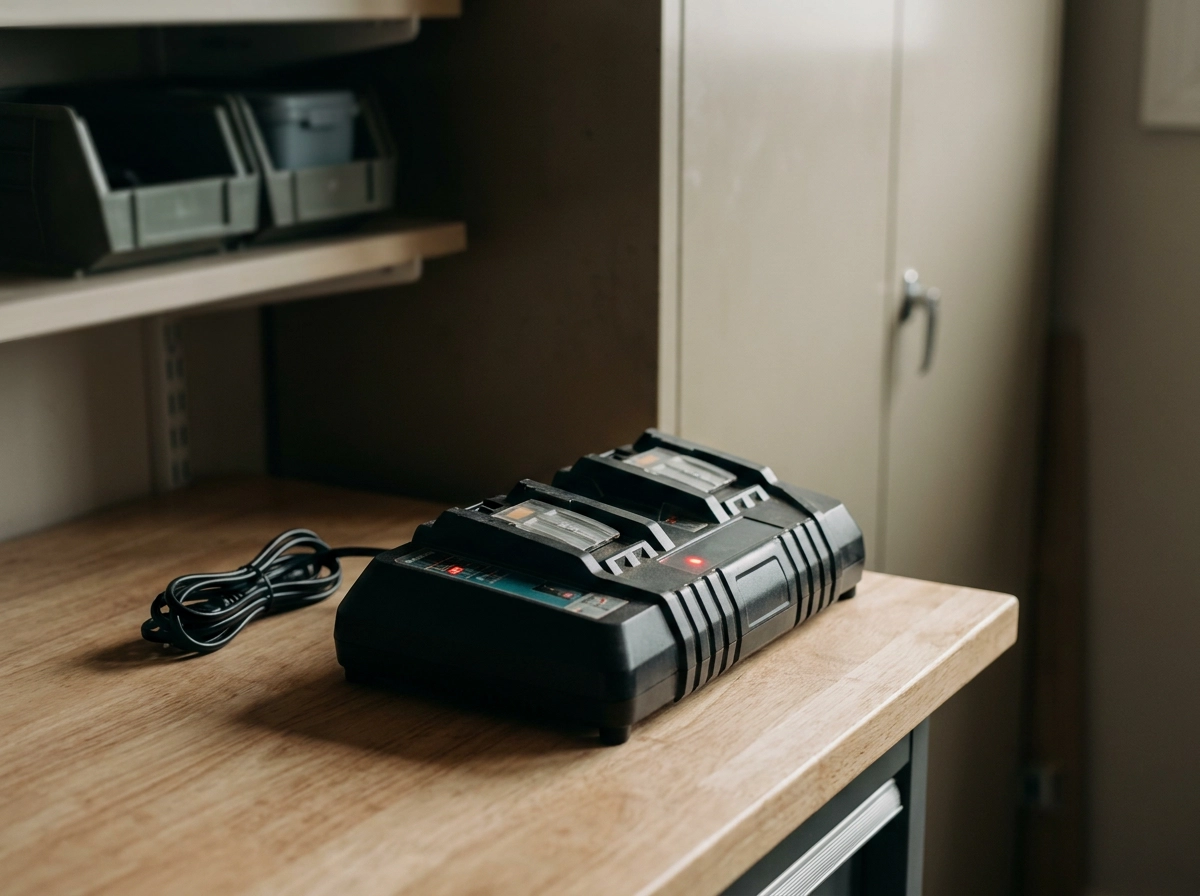
Reducing ignition risk at the source is the most durable way to strengthen your extinguisher compliance posture. Hardware placement addresses what happens after a fire starts; operational controls reduce the probability that one starts at all.
Charger discipline is a legal requirement, not a suggestion. San Francisco Fire Code Section 325 prohibits extension cords and power strips for lithium-ion battery charging. Every device must plug directly into a wall outlet using original or manufacturer-approved charging equipment. This prohibition exists because improper charging equipment is a documented ignition source, not a theoretical one.
Damaged batteries require immediate removal. Any battery showing cracks, swelling, punctures, or leaking contents must be pulled from service and stored in isolation, not left on a shared charging rack. Continuing to charge a physically compromised cell is an uncontrolled ignition hazard. Isolated storage holds the unit until it moves through an approved recycling program.
Document your spacing protocol regardless of fleet size. The three-foot minimum charging separation under SF Fire Code Section 325 is a prescriptive trigger at five or more units, but facilities should establish and record a spacing standard even for smaller charging areas. Documented safe practices reduce AHJ scrutiny and demonstrate institutional seriousness about hazard management. First Response's Compliance & Certifications standards reflect this same documentation-first approach.
Recycling is mandatory. Landfill disposal and standard recycling bins are prohibited for lithium-ion batteries. Improper disposal creates both a regulatory violation and a physical hazard if a damaged cell is mishandled.
Taken together, these controls lower ignition probability, which directly affects how an AHJ evaluates whether your extinguisher placement plan is adequate for the actual risk level present.
Before Your Next AHJ Inspection: How to Conduct a Lithium-Ion Compliance Gap Audit
Safe charging practices reduce ignition risk, but they don't close the compliance gap IB-26-007 creates on the suppression side. That requires a structured audit before an AHJ inspector does it for you.
Step 1: Map every lithium-ion hazard zone. Walk the facility and inventory all locations where lithium-ion batteries are charged or stored: EV charging stations, e-bike and scooter storage, forklift battery bays, battery backup and energy storage systems, and employee device charging areas.
Step 2: Overlay your current extinguisher placement plan. Pull your existing layout and mark each hazard zone identified above. Any zone without a documented, agent-appropriate extinguisher within compliant travel distance per NFPA 10 fire extinguisher placement standards is a gap. Unmarked gaps on paper become cited deficiencies during an inspection.
Step 3: Evaluate agent type at each marked location. If the unit covering a lithium-ion zone is a standard ABC dry-chemical or CO2 extinguisher, document that limitation explicitly. Begin evaluating replacement or supplementation with a lithium-ion-appropriate agent; leaving the standard unit in place without documentation is the worst outcome.
Step 4: Confirm signage at every affected location. California fire code requires extinguisher locations to be clearly marked and visible. A newly placed unit without proper fire extinguisher signage does not satisfy the requirement; the hardware and the identification must both be present.
A CSFM-licensed provider with direct experience interpreting OSFM bulletins compresses this process significantly. First Response Fire Protection Services conducts site assessments that map current extinguisher placement against IB-26-007 requirements and identify specific remediation steps before your next AHJ visit.
Conclusion: Close the Gap Before It Becomes a Deficiency
The gap audit outlined above is the mechanism. What drives the urgency is simpler: IB-26-007 took effect August 28, 2026, and facilities operating lithium-ion battery charging or storage are already within its scope. There is no grace period to wait out.
The gap is not theoretical -- standard NFPA 10 logic and conventional agents were not designed for self-oxidising thermal runaway, and IB-26-007 makes that gap citable.
Facilities that complete a written gap audit before their next AHJ inspection convert that risk into a compliance record. An inspector who arrives after a deficiency is issued controls the remediation timeline. An inspector who arrives at a facility with documented assessments, corrected agent types, updated placement plans, and proper fire extinguisher signage has far less to work with.
First Response Fire Protection Services provides site-specific assessments that map your current extinguisher layout against IB-26-007 requirements and identify the equipment and placement decisions your facility needs to make before the next inspection arrives.