What a New Fire Extinguisher Actually Costs to Install
If you are building a budget line for a new extinguisher, the sticker price can be misleading. The unit itself is only one component of the true fire extinguisher cost. A compliant installation also requires mounting brackets, cabinets, or hardware; signage and identification; an inspection tag; and the first certification that puts the extinguisher into service. In regulated jurisdictions such as California, the Office of the State Fire Marshal licenses and certifies who may service and sell portable extinguishers, which means compliance labor and documentation belong in the same budget line as the hardware. This tutorial breaks down the full installed cost piece by piece. You will see why the shelf price is not your budget line, what each line item includes, how the regulatory layer adds cost, how to compare a distributor quote to a retail run, and what to put in your final budget line. By the end, you will have a clear per-unit figure that makes quotes genuinely comparable and prevents surprises when the invoice arrives.
Why the Shelf Price Is Not Your Budget Line
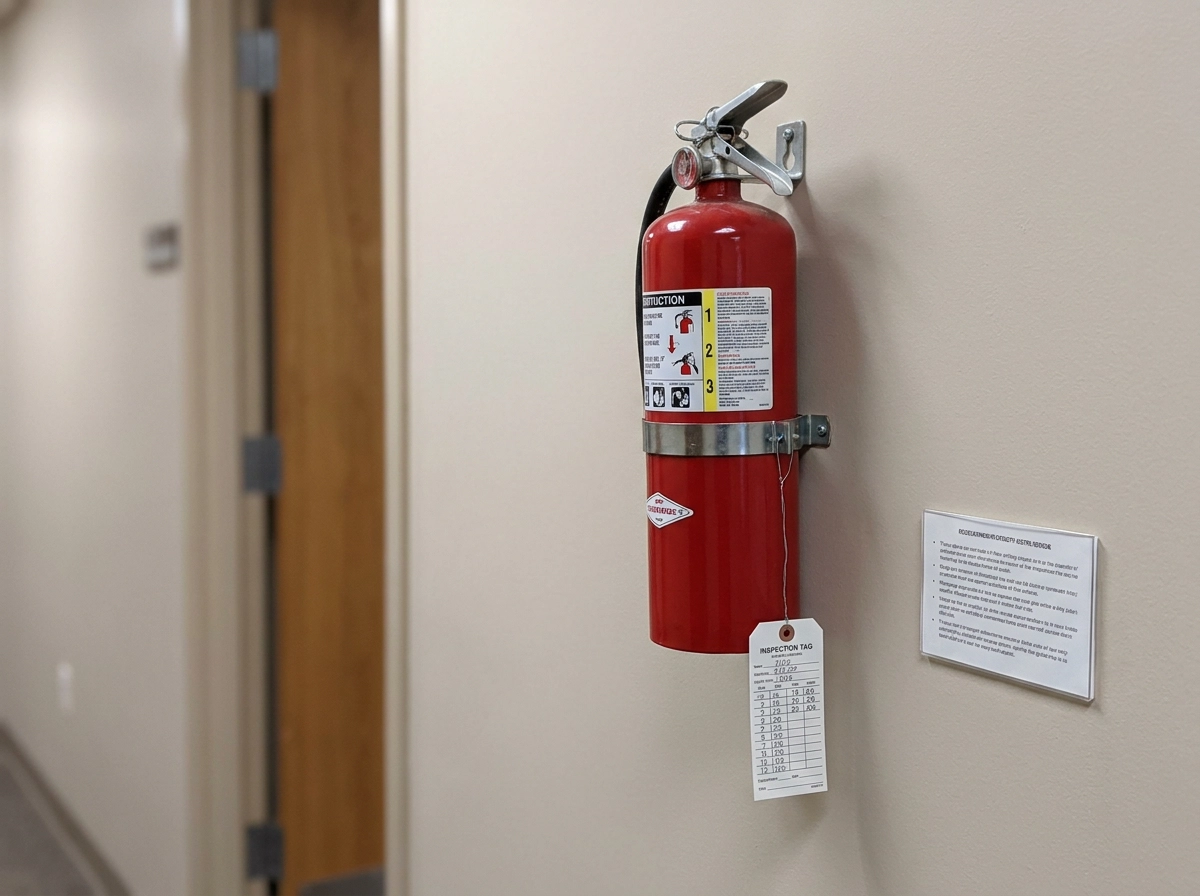
The unit price typically reflects the hardware and factory agent charge, but the components beyond the cylinder are only part of what a compliant installation requires. It does not cover the bracket, signage, tag, or labor that make the unit legally compliant on your wall. In California, portable extinguishers sold or serviced in the state must meet the manufacturing and performance standards of a testing laboratory approved by the Office of the State Fire Marshal and display that laboratory's label, per the OSFM Fire Extinguisher Program. That rule controls which units you may legally buy, not what the finished install costs.
A compliant installed unit is five separate line items: the extinguisher, the bracket or cabinet, the signage identifying its location, the tag recording service history, and the first certification that puts it into service under OSFM rules. Budget per installed unit, not per box. The unit price is the smallest and most predictable number; the other four lines move with unit counts, building conditions, and who performs the work.
This gap is why two fire extinguisher sales quotes can look different for the same product. One may bundle hardware and tagging; another hands those back as your responsibility. How to Justify Extinguisher Purchases to Safety Officers and Budget Approvers can help once you have that installed number.
When you search for fire extinguisher costs, compare installed cost, not unit cost. Otherwise you are comparing two different things.
Line Item 1: The Extinguisher Itself
With the budget framework in place, here is how to price Line Item 1. Agent type and rating affect the unit price; your provider can explain which rating your occupancy requires. Size and rating also move the number.
Quantity is a compliance calculation, not a preference. Placement requirements under the applicable fire code will set your unit count, so treat quantity as a compliance output, not a preference.
Verify the label before the price. Units sold or serviced in California must carry an OSFM-approved testing laboratory label, so a listing that omits the laboratory or listing mark deserves a written question. Ask whether any mounting accessories are included or sold separately.
First Response Fire Protection Services is a CSFM-licensed, authorized Amerex distributor, so ask for a specific Amerex model number, rating, and listing confirmed on the quote. A quote that names only size and rating is hard to compare and impossible to verify. To see how the inspection side is priced later, review fire extinguisher inspection cost.
Line Item 2: Mounting Brackets, Cabinets, and Hardware
Mounting is not a generic add-on. Every extinguisher needs a method rated for its weight and size: typically a wall bracket, but larger cylinders, mobile equipment, and high-traffic areas call for heavy-duty brackets, vehicle brackets, or wheeled carts.
Wall construction drives both anchor selection and labor. Drywall, masonry, steel studs, and concrete each take different anchors, and blocking or a backing board may be required before the bracket can carry the load. Those are field conditions, not catalog items.
Cabinets are a separate line from brackets and are chosen for appearance, weather or dirt protection, or concealment in finished spaces. Recessed and semi-recessed cabinets need framing work, which is labor.
Hardware is the line most often missing from a retail purchase. A unit hung on an existing bracket is a different install from one that arrives with nothing to mount it on. Because brackets and cabinets scale with unit count and with distinct mounting conditions, a property walkthrough changes this number more than any other line. Ask your provider to itemize brackets or cabinets per location rather than a lump sum. If your project also involves new construction or tenant improvements, ask whether cabinets, extinguishers and final-inspection tags can come from one sub.
Line Item 3: Signage and Identification
Mounting decides where the unit hangs; signage decides whether anyone can find it. That looks like a minor line until the extinguisher sits inside a cabinet, in a recess, or out of sight from the normal travel path, which is exactly when fire extinguisher signage requirements do the job a visible cylinder would otherwise do.
Because signs cost little next to the install, they are easy to skip and easy for one quote to include while another silently leaves them out. Signs that are missing or non-compliant will need to be corrected before a unit passes service, confirm upfront whether signage replacement is included in your quote.
Confirm in writing whether signage is supplied and installed at every location, and whether old or non-compliant signs are removed during the same visit. In areas with reduced lighting, ask specifically how sign visibility will be handled rather than assuming a standard sign covers it.
Line Item 4: The Inspection Tag
Signage directs people to the unit; the tag records what happened to it. The inspection tag documents the unit's service history. A unit without a current tag may be considered out of compliance under the state's extinguisher program rules.
What must appear on the tag, and who may sign it, is governed by the applicable fire code and licensing requirements, not by the person holding the pen. That is why tagging and certification are usually performed by the same licensed provider.
Tagging accompanies each required service event; ask your provider whether the first tag is included in the initial certification visit. Together, the tag, signage, and bracket are the line items most commonly absent from a retail transaction.
Line Item 5: The First Certification
The first certification is what the tag records: the unit is in place, documented, and compliant. This is labor and documentation, not a product, and it is what puts the extinguisher into service.
The step is not open to whoever bought the unit. Licensing, not marketing, is the first thing to verify. California requires a concern license to perform, for a fee, the servicing, charging, and maintenance of extinguishers, with a separate application for each business location. Servicing personnel must hold Certificates of Registration, earned through a written exam and documented experience, and the company must carry an adequate inventory of testing equipment and repair parts. The line item covers that credentialing and equipment structure, not an hour of labor.
Under 19 CCR section 560, fees accompany each application, are non-refundable, and are retained to process and evaluate applications. Treat application-related fees as structural in any licensed operation's pricing, and confirm current amounts and the current revision with your provider rather than an older published copy.
Cost drivers are travel, site access, unit count, distinct locations, and documentation. A hundred units in one building is a different job than fifty spread across two counties. Retail buyers must still arrange this step, which is why a retail run and an installed purchase are not directly comparable.
The Regulatory Layer Behind the Extra Cost
The certification visit is where a licensed provider earns its fee. Beneath it sits the Office of the State Fire Marshal (OSFM), which licenses and certifies portable extinguishers serviced and sold in California. All of this lives under the OSFM program.
Here a CSFM-licensed company separates itself from a general handyman or a big-box run. First Response Fire Protection Services is CSFM-licensed with OSFM-certified technicians and founded by a firefighter with 30-plus years of hands-on extinguisher experience, including 28 as a full-time paid firefighter. Verify the license before you verify anything else, then ask who handles the recurring events your budget will carry: annual maintenance, 6-year maintenance teardowns, hydrostatic testing, and recharging. One provider covering all of them plans the full life cycle, not just the first invoice.
Fee schedules and regulations change, and revision dates are not always current. Confirm any fee or code reference before it enters a signed budget.
How to Compare a Distributor Quote to a Retail Run
A quote is only comparable when it covers the same five lines introduced above. What travels with the unit matters more than the channel it came from, which is the focus of Authorized Distributor vs. Box Store: What the Purchase Channel Actually Changes.
Three questions separate a real quote from a retail run.
Where is the certification visit? Ask whether it is included or billed separately, and whether it is priced per unit, per location, or as flat mobilization. On a multi-site property, those three structures produce very different totals.
Who signs the tag, and under what license? Confirm that the work is performed by an OSFM-registered technician working under a licensed concern.
What happens after year one? A provider who also performs annual maintenance, 6-year teardowns, hydrostatic testing, and recharging can price the maintenance tail alongside the purchase. That tail is usually the larger lifetime number.
Do not assume retail is cheaper, or that a distributor is. Nothing supports a blanket claim either way; the answer depends on your building, your unit count, and whether the small line items are already covered. The only way to know your true per-unit installed cost is a fully itemized quote. Everything else prices one line out of five.
What to Put in the Budget Line
Structure your budget as those five lines, unit, mounting, signage, tag, and certification, so nothing hides in a lump sum.
Write the total as cost per installed unit. Your unit count should come from a compliance walkthrough, not a guess, because the applicable fire code sets placement requirements based on your occupancy.
Before you compare totals, require four details on every quote: model number, size, rating, and the label of an OSFM-approved testing laboratory. A quote that omits the listing cannot be verified against the standard.
Get the inclusions in writing. Are installation, signage, tagging, and the certification visit covered? Are they priced per unit or per location? Those two structures produce very different totals across multiple sites.
Add the maintenance tail, annual, 6-year, and 12-year events, as discussed above.
For the real number, request a fully itemized quote for your properties. First Response Fire Protection Services, CSFM-licensed and an authorized Amerex distributor serving Southern California from San Jacinto, will walk your sites and price the install and the maintenance tail together.
Conclusion
The real cost of a fire extinguisher is not the shelf price. Use the five-line framework and require the OSFM lab label on every quote. The maintenance tail outlasts the purchase; budget it now. Request a fully itemized quote from First Response Fire Protection Services, CSFM-licensed, authorized Amerex distributor, serving Southern California from San Jacinto.