Monthly Fire Extinguisher Inspection: Sign or Call a Tech
Most extinguishers do not fail on the day of an annual inspection. They can fail quietly, month after month, while a tag collects initials. The fire extinguisher monthly inspection is often reduced to a quick set of initials, but that habit can hide a damaged gauge, a missing pin, powder residue, or corrosion until the annual visit arrives. This guide draws a clear line between the visual observation task that trained staff can own and the conditions that must stop the process and bring a licensed technician on site. You will learn why initials alone can leave problems undiscovered, what the monthly visual check is and is not, how often inspections are required, and what a trained observer can safely sign off on. We also cover hard-stop conditions such as a damaged or unreadable gauge, a missing pin or broken seal, powder at the collar or base, and corrosion, dents, or a damaged hose. Finally, you will see what happens after you call a certified technician, how to keep records, and how to avoid annual inspection surprises. Our team is CSFM-licensed and works under OSFM certification, and we point to the standards and manufacturer guidance that support each step.
Why Initials on a Tag Do Not Protect Anyone
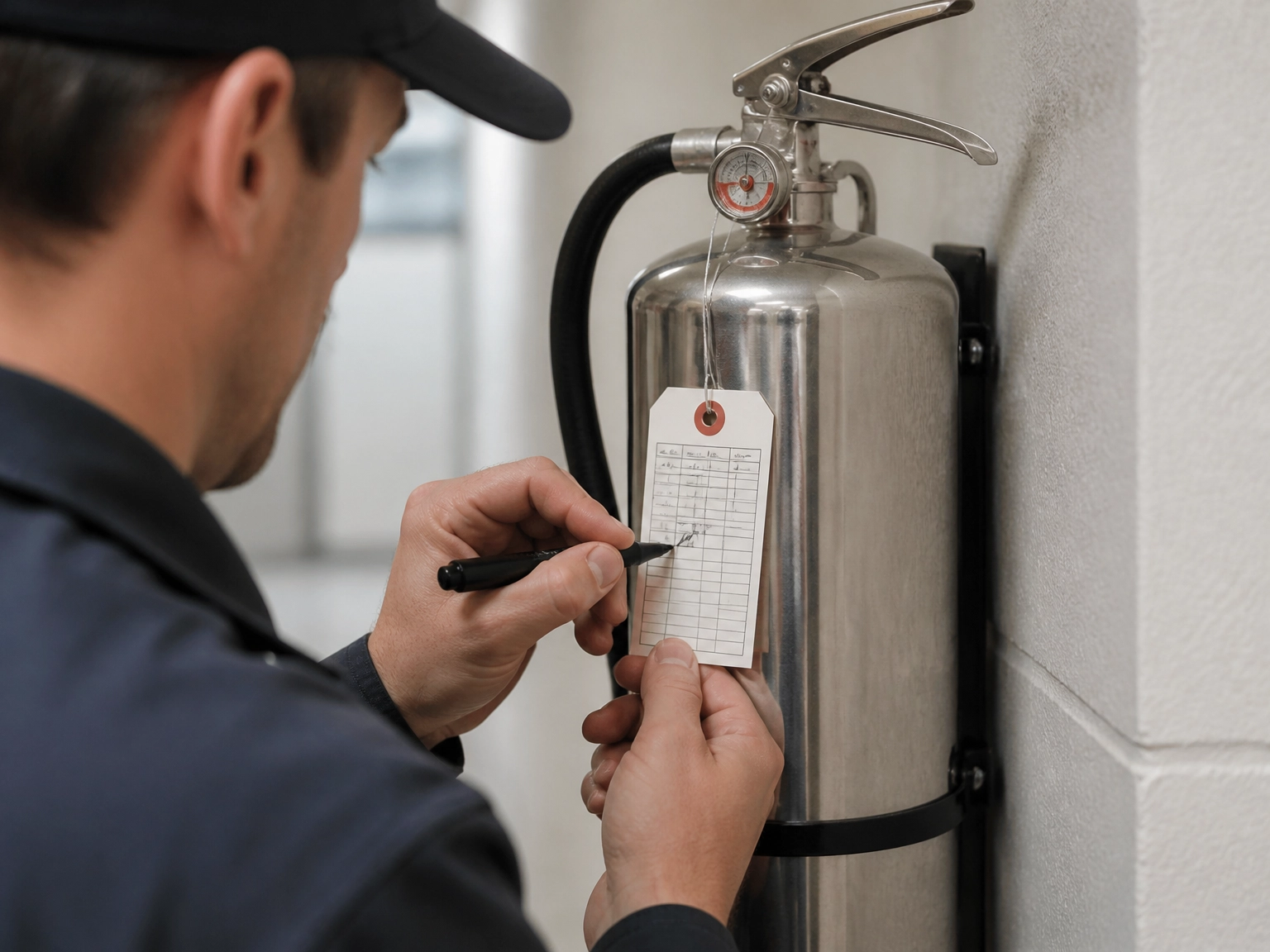
In the facilities we service, the monthly check has quietly collapsed into a signature. Someone walks the route, finds the tag, writes initials, and moves on. Nobody looks at the unit. That is a field observation, not a statistic.
The habit creates two failures at once. The extinguisher may not work when it is needed, and the tag tells everyone it was fine. If you have ever wondered what that tag actually records, that gap is the answer.
Underneath the ritual sits a quiet assumption: the annual visit will catch whatever the monthly walk missed. So a damaged gauge or a missing pin waits months for attention. The check itself starts with someone who knows what to look at.
What is actually at stake is plain. A discharged unit, a corroded shell, or a stuck valve sits on the wall looking compliant while your building quietly loses one usable extinguisher.
A short observation list staff can own covers the routine pass, and the hard-stop conditions end the check with a service call instead of a signature.
What the Monthly Visual Check Is, and What It Is Not
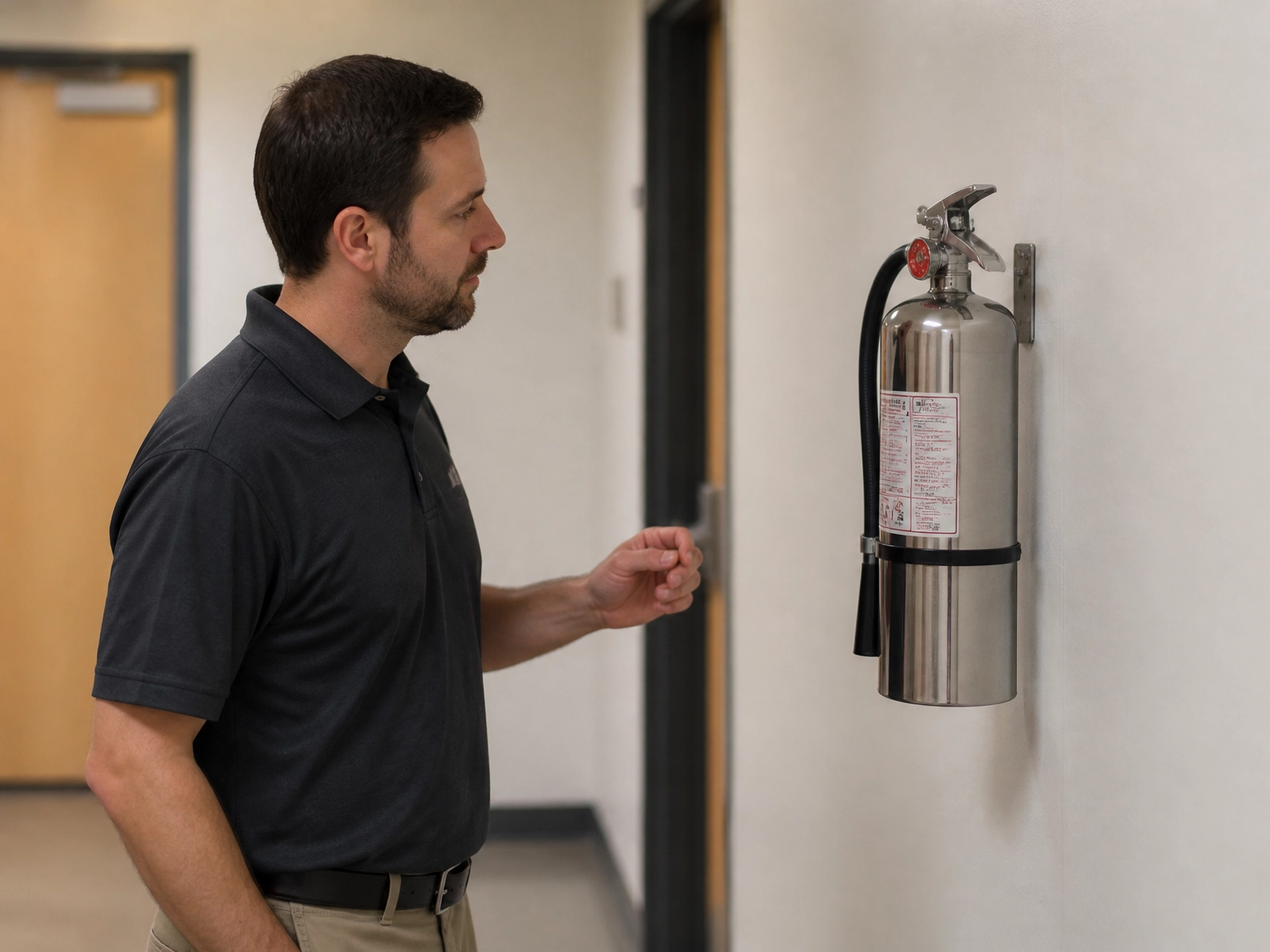
The monthly visual check is a hands-off walkthrough of each unit, its mount, its label, and its placement: nothing opened, discharged, or disassembled.
It is the lowest of five service tiers:
Monthly: visual inspection by a trained staff observer.
Annual: inspection and maintenance by a qualified technician.
Six-year: maintenance teardown.
Twelve-year: hydrostatic testing.
Any discharge: the unit comes out of service before it is used again.
It is not a pressure test, a hydrostatic test, a teardown, or a recharge, and it cannot return an out-of-service extinguisher to service. That is the line between the staff tier and everything above it.
On the tag or report: the tamper seal is the tie through the pull pin showing the unit has not been used; the pull pin starts the discharge; the pressure gauge indicates internal pressure; the collar is where the valve meets the shell; the valve assembly sits on top; the manufacture date stamp sets the six- and twelve-year deadlines.
Who may perform these checks is set by the adopted fire code, NFPA guidance, and workplace rules such as OSHA 1910.157; confirm current editions before quoting them. For how the intervals fall on a calendar, see inspection frequency in California.
How Often Is Fire Extinguisher Inspection Required? Monthly, Annual, and the Service Years
Fire extinguisher inspection follows a rhythm rather than a single date. Staff check every month, a technician confirms the units once a year, and the shell comes off the wall a couple of times over its life.
Monthly. Staff walk a fixed route and spend a few minutes on each unit, looking without opening any part of it. The result goes on the tag or in the site log.
Annual. A licensed provider's annual fire extinguisher inspection service is the technician-level visit, covering inspection and maintenance together. See California extinguisher service explained for how the tiers fit.
Six-year and twelve-year. The maintenance teardown and hydrostatic testing fall on those milestones, counted from the manufacture date stamped on the label. Staff can read and record that date; the work itself is technician work.
Recharge. Any unit discharged even partially, or one that has lost pressure, needs recharge before it returns to service. The monthly check is usually where that gets noticed.
Post one sheet at the station so no one guesses from a faded tag. The monthly route and the service years live on the same page, and the inspection frequency in California fits the same schedule.
What a Trained Observer Can Look At and Sign Off On
With the route posted, the check itself comes down to five observations.
Placement and access. The unit is where the plan says, nothing blocks access, the location sign is posted, and it is visible from the room's normal path. If its class does not match the hazard, confirm which class belongs there.
Mount and bracket. The unit sits securely in its bracket or cabinet, the mount is fastened, the hanger is not bent, and it is not resting on the floor.
Label and instruction plate. Instructions are legible and facing out, not painted over or peeling; the service tag is present and readable.
Pin, seal, and gauge. The pull pin is in place, the tamper seal unbroken, the gauge lens clear and intact, the needle inside the operable range, and the unit feels appropriately heavy.
Housekeeping and the meaning of a signature. No dust, grease, or debris blocks the label; the cabinet door opens freely. Signing means the unit is present, accessible, visually intact, and in range. Anything else goes to a technician.
Hard-Stop Conditions: When the Tag Does Not Get Signed
A hard stop means one thing: the unit is not signed as checked. It is pulled from the signed count, and a service request goes out the same day.
Staff need to memorize only four hard stops:
Damaged or unreadable gauge
Missing pin or broken tamper seal
Powder residue at the collar or base
Corrosion, dents, or hose damage
The tie-breaker: when in doubt, do not sign. A service call for a unit that turns out to be fine is the cheaper outcome. If replacement looks likely, replacement unit install pricing gives the manager a real number for that decision.
Post these four lines beside the tag so no one makes a judgment call in the field. Treat them as field practice for trained observers, not a code citation.
These are escalation triggers, not a diagnosis. Whether the unit is repaired, recharged, or replaced is a certified technician's call.
Damaged or Unreadable Gauge
The gauge is the first hard stop, and the easiest to misread as fine.
What it looks like: a cracked, clouded, or missing lens; moisture or debris behind the glass; a needle bent or resting outside the operable band; a housing that is cracked or loose.
Why it matters: the gauge is the only at-a-glance reading of pressure. A unit that cannot show pressure cannot be trusted in a fire.
What staff do: do not tap, shake, or nudge the needle back into range. Escalate the unit and leave it in place unless your site procedure says otherwise.
What still counts as a pass: a clear, intact lens with the needle inside the operable range. That is a visual observation, not a pressure test, and it does not replace the annual service. Your inspection report should show that distinction. See how each line item reads.
Missing Pin, Broken Seal, or Tamper Evidence
The pin and seal are your next hard stop after the gauge. Look for a pull pin that is absent, a tamper seal that is broken, missing, or hanging loose, or any other sign the unit has been handled since the last check.
An unsealed or tampered extinguisher may have been used or partially discharged. It may not carry the charge it needs. Replacement pins and seals belong to persons with factory training or acceptable certification, not to staff.
Record the unit ID and location, photograph the condition if site policy allows, and request service. Never insert a replacement pin or seal yourself.
Related flags point the same direction: powder smudges, a low needle, or a nozzle that looks used. More monthly check guidance sits alongside this list.
Powder Residue at the Collar or Base
Powder is often the first visible clue to a unit that has lost its charge. Dry chemical dust at the collar or valve, or settled on the cabinet floor or the wall beneath the unit, points to a leak or to a unit that has been used and set back on the bracket. Leakage is a recognized monthly inspection failure, so none of those conditions is a visual pass.
Do not wipe the residue away and sign the tag. The powder is the evidence. Photograph it, note the unit ID and location, and escalate.
Check below the unit, not only on it. Powder collects on the surface under a slow leak long before it becomes obvious at the valve. If the unit is later replaced, right agent for the rating matters as much as the unit it sits beside.
Corrosion, Dents, or a Damaged Hose
Past the powder, the shell and the delivery path get the same treatment. This is the fourth hard stop, and a hard stop looks like:
Rust or bubbling paint, especially along the bottom and seams
Deep dents, gouges, or a missing base ring
A cracked or stiff hose, or a missing or cracked nozzle
The shell holds the pressure, and the hose and nozzle carry it out. Damage there is a technician-level question, not an observation call.
Report it and stop. Do not sand, repaint, tape, or straighten anything; repair and replacement decisions belong to a certified technician.
Light surface dust or a scuffed label is not corrosion. Learn the difference, but escalate whenever the call is close.
What Happens After You Call a Certified Technician
Once a unit is escalated, it stays out of the signed count until a certified technician evaluates it. In the meantime, arrange temporary coverage for that area: relocate a spare to the spot or add a unit to the monthly route.
The technician confirms the condition and assigns the right service tier: recharge, 6-year maintenance teardown, 12-year hydrostatic testing, repair, or replacement. No unit returns to service on a visual check alone.
First Response Fire Protection Services is a CSFM-licensed fire extinguisher inspection, maintenance, and sales company based in San Jacinto, California, serving customers throughout Southern California. Services include annual fire extinguisher inspections, 6-year maintenance teardowns, 12-year hydrostatic testing, recharging, and equipment sales; technicians hold current OSFM certification, and the company is an authorized Amerex distributor.
Schools and agencies should batch escalated units into one service request instead of calling per unit, and plan access for classrooms, locked utility rooms, and secured areas.
Ask for a written record of the findings and the work performed, so each fix traces to the monthly finding and the annual file stays complete.
Records, Timing, and the Annual Inspection Surprise
Once a work order is closed, the finding needs a home. A useful monthly record has four parts: date, unit ID and location, who checked it, and either "pass" or "escalated" with the reason. A blanket OK tells the next reader nothing and cannot support the annual inspection. Keep the log, binder or digital, tied to the site's unit list and stored where the annual inspector or a fire marshal can review it on request.
Why the Hard Stops Pay Off
Units escalated this month get serviced this month. The annual walkthrough then confirms condition instead of producing surprise findings and surprise costs.
Keep the List and Calendar Current
Renovations, new installs, and room changes add extinguishers; each new unit joins the monthly route immediately and its manufacture date joins the schedule. Put the monthly route and every technician visit on a single calendar.
That keeps the annual inspection a confirmation, not a discovery.
Conclusion: Sign the Check, Escalate the Doubt
With the log and calendar in place, the line holds: staff sign the monthly visual check, technicians own anything that touches pressure, seals, shells, hoses, and service intervals.
Do three things this month. Post the observation list beside the tag. Post the four hard stops where staff will actually see them, not on a break room bulletin board. And make "escalated" the accepted entry when something does not look right.
Keep one log for the site and review the month's escalations together. Patterns surface early that way, whether it is one unit, one room, or one type of damage, often before the annual visit.
If escalated units stack up, work them in a single technician visit instead of one at a time. Put the 6-year and 12-year dates on the same schedule. The next surprise is already handled.